Whooping Cranes Grus americana
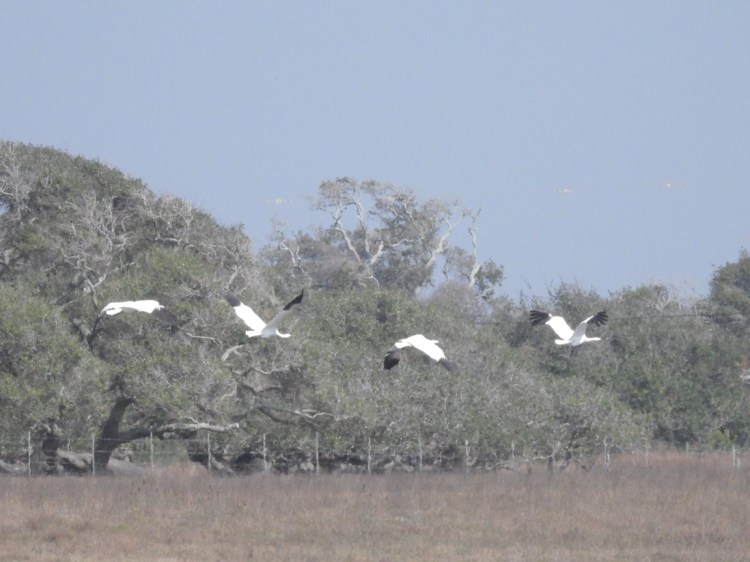
Photos taken by Melissa Fey in Lamar, Texas
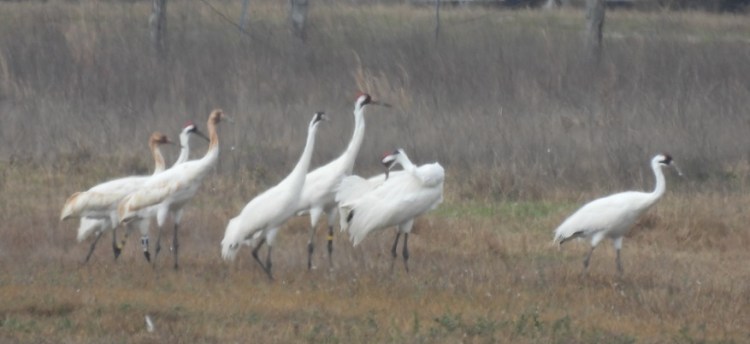
This large eloquent white bird was on the edge of distinction in the 1940s. There were only 20 birds known to exist. Through a captive breeding program, wetland management and an innovative program that taught young cranes how to migrate their numbers at this time are close to 600 birds. However the Whooping Crane is still considered to be an endangered bird.
The Whooping Crane is 5’ tall with a 7’ wingspan. It is the tallest bird in North America. It is all white with a red cap on its head and black tips on its wings. The Whooping Crane is known for its bugling call and its graceful courtship dance, which consists of leaping, kicking, head-pumping and wing-sweeping. Quite a sight to see.
In 1941 there was only 15 migrant birds living between Canada and Texas. There are currently 440 Whooping Cranes living in the wild and another 160 in captivity. All of them descendants of the small flock that was found in Texas. There is a small group of birds that live all year round in Louisiana and another group that migrates from Wisconsin to Florida. However, the only sustaining population is the group of birds that fly from Aransas National Wildlife Refuge in Texas to Wood Buffalo National Park in Alberta, Canada. This journey is approximately 2500 miles and passes through the Great Plains. The migration, which they do twice a year, takes about 29 days in the Spring and 45 days in the Fall. This is the longest migration of any species in North America.
In the 1940s, although the Whooping Cranes were visible in Aransas NWR in the Winter, no one knew where they flew to in the Spring to breed and raise their young. It was a mystery, every Spring they flew north from Texas and disappeared. Then by a stroke of luck their breeding ground was discovered. In 1954 there was a wildfire burning in the remote northern part of Wood Buffalo National Park. A forestry helicopter pilot performing recognizance noticed several large white birds, which they suspected to be Whooping Cranes. The pilot reported this to the regional biologist, Dr Fuller, who was later able to confirm what the pilot suspected. The following year, a ground survey was conducted and a team led by Robert Porter Allen, Ray Stewart of the Canadian Wildlife Service and Bob Stewart of the US Fish and Wildlife Service made the grueling effort of padding and portaging on foot through miles of inhospitable wetland. Finally, they were successful, a quote from a crew member after the discovery: “It has taken us 31 days and a lot of grief, but let it be known that at 2 pm on the 23rd of June, we are on the ground with the whooping cranes! We have finally made it!”
With the breeding ground discovered a plan was put in place for captive breeding. In 1966 under the direction of Canadian Wildlife Biologist, eggs were collected, never taking more than one from a nest. The eggs were flown to Patuxent Wildlife Research Center in Laurel, Maryland. During this period, a total of 242 eggs were collected and sent to various captive breeding facilities. The egg collecting continued until 1998. They also started a color-banding, monitoring and research project. Due to the success of the program, there are now 600 Whooping Cranes, up from the near extinction of only 15 birds.
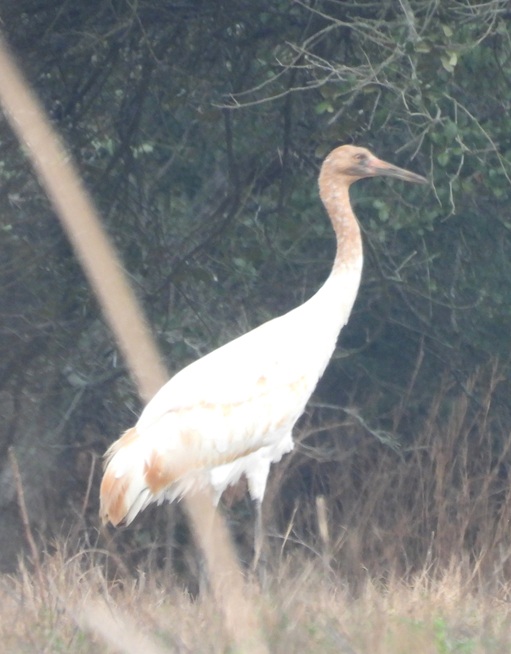
The Whooping Crane feeds in shallow water and fields. Its diet consists of crustaceans, mollusks, grasshoppers, fish, small reptiles, mice, voles, aquatic plants, acorns and fruit. Waste grain, including wheat, barley and corn is an important food for migrating whooping cranes. They build their nests on raised areas in wetlands for protection from predators. They normally lay two eggs and will raise at least one young bird referred to as a Colt. The Colt is born with reddish-cinnamon plumage that starts turning white at about four months old. The transition to full white comes at about one year old.
The Whooping Crane is a close relative of the Sandhill Crane, Antigone canadensis. They both belong to the family Gruidae and are North America’s only two native crane species. They often migrate together. Whooping Cranes often pass through Indiana and can be viewed at Goose Pond Fish and Wildlife Area near Linton, Indiana. Goose Pond offers a Whooper Wednesday Walk every Wednesday from November to February. They meet at the visitor center with a representative from the International Crane Foundation and walk around the property looking for the large white migrating bird.
To learn more about the Whooping Crane and to donate to their conservation efforts, visit www.savingcranes.org. This is the website for the Internation Crane Foundation where you can learn about their conservation efforts. You can also visit their location in Baraboo, Wisconsin.
Article written by Melissa Fey – References are Wikipedia, International Crane Foundation and Parks Canada
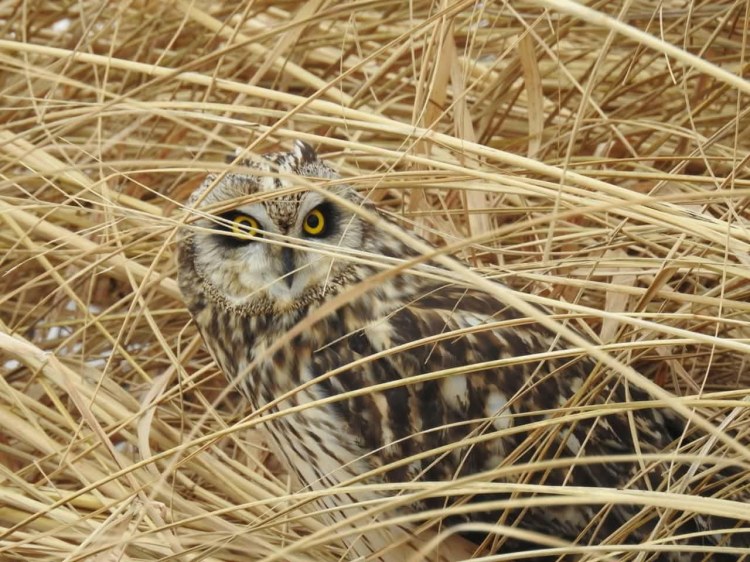
Photos by Brian Daugherty
The short-eared owl is a medium-sized owl measuring 13–17 in in length and weighing 7.3–16.8 oz. It has large eyes, a big head, a short neck, and broad wings. Its bill is short, strong, hooked and black. Its plumage is mottled tawny to brown with a barred tail and wings. The upper breast is significantly streaked. Wingspans range from 33 to 43 in. Females are slightly larger than males. The yellow-orange eyes of the Short-eared Owl are exaggerated by black rings encircling each eye, giving the appearance of them wearing mascara, and large, whitish disks of plumage surrounding the eyes like a mask.
This medium-sized owl is more frequently seen in the daytime more than other owls. Especially active around dawn and dusk, when it flies lazily over open fields or marshes in search of small mammals. Although it generally uses acoustical cues to locate prey, it can rely on vision as well. Its food consists mainly of rodents, especially voles, but it will eat other small mammals such as rabbits, mice, ground squirrels, shrews, rats, bats, muskrats and moles.
One of the world’s most widely distributed owls, the Short-eared Owl is an open country, ground-nesting species that inhabits marshes, grasslands, and tundra throughout much of North America and Eurasia. It also breeds in South American grasslands and on islands such as Iceland, the Hawaiian chain, and the Galápagos. Annual fluctuations in the number of breeding Short-eared Owls is tightly correlated with the abundance of small mammals.
The short-eared owl is a widespread grassland species in the family Strigidae. Owls belonging to genus Asio are known as the eared owls, as they have tufts of feathers resembling mammalian ears. These “ear” tufts may or may not be visible. The short-eared owl will display its tufts when in a defensive pose, although it’s very short tufts are usually not visible.
It is partially migratory, moving south in winter from the northern parts of its range. The short-eared owl is known to relocate to areas of higher rodent populations. It will also wander nomadically in search of better food supplies during years when vole populations are low.
The short-eared owl has an estimated global population of 1,200,000 to 2,100,000 and a very large range.
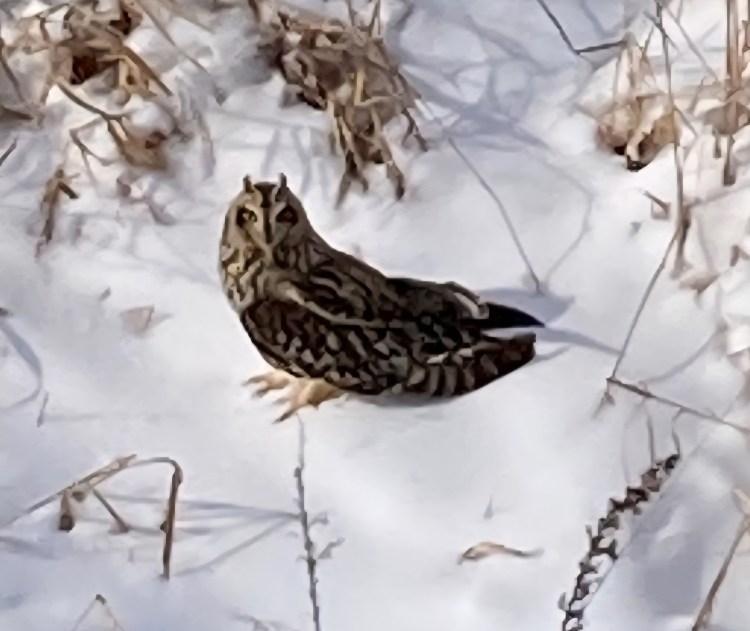
Image of Short Eared Owl above provided by Richard Yoder. The ear tufts are not normally displayed and are normally only seen when owl is in defensive mode.
Article by Melissa Fey
References from Merlin eBird and Wikipedia
 Friends of the Limberlost