Wherein we examine the attraction that villains and outlaws have to wild and wooly wetlands like the Limberlost Swamp

By Curt Burnette

In her book, “Freckles”, Gene Stratton-Porter creates a character called Blackjack, whom she describes as a villain, whose “face is coarse and hardened with sin and careless living.” He is a tree poacher in the Limberlost, cutting and stealing trees from property owned by the Grand Rapids Lumber Company. He is a dangerous man, who even goes so far as to kidnap Freckles.

In “A Girl of the Limberlost”, Gene creates another character called Pete Corson, who is a member of a gang of troublemakers who frequent the Limberlost. Although he helps Mrs. Comstock catch moths one night in the swamp, he cautions her that her lights will summon others who will ride like fury to get there and “they won’t be nice Sunday school men.”

These men are works of fiction, but the Limberlost Swamp and other wetland areas which were remote and difficult to access actually did harbor criminals and outlaws. At the end of August and the beginning of September of 1900, police from Muncie and Portland searched the Jay County portion of the Limberlost—the Loblolly—for several days in an attempt to capture the Keating brothers. The brothers were wanted for the murder of a Muncie man, who had been stabbed in the neck with a knife. The search was unsuccessful. But a bloody pair of trousers and a blood-stained knife were recovered from the residence of a brother-in-law who lived near the swamp.

In the vast Grand Kankakee Marsh of northwest Indiana, there were two islands located deep within which were notorious hideouts for counterfeiters, horse-thieves, and murderers. Big Bogus Island and Little Bogus Island got their names from the bogus coins the counterfeiters made there. The islands were surrounded by water and marshy terrain, which made it very difficult for law enforcement to sneak up on the lawless inhabitants. The outlaws, however, knew of a hidden sand ridge located just beneath the surface of the water that zigged and zagged its way to their hideaway. At the one spot where the ridge ended before it reached the islands, the resourceful outlaws constructed a 300-foot long submerged log corduroy road on the muck of the marsh bottom. This “hog-back highway” allowed them to come and go easily while officers of the law were floundering through deeper water on their horses.

Many other types of rugged, inaccessible terrain have been used as hideouts. One of the most famous is the Hole-in-the-Wall Pass in the mountains of Wyoming, where for more than 50 years famous outlaws, such as Butch Cassidy and The Sundance Kid, were able to successfully elude the posses sent after them. Wetlands, however, have always been one of the best spots for the lawless to hide, from the pirate Jean Lafitte in the vast swamps south of New Orleans, to Blackjack of Gene Stratton-Porter’s fictional version of the Limberlost Swamp.
Spring Calls of the Marsh: An Orchestra of Music

by Terri Gorney

“The marsh, that can die and yet return to life in the first breath of spring, seems each year to repeat anew to its lovers,” wrote Gene Stratton-Porter in “Music of the Wild” which was published in 1910. She wrote very descriptively about the songs of the marsh. Her nature writings of the Limberlost are timeless. She could be describing the spring of 2015.

“It is the marsh that furnished the croakings, the chatter, the quackings, the thunder and the cries,” Gene knew that the sounds of the marsh are heard both day and night. She especially loved the birds and their calls. The birds that Gene observed, photographed and studied are species that make their home at least part of the year at Limberlost today. 

Gene described the whip-poor-will’s song as “unmusical” and a cry with peculiar notes that was “mingled always with the mystery of the dark.” Another species of the night were the owls which Gene had a special affection. She wrote that “the maestro of all night musicians is the great horned owl. The big hollow sycamores and the impenetrable thickets around the marsh are his birthright.”

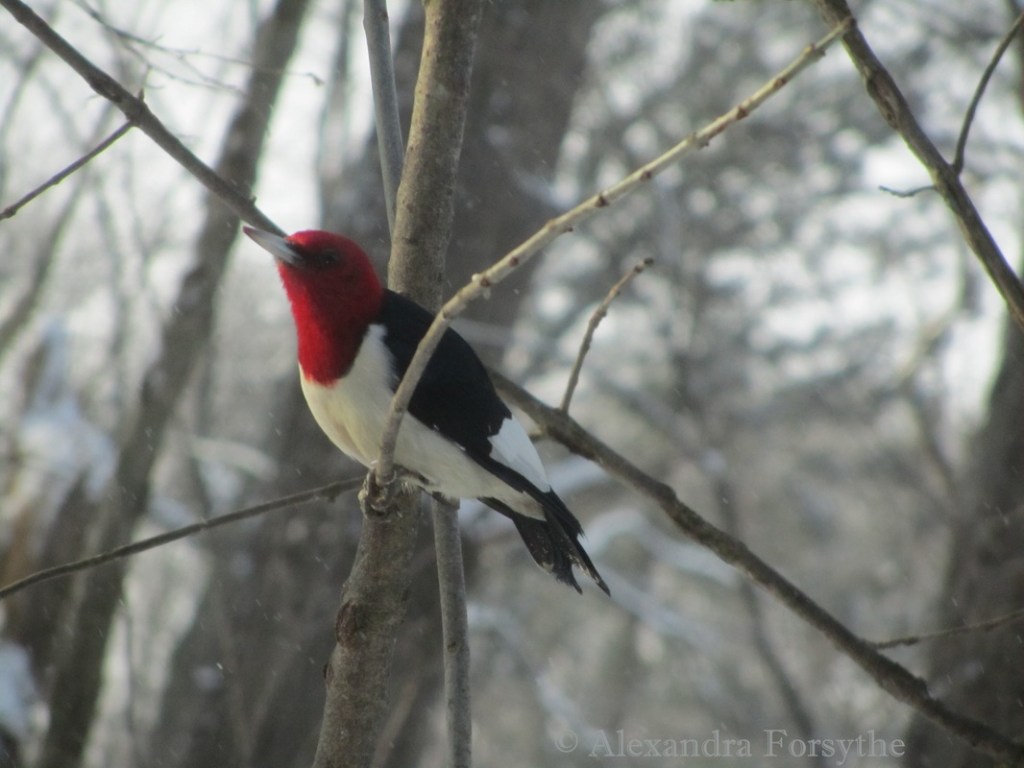
“The water carries sound clearly and for such distances for the woodpeckers and flickers,” Gene noted. With their tap, tap, tapping on the trees, they are the drummers of the marsh. Yellow-shafted Flickers, Downy, Red-bellied, Red-headed, and Pileated Woodpeckers inhabit this area.

The great blue heron makes a “rasping scream” and the male’s voice “is its best when he calls his mate,” according to Gene. In 2013, the herons had a rookery by the Wabash River and are again raising their young in the Limberlost area. January and February of 2012 were so mild, some herons overwintered here.

Flocks of wild ducks, especially in spring migration, can make “entrancing music” according to Gene. Early in 2012, Ken Brunswick estimated that there were between 3000 and 4000 waterfowl at Limberlost. The beating of their wings as they take off for flight is incredible to witness. 

The late spring the last of the arrivals come back to nest. “The rushes are weighted with bobolinks, and the air resounds with their sweet, liquid notes. A few days later the straying killdeer and upland plover return, and the blackbirds and tanagers sweet upon us in countless numbers,” noted Gene. She loved the “endless variety of exquisite tones.”

We hope that this spring you can spend some time at the Limberlost and Loblolly Marsh and enjoy the music of the marsh. 

Writer’s note: All the above quotes by Gene Stratton-Porter are from “Music of the Wild”

Christmas Bird Count 2015

by Terri Gorney & Alex Forsythe

Many of us start off the New Year with a variety of resolutions, often related to self-improvement. However, in the tradition of Gene Stratton-Porter, the birders of Limberlost and Adams County have a different sort of resolution: conservation. They choose to spend New Year’s Day participating in the Christmas Bird Count, the longest running citizen science program in the world. Using strict protocols, the birders study a prescribed area and count not just the number of species of birds, but the number of individual birds per species. By recording and sharing this information, we can watch trends and patterns and determine whether any of the bird species are declining and require further study.

On January 1, 2015, the weather was anything but ideal. The temperatures were far below normal, causing the lakes and ponds to freeze and the waterfowl to abandon the area. The winds were howling, causing the birds to take shelter and sit silently. The birds would be very difficult to see and impossible to hear.

If there is one word that can describe the birders of the Limberlost area it is “determination”. Despite the horrible weather conditions, 18 determined birders spent their holiday recording the birds in the area.

They found a total of 37 species with 3963 individual birds, far better than expected under the circumstances. They drove a total of 213 miles, and they even braved the elements and walked through habitats to locate the birds.

Included in the list of species they found were Bald Eagles, Northern Harriers, Red-headed Woodpecker, Brown Creepers, Great Blue Heron, Pine Siskins, Hairy Woodpeckers, Northern Flicker, Swamp Sparrow, American Wigeon and Tundra Swans.

Afterward, they gathered around the table and enjoyed a steaming bowl of hearty chili, scrumptious cheesy biscuits, melt-in-your-mouth cookies, and other goodies while sharing stories of their morning adventures. Limberlost supplied the venue, Terri Gorney supplied the food, and Gene’s teachings helped supply the incentive.

“Helping the birds” – the first resolution of the year was off to a healthy start. Gene would have been pleased.

Wherein it is speculated upon how Gene Stratton-Porter could potentially be a hazard to the International Space Station

By Curt Burnette

In 1925, the year after Gene Stratton-Porter’s death, it was estimated that about 10,000,000 copies of her books had been sold. Based on that number and an average thickness of the different books, another estimate about her books was also put forth. If every book sold could be stacked on top of each other into a single pile, that pile would be 1,250,000 feet tall! I found that number to be so large I couldn’t really grasp how high it was. So I divided it by 5280, which is the number of feet in a mile, and came up with a stack of books that would be 236 3⁄4 miles to the top!!! Out of curiosity I looked on the internet to see how high up the International Space Station was orbiting the earth. On average, it orbits 230 miles above the surface of our planet. If it really were possible to make a stack of all the books Gene had sold by the time of her death, the space station would have to be careful its orbit did not run into it!

Maybe a stack of books hundreds of miles high seems too outrageous to think about. Another way of explaining how many books Gene sold has to do with time. Ten million copies sold would average out to over 1600 books a day, every day, for 17 years. This would be over a book a minute being sold every minute of every day for 17 years straight! By any account, Gene Stratton-Porter sold a lot of books. 

Gene was one of the best-selling authors of her time. In seven different years with six different books she made the top ten bestseller list. Her first bestseller was “The Harvester”, which was number 5 in 1911, but was number 1 in 1912. Her second was “Laddie” which made the number 3 spot in 1913. Next was “Michael O’Halloran” which was number 3 in 1915. “A Daughter of the Land” was number 9 in 1918. “Her Father’s Daughter” was number 8 in 1921. Gene’s last book that made the top ten bestseller list did so after her death at the end of 1924. “Keeper of the Bees” made the number 3 spot in 1925.

Oddly enough, the two of Gene’s books that have sold the greatest number of copies over the years never made the top ten bestseller list. Her two most popular and famous books, “Freckles” and “A Girl of the Limberlost”, have each sold well over 2 million copies, but have done so over many years and were both published before Gene’s first appearance on the bestseller list. Even today, the two books which sell the best at the Limberlost Gift Shop are “Freckles” and “A Girl of the Limberlost.” Gene Stratton-Porter was certainly not what we would call nowadays a “one-hit wonder”!

The Story Behind “The Song of the Cardinal”Gene Stratton-Porter’s first book that almost was not written

By Terri Gorney

The “Song of the Cardinal” was Gene Stratton-Porter’s first book published in June of 1903. The book came close to not being written as Gene almost died in Geneva at the age of 39 in 1902.

Newspapers from Indianapolis to Fort Wayne wrote of her illness. In 1934, Lorene Miller Wallace, her secretary from 1908-1915, wrote about Gene’s almost “paying the supreme sacrifice for her loving and painstaking work on this book” in the summer of 1902. Gene herself wrote about her ordeal in “Homing with the the Birds.”

During the night of August 23, a special train was arranged and brought Charles Porter’s brother, noted specialist Dr. Miles Porter of Fort Wayne, to Gene’s bedside to care for her. She was suffering from typhoid fever. According to Lorene, she was unconscious for several days and remained weak and bed ridden for six weeks at the Limberlost Cabin in Geneva.

“Song of the Cardinal” was first an article in “Century Magazine.” The editor, Richard Watson Gilder, was so enthusiastic about Gene’s article and bird photography that he encouraged her to enlarge it into a book. 

According to Lorene, in the summer of 1902, Gene dressed in green clothing to blend into the scenery and hid her camera in bushes in order to photograph the cardinals. In her daily treks, she learned where there were several cardinal nests along the Wabash River in Geneva. She tied bits of beefsteak to tree branches to encourage the birds to eat so she could photograph them. The birds soon became comfortable with her. One of her prized photographs was of a bird bathing in the river.

One day, following a night of rain, she worked under the hot sun in the steaming heat. Wading into the Wabash River, she worked on taking pictures of trailing vines of wild morning glories and rose mallow and she became chilled. Realizing the seriousness of her condition, she immediately returned to the cabin where she was to remain for six weeks.

Two weeks after recovering from her illness, Gene was back in the field photographing nature in her beloved Limberlost. Doctors credit her normally good health with aiding in her recovery.

“The Song of the Cardinal” came out to good book reviews across the country in the summer of 1903 and Gene’s career as an author was launched. In 1933, the cardinal became the state bird of Indiana. The book “The Song of the Cardinal” would be translated into nine languages and Braille in the first twenty-five years of publication.

Wherein we learn why the Limberlost now abounds with deer but Mrs. Porter never saw any

By Curt Burnette

It is easy to imagine the mighty Limberlost swamp would have been brimming with wildlife during the years Gene Stratton-Porter wandered about it recording her observations and taking photographs. And in the case of many types of wildlife this would have been true. But other kinds of wildlife are more abundant now than they were in the late 19th centuries, and some were already gone or were disappearing even during Gene’s time.

 It is quite common now to see white-tailed deer crossing our local roads or dead along the highways. Deer season is a joy to many a Hoosier hunter. If anything, parts of Indiana and some of the eastern United States are overrun with deer, even in suburbs and cities. Can you imagine a time when there were no deer here at all? Although it does not seem possible, it is true. Deer were abundant when the first settlers began arriving in the early 1800s, but were so heavily hunted during the 19th and early 20th century that the last deer was reported in our state in 1893.  For the next 41 years there were basically no deer in Indiana but for the occasional stray from a surrounding state! As I wander the Limberlost area these days, I always see deer or deer tracks everywhere I go. But when Gene was wandering over 100 years ago, she would never have seen a deer or a track. In 1934, the Division of Fish & Game (now known as the Division of Fish & Wildlife) began reintroducing white-tailed deer into seven counties. By 1951, the deer population had recovered well enough to allow limited hunting and nowadays hunting is allowed throughout the state. Hunting fees are critical to managing and maintaining Indiana wildlife populations.

 There were other animals that were formerly present in the Limberlost but were gone by Gene’s time. The hunting party from which Limber Jim got himself lost in the early 1800s could have encountered wolves and bear, but Gene would not have. Another animal both Limber Jim in his day and I at the present time could see are beaver. By Gene’s time they had been trapped almost to extinction, but like the deer they have been reintroduced and are now common. Wild turkey were also once plentiful in Indiana but disappeared. They too have been brought back successfully. I have seen them in the Limberlost. Gene would not have.

There is at least one animal Gene encountered frequently which is so rare today it is classified as endangered in Indiana. In her writings, Gene mentions how common the massasauga rattlesnake (the swamp rattler) was in the area. Now they are pretty much found only in a few protected spots in northern Indiana such as state parks. In the Limberlost of the past, Gene and other residents were concerned about the bite of a rattlesnake but never saw deer. In the Limberlost of the present we are concerned about colliding with a deer as we zoom along the roads and highways, but we do not fear rattlesnakes. Times change. 

Land of the Limberlost

By Terri Gorney

“The marsh, that can die and yet return to life in the first breath of spring, seems each year to repeat anew to its lovers,” wrote author, naturalist, artist and photographer Gene Stratton-Porter in “Music of the Wild” which was published in 1910. She immortalized the Limberlost Swamp in her novels and nature studies of the early 20th century. For twenty-five years, Gene drew inspiration from the swamp and lived in Geneva at the edge of it. By around 1913, the great swamp that was once 13,000 acres was drained.

Fast forward to the present, there are over 1800 acres of restored wetlands around Geneva that is owned by the Department of Natural Resources and the Friends of the Limberlost. Gene’s fourteen room Queen Anne style cabin, carriage house and visitor center is now the Limberlost State Historic Site. There are separate sections of wetlands. The 460 acres Loblolly Marsh has about 3 miles of walking trails with habitats of prairie, woods and wetlands. On the Adams/Jay County line is the Limberlost Swamp Wetlands Preserve. This spot is great for birding by car. Seen this year in the area were king rails, least bittern, short-billed dowitchers, black-necked stilts and a number of shorebirds.  Other wetland restoration projects include Rainbow Bottom, Munro Nature Preserve, Music of the Wild Preserve and the Bird Sanctuary. Around these sites are interpretive signs that include quotes of Gene Stratton-Porter.

Ken Brunswick is the man who had the vision over thirty years ago to restore some of the wetlands in areas that were prone to flood causing loss of crops in the fields. In the beginning, he ran into opposition but slowly won over his detractors. In 1993, he and others founded Limberlost Swamp Remembered, a group that continues to advocate for restoring portions of the original 13,000 acre Limberlost Swamp. In January 2003, the title of east central regional ecologist was created by the Department of Natural Resources for Ken. A title he held until his retirement in December 2013. Limberlost naturalist Curt Burnette called Ken “The Keeper of the Limberlost,” a title that is well deserved. Ken  lives in a home that overlooked flood-prone farmland, but thanks to his tireless efforts his home now overlooks the Loblolly Marsh Wetland Preserve. The new east central regional ecologist is Ben Hess. Ben has a vast knowledge of plants, seed propagation, and developing land management plans. 

In 1999, Randy Lehman, became the site manager of the Limberlost State Historic Site. His master thesis was on water ecology of the Patoka River in southern Indiana. Randy was a perfect fit at Limberlost, working with Ken and now Ben. Limberlost Swamp Remembered became a committee of the Friends of the Limberlost in 1996 when the first land was purchased for wetland restoration. The Friends group is unique in that it works with the DNR Division of Nature Preserves, and the Indiana State Museum, which owns and manages Limberlost State Historic Site.

Every season has its own charm of flora and fauna. As I’m writing this article, big blue stem grass, goldenrod, sunflowers, prairie dock and asters are in full bloom at the Loblolly. Bees and monarch butterflies were enjoying the fall day. Our native sparrows: field, chipping, and savannah were flitting among the plants. In November, short-eared owls return to spend most of the winter at the Limberlost Swamp Wetlands. In a mild winter, like we had in 2012, over 4,000 waterfowl wintered here, including 72 tundra swans. In February or early March on the first warm day, the spring peepers and chorus frogs will begin singing. “The music of spring begins in the marsh with the frogs,” wrote Gene Stratton-Porter. Limberlost has 9 of the 11 frog species in northern Indiana, including the northern cricket frog.

The Limberlost is getting recognition for being a natural gem of Indiana. The Loblolly  Marsh Wetland Preserve became Indiana’s 250th state dedicated preserve in 2012. In 2013, Geneva received Indiana’s first Bird Town designation by the Indiana Audubon Society. The Limberlost bird list is over 200 species in five years.

For those who wish to visit and want a personal tour of the Limberlost wetlands, you can Rent-a-Naturalist for a small fee and hire Limberlost naturalist and program developer Curt Burnette, to show you around the area. Everyone from Red Hat Ladies, Book Clubs and Families has rented Curt. For more information contact Curt at cburnette@indianamuseum.org or call 260-368-7428.

Wherein we learn of the connection between the scientific name of an ancient sea creature and Gene Stratton-Porter

By Curt Burnette

Gene Stratton-Porter referred to herself as a Nature Lover, and she called scientists who studied nature, Naturalists. In her mind, in her day, a naturalist was a learned person who studied and specialized in some aspect of nature. An ornithologist who studied birds would be a naturalist. An entomologist who studied insects would also be a naturalist.

Nowadays, we refer to naturalists as someone who is knowledgeable about nature in general and is usually more of an educator than a scientist. Using this modern definition, Gene could be considered a naturalist since she was knowledgeable about many aspects of nature and was an educator through her articles, books, and photographs. Gene corresponded with scientists in certain fields of biology. One such person she communicated with was Professor R. R. Rowley, a prominent paleontologist from Missouri who was her scientific advisor on her book “Moths of the Limberlost”. He was of great assistance to her and apparently had respect and admiration for her. When he gave a scientific name to a trilobite (an extinct marine arthropod related to insects, spiders, and crabs), it was a tribute to Gene—Phillipsia stratton-porteri. 

A scientific name is the unique name given by scientists to every known species of living thing. It is composed of a two-part name, the genus and species. Often a third part, the subspecies name, is included. Human beings are Homo sapiens. The wolf is Canis lupus. The dandelion is Taraxacum officinale. The scientific name of an organism is its one true name. Any scientist anywhere in the world would know exactly what the organism is. But a common name can sometimes apply to different animals. In the United States, a robin is one species (Turdus migratorius), while in England, a robin is a different species (Erithicus rubecula). Many animals have several common names. The black rat snake is also known as the cow snake or chicken snake, but it has only one scientific name—Elaphe obsoleta obsoleta.

When I ask non-scientist folks, especially children, if they know any scientific names, they usually shake their heads no. They think scientific names are just for scientists. When I tell them that they do know scientific names, they look at me as if I’m crazy. But almost everyone knows the name of the most famous dinosaur of all—Tyrannosaurus rex. Tyrannosaurus rex is a scientific name, Tyrannosaurus is the genus, rex is the species. Dinosaurs are generally known only by their scientific names. Triceratops is a genus. Stegosaurus is a genus. And even some modern animals are known by their scientific names. Gorilla gorilla is the scientific name of the gorilla and Bison bison is the scientific name of the American bison.

Scientific names aren’t just for brainiacs. We all use them from time to time, whether we realize it or not. However, becoming part of a scientific name is a rare privilege that only a few individuals, such as Gene Stratton-Porter, ever experience.

Gene Stratton-Porter and Charles Deam

By Terri Gorney

Gene Stratton-Porter’s husband Charles enjoyed collecting Native American handiwork and relics as he called them. In 1895, the Geneva Herald wrote “C.D. Porter has probably the finest collection of Indian relics in this section of Indiana.” In October 1906, he wrote to Charles “Charlie” Deam asking if it would be all right if he and his wife could “drive over and call on you sometime” as he understood that Deam was also a collector. 

Charlie Deam was two years younger than Gene and like Gene was born close to the Wabash River on a farm; he in Wells County, to the northwest of Geneva. Deam, like Gene, loved to roam the countryside studying nature. By the 1890s, he was a druggist with his own pharmacy in Bluffton. A profession he shared with Charles Porter. 

Slowly, Deam evolved into a self-taught botanist who in his lifetime collected 73,000 specimens in the state. This collection is housed at Indiana University. His books on Indiana’s flora, grasses, shrubs, and trees are four classic books that are still consulted by those studying the field.

Both the Deam and Stratton families came to northern Indiana in the late 1830s. According to his biographer, Robert Kriebel, Deam’s grandfather, John Aughey Deam, brought his family and followed the Wabash River “to a scenic promising valley.” 

In August 1921, Gene wrote Charlie “after eighteen years and fourteen books in my swamp region of Indiana, I have done two years of botanizing in California and written a book from the new location. It you can find time to read it, I shall enjoy having your official opinion as to the change.” She sent him a copy, as well as his daughter, Roberta, of her new book “Her Father’s Daughter.” They had planned to meet for a visit at her home Wildflower Woods on Sylvan Lake but it was not to be. That August was busy time for the Porters and the Deams and Gene left for California on September 10 with plans to spend the winter there. 

It was remarkable all that Charlie Deam accomplished in 1921. He collected 1741 specimens in the state, spending 104 days in the field, driving 4880 miles. He spent several weeks revising his “Trees of Indiana.” This is the year that he began planting hickory and walnut trees at his Bluffton home which became known as the Deam Arboretum.

These two famous Hoosiers both produced an enormous body of work in their lifetimes and taught us much about the natural history of Indiana. We were fortunate that they called northeastern Indiana home. They had very similar backgrounds and lived one county a part for much of their lives. It is not surprising that they met and developed a friendship. Unlike Gene, Deam lived a long life and died in 1953. He enjoyed a long and productive career as a successful botanist and pharmacist.