Wherein we learn why 1912 was a good year for an ape-man, dinosaurs, and Gene Stratton-Porter

By Curt Burnette

If asked to think of the year 1912 and what might have been significant about it, some folks might recall it was the year the Titanic sank. A few parents of Brownies and other Girl Scouts might remember it was the year the Girl Scouts were founded. It was also a good year for literature, especially popular literature, for this was the year when (fictionally) an orphaned boy of British nobility was raised by apes and became one of the greatest and most popular adventurers of all time, dinosaurs were discovered (fictionally) on a lost plateau in South America, and Gene Stratton-Porter dominated (factually) the book world.

Everyone has heard of Tarzan of the Apes, and most of us have seen at least one of the many movies. But did you know when he made his first appearance? In the October 1912 issue of an American pulp magazine, Tarzan made his debut. The author Edgar Rice Burrows also began his John Carter of Mars series earlier that year in the same magazine. Tarzan became enormously popular around the world and still has a strong presence today, over 100 years later.

 Another fictional story known around the world appeared in 1912 when Sir Arthur Conan Doyle (creator of Sherlock Holmes) published his novel The Lost World. The familiar tale of explorers in South America, who come across a mysterious, hidden, and almost inaccessible mountain plateau where dinosaurs have survived over the eons, continues to thrill us today. It has influenced such books as Jurassic Park and The Lost World by the modern writer Michael Crichton, and the movies of the same names. But it was Sir Arthur who started it all. His book also contained a version of ape-like (although prehistoric) men. In a later adventure, Tarzan also traveled to a lost world of dinosaurs in Tarzan at the Earth’s Core, but inside the earth instead of on a remote plateau.

By the end of 1912, a number of books had been published about the sinking of the Titanic, which had happened earlier in the year in April. Like Tarzan and the dinosaurs of Conan Doyle’s lost world, the sinking of this “unsinkable” ship continues to reverberate today with books and movies still engaging us with the famous tragedy.

In 1912 Gene Stratton-Porter made it to the top of the book world. Her novel, The Harvester, was published in August of 1911, and had made its way up to number five on the best-seller list by the end of that year. Sales continued strongly throughout the next year. By the end of 1912, Gene’s tale of David Langston, the harvester of medicinal plants, had become the number one fiction book sold in America. The story of the Harvester and his Dream Girl was Gene’s first Top Ten book, with five more to follow: Laddie, Michael O’Halloran, A Daughter of the Land, Her Father’s Daughter, and Keeper of the Bees.
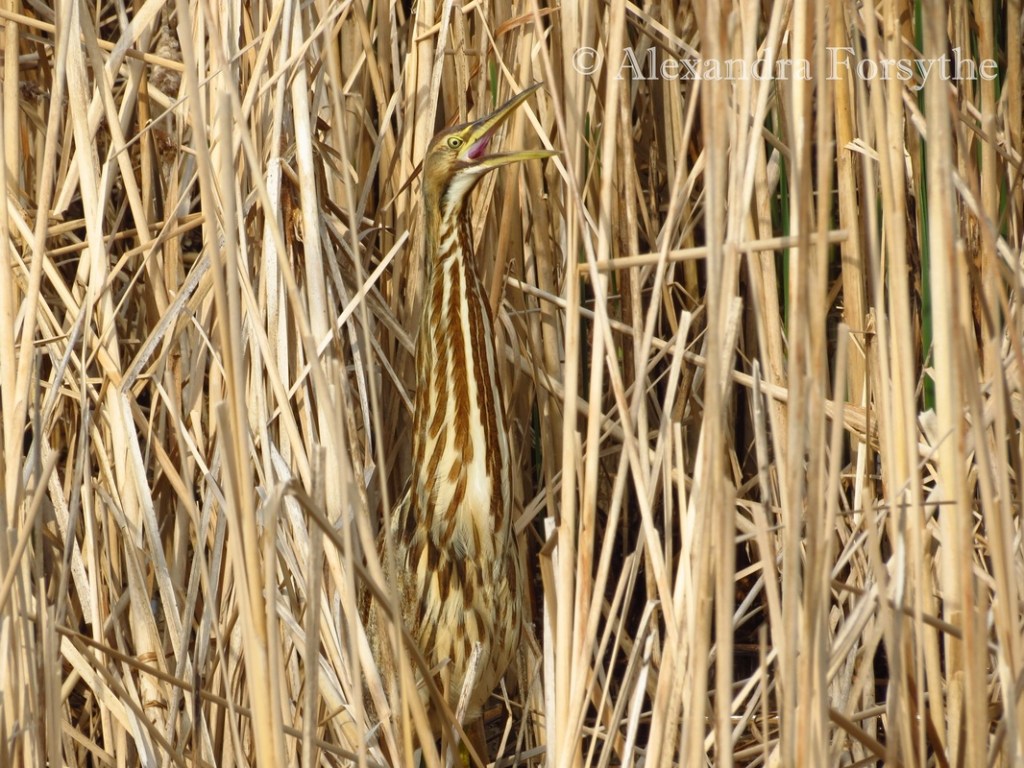
American Bittern and the Limberlosst swamp

by Alexandra Forsythe

If you ever have any doubt about the importance of restoring the Limberlost Swamp and others like it, take a walk through the area, pause, close your eyes, and listen. Listen carefully to all that you hear. If you are quite still, you might hear something that sounds like a water pump. That is the sound of conservation success: the return of an endangered but amazing bird. That is the sound of an American Bittern.

Despite its size (23” – 33” inches in length with a wingspan of 36”), this member of the heron family can be quite difficult to see. It is a master of camouflage! With the American Bittern’s thick neck and bill, yellow eyes, and stripes of brown, tan and white, it blends perfectly in the tall reeds. American Bitterns are usually solitary birds and they move slowly and fluidly through the vegetation imitating the movement of the plants (watch a video here). Even when they are actively searching for food, they do so in low light and usually use a “stand and wait” approach to hunting.

When alarmed, the American Bittern will not fly away as other herons do. Instead, it will hold perfectly still with its beak straight up in the air in an attempt to become indistinguishable from the plants surrounding it. Professor Walter Barrows was impressed with the Bittern’s ability to blend so perfectly with the swaying cattails and described his observations in “Life History of Marsh Birds”: “As we stood admiring the bird and his sublime confidence in his invisibility, a light breeze ruffled the surface of the previously calm water and set the cattail flags rustling. Instantly the bittern began to sway gently from side to side with an undulating motion which was most pronounced in the neck but was participated in by the body and even the legs. So obvious was the motion that it was impossible to overlook it, yet when the breeze subsided and the flags became motionless the bird stood as rigid as before and left us wondering whether after all our eyes might not have deceived us.”

The American Bittern has a unique, gulping “oong-ka-choonk” call that has been described as sounding like a water pump. Nutall described it as “the interrupted bellowing of a bull, but hollower and louder, and is heard at a mile’s distance, as if issued from some formidable being that resided at the bottom of the waters.” In “Summer”, Henry David Thoreau joked that the Bittern was able to make that watery call by thrusting its bill deep into the ground until it found water: “I went to the place, but could see no water, which makes me doubt if water is necessary to it in making the sound. Perhaps it thrusts its bill so deep as to reach water where it is dry on the surface. It does not sound loud near at hand, and it is remarkable that it should be heard so far. Perhaps it is pitched on a favorable key.” In fact, a specialized esophagus allows the American Bittern to make that distinctive call.

It is believed that American Bitterns migrate individually or in small groups of two or three at night. They overwinter in southern coastal areas and Central America, returning to Indiana in the spring.

Sadly, the American Bittern is endangered in Indiana due to habitat loss. Studies have found that American Bitterns require at least 6 acres of wetlands in which to nest, but such wetlands are now difficult to find in Indiana. Limberlost is a rare jewel! Indiana is fourth in the nation in percentage of wetlands lost: 87% since the 1780’s. The vast majority of the loss has been due to drainage for agriculture. Fortunately, there are programs in place to restore wetlands. For example, the U.S. Fish and Wildlife Service and the USDA (NRCS) have programs that will reimburse landowners up to 100% of the expenses incurred for the restoration of wetlands, and the Indiana Heritage Trust has acquired thousands of acres through the environmental license plate program. There are also conservation organizations like ACRES Land Trust that preserve important habitats. Of course, there are ongoing conservation efforts at Limberlost that could use your support, as well. With such programs and organizations in place, the American Bittern may one day become more common in Indiana and be removed from our state’s “State Endangered” list.

Gene Stratton-Porter, a Woman of Many Talents

By Terri Gorney

Most people in northern Indiana know Gene Stratton-Porter as a novelist; her most famous books being “The Girl of the Limberlost” and “Freckles.” Few knew that among her talents she was an early naturalist, nature photographer, artist, and movie director. 

Gene wrote both fiction and non fiction books and magazine articles. She illustrated her writings with her own drawings or used her own photography. She even developed her own film. Her darkroom was the family bathroom. She was not content to use pictures of mounted birds and animals in her books which was the common practice at the time. She would go into the Limberlost wearing rubber boots, taking her large camera and often a gun with her for protection against the Massassauga rattlers that infested the swamp. It is at the Limberlost Swamp near her home in Geneva that she began her serious nature studies. 

Her first ten books were written while living in Geneva near the Limberlost swamp which was her inspiration for both her fiction and non fiction writings. Her first book “Song of the Cardinal” was published in 1903. In an early book review, she is quoted as saying “The Limberlost……is a great natural paradise as there is anywhere in the central states.”

Her writings of the Limberlost swamp have inspired Ken Brunswick to restore some of the 13,000 acres of the old swamp. Since the 1990s, Ken has worked hard to return over 1500 acres of Gene’s beloved swamp back to wetlands.

Gene tried to put nature into her fiction writings. She preferred to write non fiction but the books of fiction were more popular. “Moths of the Limberlost,” “Friends in Feathers,” and “What I have Done With Birds,” were three of her best known non fiction books. William Lyon Phelps, an educator and critic, said of Gene about 1913, “she is primarily a naturalist, one of the foremost in America and has published a number of books on the flora and fauna illustrated with photos of her own taking.” She spent years collecting material for these books. Her book on moths greatly added to the knowledge of these beautiful creatures of the night.

She was accepted by her peers in the birding community. Gene was the main speaker at the 1908 Indiana Audubon state meeting that was held in Fort Wayne. Her two lectures were on “The Experiences of a Bird Woman” and “The Camera vs the Brush in Bird Reproduction.”

With some of the proceeds from “The Girl of the Limberlost” she bought 115 shares of stock in the Bank of Geneva for both her husband and herself. This secured his position as head cashier and placed both of them on the board of directors. This was in 1912 and still eight years before women had the right to vote. By this time, she was financially independent and when she chose to build her home “Wildflower Woods” on Sylvan Lake it was with money she earned as a writer. 

By the 1920s, Gene was trying her hand turning her books into movies. She formed Gene Stratton-Porter Productions and hired James Leo Meehan as her director. He married her daughter Jeanette making it a family business. She was just getting into this business and building a home in California when she was fatally injured in a car accident on 6 December 1924.

Gene’s homes in Geneva and Rome City are now both state historic sites and open to the public.

Few authors have had as many of their works made into films as did Mrs. Porter

By Curt Burnette

Certainly one measure of the popularity of an author is the number of books they sell. Another measure of their popularity might be how many movies have been made based on that author’s works. Gene Stratton-Porter rates quite highly in both of these measures. Not many people know that Mrs. Porter was a best-selling author with many of her books—and even fewer know that more of her books were made into movies than almost any other female author—and many male authors also.

The two best-selling authors of fiction in history, William Shakespeare and Agatha Christie, have had numerous movies made from their many works, both on television and in movie theaters. Shakespeare’s works have produced over 400 movies and TV movies, and Agatha Christie (the great British mystery writer) has had at least 35 movies and 60 TV movies made from her novels and stories. Two other female writers whose numerous stories were translated to film many times are the current American author Danielle Steel, and the Swedish author of the last century Astrid Lingren (creator of Pippi Longstocking). Danielle Steel has written 120 books that have resulted in 25 movies and Astrid Lingren wrote 100 books that resulted in 52 movies (filmed in Sweden and Russia mostly).

 Not every author who sells a lot of books have their works made into numerous movies–but often it is the most prolific writers whose works produce the most movies. After all, there are more to choose from. Gene Stratton-Porter falls into the more unusual situation where the author writes relatively few books, yet most are made into movies. Harper Lee wrote only one book (To Kill a Mockingbird), but it was made into a famous movie. A more modern example would be J. K. Rowling, whose 7 Harry Potter books were all made into movies. Gene wrote only 12 novels, yet 8 of these were made into 24 movies. Freckles and A Girl of the Limberlosteach were filmed 5 times, The Keeper of the Bees was filmed 4 times, Michael O’Halloran and Laddie were filmed 3 times each, The Harvester was filmed twice, and Her Father’s Daughter and The Magic Garden were each filmed once. 

Two of the films listed above were made by Gene herself. She was one of the very first women to start a movie production company. Gene Stratton-Porter Productions released her filmed version of Michael O’Halloran and A Girl of the Limberlost before her death, during the silent movie era. But even discounting the two she made herself, it’s obvious that Mrs. Porter’s small number of novels influenced movie-making in a way that few other authors have been able to do.

Our Native Sparrows

By Terri Gorney

When most of us think of sparrows, we think of the English or house sparrow which is commonly found at our bird feeders in urban and rural areas. At Limberlost, we are fortunate to have a number of native sparrows who make their home at least part of the year at Limberlost. Those include the American tree, chipping, song, savannah, field, white-throated, white-crowned, and fox sparrows.

The song sparrow is one of the most common sparrows and can be found at the Limberlost throughout the year. They were first described by Alexander Wilson in 1810. Gene Stratton-Porter wrote that she enjoyed the song sparrow all year. She believed that this beautiful bird was the “master singer of our winter woods.” They like to nest in brushy habitats, usually around water. A perfect place to see them is at Rainbow Bottom along the Wabash River. Ken Brunswick made sure a brush pile was left there as habitat for the birds. These sparrows have nested here and also use it for cover as when a raptor is in the area.

When most of the earth sleeps in winter, the meadow at the Loblolly Marsh still provides nutriants for the song sparrows and American tree sparrows or they may be found flocking to yard bird feeders when the snow covers much of the ground. Last January, at a home on Rainbow Lake, there were twenty or so American tree sparrows along with a couple song sparrows who regularly came to a ground feeder. Both species are seed eating birds and enjoy the seeds of the thistle, goldenrod and coneflower. Last winter both species were here in good numbers. 

The small and slender chipping sparrow is a bird of summer in this area. They can commonly be heard “chipping” early in the morning. Many will nest and raise their young in northeastern Indiana. In the fall they will migrate south and return in the spring. The chipping sparrows close looking counter part, the American Tree sparrow, is a little larger has a dark spot on the breast and will spend the winter at Limberlost but will nest and raise their young further north. 

Field sparrows have seen their numbers decline in past years but their unmistakable vocalization of clear whistled notes and a trill could be heard at several places at the Loblolly Marsh and Limberlost Wetlands this past summer. This is one bird that is easier to hear than to see. Habitat restoration is helping this species make a come back in the area.

One species of sparrow that are not as common and tend to be a little shyer is the savannah sparrow. Jane Brooks Hine, a bird woman from DeKalb County, wrote in 1911 that “this little sparrow is one of her most intimate friends.” Jane wrote that he would be outside her kitchen window and that like the song sparrow, used the brush heap for shelter all year long. 

Fox sparrows are few in numbers but one or two can be seen in the winter months at the Loblolly Marsh. Jane Hine wrote that they were in greater numbers in the late nineteenth century. 

White-throated and white-crowned sparrows are in the area in the early spring, fall and winter months. Both species nest further north, mostly in Canada. The Loblolly Marsh around Woody’s Retreat is a good place to watch for these birds. The white-throated sparrow is a species that likes the woods or is found at the edge of wooded areas. The white-crowned sparrow is commonly seen in shrubs or at the edge of a woods. 

The Cornell Lab of Ornithology website is a good place to research these birds further or listen to their calls http://www.allaboutbirds.org

Wherein is revealed the two types of birds for which the Bird Woman had no love

By Curt Burnette

Gene Stratton-Porter was known as “The Bird Woman”. It was a nickname she acquired as a child when her mother called her “the little Bird Woman”, and it stuck with her for the rest of her life. A feature article in a 1904 Muncie newspaper was titled “The Bird Woman of the Limberlost”. Gene capitalized on the name by writing herself into her two most popular novels, Freckles and A Girl of the Limberlost, as the character of the Bird Woman who befriends Freckles and Elnora. Gene’s love of nature was broad, but of all the living things which are a part of nature her greatest love was for birds.

It might be thought that this love encompassed every type of bird—but that would not be entirely true. There were, in fact, two types which she definitely did not love, and actually wished for their extinction. In her own words: “If I have any influence whatever, I shall most earnestly use it in advocating the complete extermination of cowbirds and English sparrows”. What was it about these two species that could bring about such vitriol and hate from a passionate bird-lover?

The English sparrow, also known as house sparrow, is a species from Europe and Asia that was introduced to the United States in New York in 1852. They spread rapidly across this country and by 1886, the year Gene married Charles Porter, they had already invaded the entire Midwest and were making their way across the Great Plains. The Bird Woman considered English sparrows to be a threat to her beloved native Limberlost species as they would attack other birds, destroy their nests, break their eggs, and kill their young. She considered them to have “disgusting habits” and called them “…little villains…[which]…were always hanging around ready for any mischief they might do.”

Cowbirds, specifically the brown-headed cowbird in Indiana, are nest parasites which the Bird Woman found to be intolerable, even though they are native, not introduced like the English sparrow. Cowbirds do not build their own nests in which to lay their eggs, they lay in the nests of other birds and let a different species rear their young. The Bird Woman witnessed cowbirds destroying host bird eggs when they laid their own, and considered them to be lazy slackers since they did not raise their own young. Modern science has documented retaliatory behavior from cowbirds, which watch the nests they laid their eggs in, and if they see that their own eggs have been thrown out, will ransack or destroy the nest of the offenders. This amazing vengeance has been labeled “mafia behavior”! Although the Bird Woman apparently did not know about this nasty side of her despised cowbirds, it did not matter. She still thought of them as “such unspeakable pests they are worthy of mention only to advise their extinction.”

Short-eared Owls of Limberlost

By Terri Gorney

While living at Limberlost, Gene Stratton-Porter wrote, “The owl can afford to be silent of the wing, it so dominates the night with its voice. It would give me great satisfaction if I had some way of knowing surely whether other birds sleep serenely…or whether they are awake and shutter in fear.” Gene was in awe of owls. Adorning her carved bed that is still in the cabin, the owl is one of the main motifs.

Short-eared owls have been one of Limberlost’s winter birds for the past four years. In 2011, Jim Haw, a Fort Wayne birder, noted the restored Limberlost Swamp Wetlands Preserve (Adams/Jay Co line) were ideal habitat for short-eared owls. On November 23 of that year, he discovered that the short-eared owls were indeed at Limberlost. The owls were seen a number of times around dusk and into the evening hours over the next few of months. Several people came from a distance to see these beautiful birds.

The owls returned the next year on November 22, 2012. On November 22, 2013, Randy Lehman and I had at least two at dusk in the same location where they were previously observed. Five short-eared owls were observed by Dave Reichlinger and I on December 13. The owls were still in the area and were counted on the Christmas Bird Count on January 1, 2014. On November 15, 2014, Randy and I had one perched on the 900N sign and then in flight at dusk. 

It is a special sight to view these masters of the night. They are so silent and seem to glide. It is fascinating to watch them on the wing together almost in a playful fashion. The owls like to perch about three to four feet off the ground. When in flight and hunting they are usually low to the ground. 

Amos W. Butler, known as the father of Indiana Ornithology and was a friend of Gene Stratton-Porter. In 1907, while on the board of the Indiana Audubon Society, he tried to convince “every open-minded person” as to the great benefit of owls because they eat small animals and insects that are “destructive enemies of the farmers’ crops.”

We wish these magnificent birds safe travels on the wing back to their summer breeding grounds further north in the United States and Canada. We now anxiously anticipate their return every November to their winter home at Limberlost.

Gene Stratton-Porter and Charles Deam

By Terri Gorney

Gene Stratton-Porter’s husband Charles enjoyed collecting Native American handiwork and relics as he called them. In 1895, the Geneva Herald wrote “C.D. Porter has probably the finest collection of Indian relics in this section of Indiana.” In October 1906, he wrote to Charles “Charlie” Deam asking if it would be all right if he and his wife could “drive over and call on you sometime” as he understood that Deam was also a collector. 

Charlie Deam was two years younger than Gene and like Gene was born close to the Wabash River on a farm; he in Wells County, to the northwest of Geneva. Deam, like Gene, loved to roam the countryside studying nature. By the 1890s, he was a druggist with his own pharmacy in Bluffton. A profession he shared with Charles Porter. 

Slowly, Deam evolved into a self-taught botanist who in his lifetime collected 73,000 specimens in the state. This collection is housed at Indiana University. His books on Indiana’s flora, grasses, shrubs, and trees are four classic books that are still consulted by those studying the field.

Both the Deam and Stratton families came to northern Indiana in the late 1830s. According to his biographer, Robert Kriebel, Deam’s grandfather, John Aughey Deam, brought his family and followed the Wabash River “to a scenic promising valley.” 

In August 1921, Gene wrote Charlie “after eighteen years and fourteen books in my swamp region of Indiana, I have done two years of botanizing in California and written a book from the new location. It you can find time to read it, I shall enjoy having your official opinion as to the change.” She sent him a copy, as well as his daughter, Roberta, of her new book “Her Father’s Daughter.” They had planned to meet for a visit at her home Wildflower Woods on Sylvan Lake but it was not to be. That August was busy time for the Porters and the Deams and Gene left for California on September 10 with plans to spend the winter there. 

It was remarkable all that Charlie Deam accomplished in 1921. He collected 1741 specimens in the state, spending 104 days in the field, driving 4880 miles. He spent several weeks revising his “Trees of Indiana.” This is the year that he began planting hickory and walnut trees at his Bluffton home which became known as the Deam Arboretum.

These two famous Hoosiers both produced an enormous body of work in their lifetimes and taught us much about the natural history of Indiana. We were fortunate that they called northeastern Indiana home. They had very similar backgrounds and lived one county a part for much of their lives. It is not surprising that they met and developed a friendship. Unlike Gene, Deam lived a long life and died in 1953. He enjoyed a long and productive career as a successful botanist and pharmacist.

Wherein we examine the history of beaver in the Limberlost— from Ice Age giants to the disappearance and return of our modern dam-builders

By Curt Burnette

Beaver are the largest rodents in Indiana, the largest rodents in the United States, and the second largest rodent in the world (South American capybara are the largest). But as large as they are now, they were even bigger in the past—or at least their relatives were. Around the end of the Ice Age, about 10,000 years ago, what is now Indiana and Illinois was home to the greatest concentration of giant beaver in North America. These cousins of the modern beaver were as big as black bears, up to 8 feet long and over 200 pounds! Unlike current beaver, their teeth were not chisel-shaped, so they would not have cut down trees and probably didn’t make dams or lodges. They would have lived in the water, though, and eaten various types of aquatic vegetation much like muskrats do today.

The two species of modern beaver, our local North American beaver and the Eurasian beaver, are not descended from their giant cousins. Modern beaver were already around when the giants were alive, sometimes living in the same area, according to fossil evidence. But as the glaciers of the Ice Age retreated and the climate warmed up, the giant beaver went extinct and their smaller tree-chewing cousins flourished.

Beaver were common throughout Indiana and much of the United States and Canada when the two countries were being settled. Many historians believe beaver were more responsible for the exploration and development of our country than any other animal, because of the great value of and desire for beaver fur. The first white men to explore many portions of North America were trappers searching for beaver. The demand was so great that the population of beaver in many areas was greatly reduced, or even wiped out. Such was the case in Indiana. Beaver were completely trapped out of our state by the late 1880s or early 1890s. When all of a certain type of animal is gone from a defined area (like a state), it is said to have been extirpated. It is likely Gene Stratton-Porter never saw any beaver in the Limberlost during the time she lived in Geneva, from 1888 to 1913.

Beaver were re-introduced into Indiana in 1935 and have been successfully re-established throughout much of the state. They have returned to the Limberlost area. Beaver don’t always build dams and lodges. They also commonly dig burrows into the banks of rivers and streams. These “bank beavers” are not nearly as noticeable as the dam building ones. Often people don’t realize they are around. If you hike along the Wabash River at the Rainbow Bend Park or Limberlost County Park you probably won’t see a beaver, but if you look along the river’s edge you might find beaver-gnawed branches. Or better yet, you might hear the slap of a beaver’s tail as it dives underwater when it realizes you are nearby—a sound Mrs. Porter may never have experienced in her wanderings through the Limberlost.

Black-necked Stilts Make An Appearance At Limberlost

By Terri Gorney

Three black-necked stilts were unexpected visitors on 3 May 2013 at Limberlost on the north side Co Rd 1200S. This was a first record of these shorebirds in Adams County. In 2011, two black-necked stilts were seen at Eagle Marsh in Allen County. 

They are typically found on Florida and California coast lines and western interior wetlands. But, since the early 1980s, the species has been expanding its breeding range northward. Tennessee saw its first nesting pair in 1983 and Indiana saw its first in 2001. The first nesting record in Indiana was confirmed by Don Gorney, Lee Casebere, and Lee Sterrenburg. It was in Sullivan County. The species now regularly nests at two places in southwest Indiana and occasionally elsewhere, much like the cardinal’s northward movement documented over one-hundred years ago, it may be just a matter of time before they begin nesting locally. 

The bird is striking in appearance with contrasting black upperparts and white underparts. It has a long, thin bill, red eyes with white eye-rings and long red pink legs. They were close to the road and very cooperative allowing Barb Gorney and myself to view them. Several other people got to see these special visitors in the late afternoon and evening, including Bill and Sherry Hubbard, Randy Lehman, Curt Burnette, and Willy DeSmet. Willy, Bill and Curt took some nice photographs of the stilts. Even though this was a short visit we hope that this is just the first visit and they will chose to become summer residents of the area.

One can imagine how delighted Gene Stratton-Porter would be to know that Limberlost habitat restoration encouraged these beautiful and regal birds to visit Limberlost. This is an example of “build it and they will come” or in this case “rebuild it” and they will find it. The black-necked stilts were not the only shorebirds seen the first week in May, others included greater and lesser yellowlegs, and solitary, pectoral, and spotted sandpipers.