Nestled in southern Adams County is a little natural and historic gem called the Munro Nature Preserve. It is the first and only preserve owned by ACRES in the county. It is located to the west of the town of Geneva and north of the restored wetlands of the Limberlost and Loblolly. The preserve is just over twenty-five acres and was generously donated in 1994 by two sister-in-laws, Esther Munro Cooper and Agnes Biery Fravel Munro, wife of Esther’s brother Lloyd.
Asa and Edith (Dillon) Munro moved their family of eight from Illinois to southern Adams County, Indiana in February 1917. The couple’s six children were Esther, Clark, Ruth, Willard, Lloyd and Warren. They arrived in a 1916 Jeffery seven-passenger touring car. A railroad box car brought the family’s household goods and livestock, including two horses, a cat and a dog and a few farm implements. Asa, a farmer by profession, purchased the land that was known as “the old Porter farm.” This land had at least forty oil wells on it at one time.
Their daughter, Esther Launa Munro was born in 1900 Piper City, Illinois. She attended Geneva High School and later taught in Hartford township schools after her graduation from Indiana University. Esther also attended Ball State University. It was there that she met and married Dr. Robert Cooper of Muncie. He later was on the faculty at the university as a biology professor. In 1969, they donated their woods and land to Ball State to be managed by the Department of Biology. Today it is known as the Esther L. and Robert H. Cooper Memorial Woodland Area.
The Robert Cooper Audubon Chapter was named in his honor. The society established the Robert and Esther (Munro) Cooper Conservation Award. Robert and Esther were honored as the first recipients in 1983.
This preserve was once part of a 239 acres farm owned by Charles Porter and his wife Gene Stratton-Porter. Even though they lived in a fourteen room cabin in Geneva, the Porters owned this land from April 1890 to the end of 1906. When Gene wrote about their farm, she was referring to this land. This farm contained working oil wells when the Porters owned it.
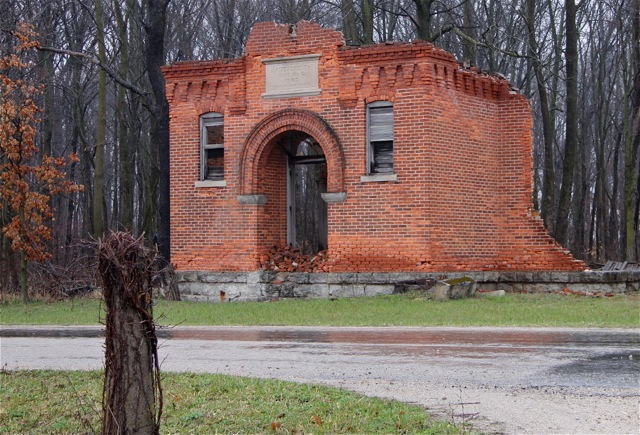
There is a brick schoolhouse ruins on the property. It is the Hartford Township Schoolhouse District No. 6 also known as Brushwood. It was built in 1903. The school was made famous in Gene Stratton-Porter’s book “A Girl of the Limberlost.” It was the school that the book’s heroine, Elnora Comstock, attended. The youngest of the Munro children were students at this school.
This area of southern Adams County is rich in the history of the old Limberlost Swamp and its restored wetlands, the Limberlost State Historic Site, and the Ceylon Bridge which is the last covered bridge on the Wabash River. Agnes died in 1996 at the age of 90 and is buried next to Lloyd at the Riverside Cemetery in Geneva. Esther died in 1997 at the age of 97. We owe them our gratitude for saving their woods and a piece of Indiana history.
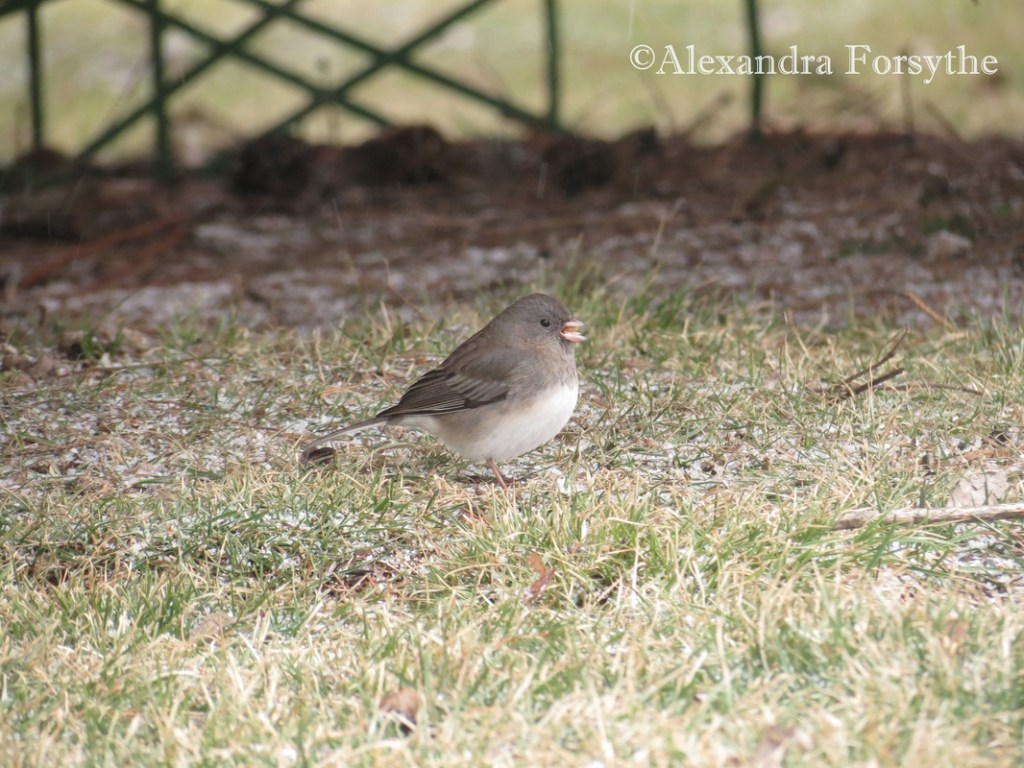
“A very quiet and well-conducted little member of our winter choir, with habits similar to those of the nuthatch, is the junco, with dark head and back, white breast, and grey sides. With an ivory-white bill, he feasts daintily at our winter offerings, occasionally remarking: ‘tsip, tsip’. This is merely a whisper of sound. Occasionally he pauses and whispers a high, halting strain of a few notes with small variation that I am unable to give any form of syllabication.” – Gene Stratton-Porter, “Homing with the Birds”.
You have no doubt seen these cute little birds hopping on the ground underneath your bird feeder in the winter, but you aren’t the only one watching them! Scientists have studied this species extensively. Over 1,300,000 Juncos have been banded since 1955, and over 15,000 of the banded birds have been recovered.
Researchers at Indiana University have conducted numerous studies on Juncos. They built the Kent Farm Bird Observatory facility including indoor and outdoor free-flight aviaries for housing flocks of juncos. A recent I.U. study monitored the effects of testosterone on Juncos. Increased testosterone allowed males to win mates, but they lost interest in raising their young had a shorter lifespan (Ketterson, et al., Indiana University 2007). In 1994, I.U. scientists studied the ability of Juncos to survive in winter when food is scarce by tracking the variations in their fat reserves. They noted that Juncos choose different wintering latitudes as they age (Rogers, et al., Indiana University 1994).
Scientists in other areas of the country have also be studying Juncos extensively. Their movements over (or more typically around) hills were tracked for three years in New Jersey. Not surprisingly, the birds chose the lower altitudes whenever possible (Schaeffer, “North American Bird Bander” 1979). The Junco’s increased oxygen demands in winter are met by the bird’s ability to increase its oxygen-carrying capacity (Swanson, Oregon State University 1990). Scientists have even studied the preening oils of Juncos and found that Juncos can distinguish between males and females by the odor of the oils, and they can use the odor to determine whether a bird is larger or smaller. Surprisingly, the females seemed to prefer the smaller males in this study (Whittaker, et al., “Behavioral Ecology” 2011).
Why are Juncos studied so often? They are easy to observe! They are common and sociable so it is not difficult to find a large group. They come easily to feeders so it is a simple task to attract them to net sites.
The interest in this bird and volume of study has even resulted in a popular documentary: “The Ordinary Extraordinary Junco” (http://juncoproject.org/). The film was designed by Indiana University to be a revolutionary type of multimedia textbook, teaching high school and college students in 8 “chapters” about the scientific method, ecology, genetics, physiology and animal behavior. I.U. allows free screenings of the 88-minute film for non-profit organizations and independent theaters upon request, so if you want to learn more about Juncos, you might want to arrange a screening for your local Audubon Society. As Bob Duquesne stated in his review of the film in “BDN Maine Outdoors” , “I will never look at a junco the same way again… [T]his little gray bird has a lot to teach us, about birds and about ourselves.”
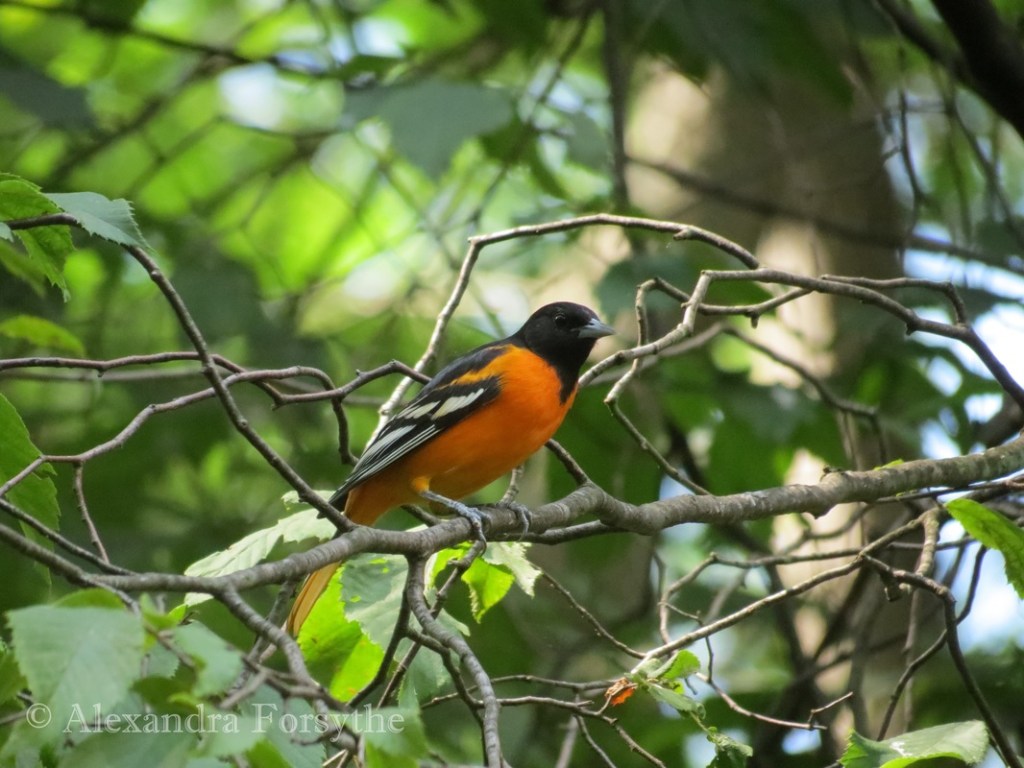
Baltimore Orioles, with their bright plumage and beautiful song, are favorites among backyard birders. John James Audubon studied and wrote about the Oriole extensively. He wrote: “Much might the traveller find to occupy his mind, and lead him into speculations regarding the past, the present, and the future, were he not attracted by the clear mellow notes, that issue from the woods, and gratified by the sight of the brilliant Oriole now before you.”
Gene Stratton-Porter greatly admired Orioles. In “Homing with the Birds” she wrote: “The oriole, spilling notes of molten sweetness, as it shot like a ray of detached sunshine to its nest in the chestnut tree across the road was mine.” She also studied Orioles extensively, particularly the architecture of their nests. Orioles typically build a nest in the shape of a hanging pouch with solid walls, but Gene documented at least one Oriole, possibly two or more, that framed a window in its nest. “It is impossible for this oriole to build this window without knowing for what purpose she intended using it; in fact, it required thought to plan and construct it. She has to remember the confinement and inconvenience of former nests, and determine that in the future she would obviate these difficulties. So remembering the past and providing for the future, in this nest she built a window. She was in advance of her time… How this bird must have enjoyed sitting with her head out of the window while she brooded, thus having light and air and seeing any danger to be avoided! …[D]ifferent birds of the same species have different degrees of mentality and different characteristics,…very much like humanity after all.”
The state bird of Maryland, the Baltimore Oriole was named for royalty. It was given its name in honor of Lord Baltimore, founder of Maryland, due to its coloration. The colors of the Oriole match the colors of Lord Baltimore’s coat of arms.
Males do not turn that bright orange color until the fall of their second year. Females get better with age, turning deeper orange each passing year. Birders can easily confuse an older female with a young male.
Not surprisingly, everyone wants to attract Baltimore Orioles to their yards. The best way to attract Orioles is through their stomachs. I set out fresh orange slices, but I also use grape jelly. I have found that it is best to use the least expensive jelly you can find and be consistent. If you switch to an expensive jelly, the birds don’t like to go back to the cheap stuff! It also helps to plant native fruit trees in your yard, preferably plants that bear dark-colored fruit at different seasons. I have several mulberry, raspberry, blackberry, chokecherry, and other native fruit-producing plants in my yard, so the Orioles tend to ignore the feeders once the fruits begin to ripen. Still I provide fresh oranges, jelly and clean water just in case they need an easy snack.
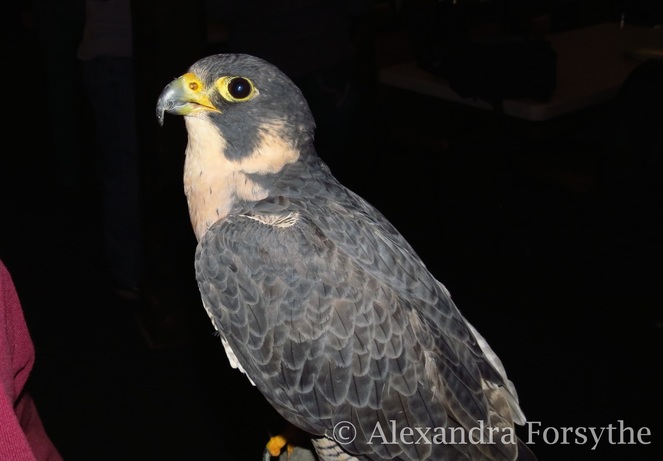
The Peregrine Falcon is the fastest animal in the world, capable of traveling up to 200 mph in a “stoop” or dive. Their primary food source is birds, and they have been documented preying on over 450 species of birds in North America, including Sandhill Cranes, White-throated Swifts and hummingbirds. As fast as Peregrines are, however, they could not escape the deadly impact of humans.
Like the Bald Eagle, the Peregrine Falcon was dramatically affected by the pesticide DDT. By 1965 no Peregrines were known to be nesting east of the Mississippi, and less than 40 pairs were nesting west of the Mississippi by 1975.
Unwilling to sit idly by and watch these magnificent birds of prey go extinct in the U.S., Dr. Tom Cade created the Peregrine Fund, a captive breeding program to reintroduce Peregrines. Getting the Peregrine Fund started was not easy!
I had the honor of interviewing Mr. Cade about his work with the Peregrine Fund. This is what he had to say about the early days of the Fund:
“The main problem was to find the money necessary to do the captive breeding and the release of falcons back into outdoor environments. In 1967 I joined the faculty of Cornell University as a professor of zoology. One of the conditions of my hiring was that the university would build a breeding facility for falcons. It took the university four years to find the money to build the facility for $150,000, but we finally got started in December of 1970. Being an academic scientist all of my experience in raising money for research had relied on obtaining grants from organizations such as the National Science Foundation, Office of Naval Research, and the National Institutes for Health, and I thought I could support the falcon program that way. It never occurred to me in the beginning that I would need to establish a nonprofit organization called The Peregrine Fund. For the first four years I did receive support from NSF, but it was little more than enough to provide salaries for a couple of assistants, and it became clear that what we were trying to accomplish was too applied to attract much support from the scientific community. Then the Laboratory of Ornithology, with which the falcon program and facility were associated at Cornell, began receiving unsolicited contributions from the general public to support the falcon work. That gave me the idea to seek this source of funding actively, and I went to the university’s Development Office for advice and help. They agreed to help but advised that I would have to abide by their priorities for asking major donors for support. To make a long story short, the arrangement never worked, because every time I wanted to approach a potential donor, the Development Office had a higher priority for that person. One of the private breeders who cooperated with me in keeping and breeding birds of prey suggested that we form our own nonprofit corporation independent of the university to support our mutual interests in breeding and releasing Peregrine Falcons; that was done in 1975. Soon we were receiving funds from various conservation organizations, foundations, many private donors, and both federal and state agencies involved in endangered species work. It turned out to be the smartest thing I ever did, but I can’t claim much credit for dreaming it up. Plato, or someone back in his time, said that ‘Necessity is the mother of invention.’”
Needless to say, the Peregrine Fund was a huge success and serves as a model of conservation. Thanks to the Fund’s efforts, by 1999 there were over 1650 breeding pairs in the U.S. and the Peregrine was removed from the endangered species list. Mr. Cade was present at the bittersweet moment when his first brood of fledglings that were hatched in the wild flew away. I asked him what he felt at that moment. He said, “This was a great time in the peregrine recovery program. I will never forget climbing up into the nest tower at Brigantine National Wildlife Refuge near Atlantic City with my colleague, Jim weaver, and banding the four nestlings. Looking out over the expanse of the Brigantine marshes, I realized that we had surmounted the last hurdle…”
He also informed me of some interesting survival rate differences based on nesting sites. “At first when falcons started nesting on buildings, and particularly on bridges, it appeared that fledging success was quite a bit less than for young fledged from cliffs. On bridges quite a few young fell into the water below when they first tried to fly and drowned, but some made it out of the water. But the Peregrines have persisted in moving into urban and industrial landscapes to nest on manmade structures in a spectacular way, so that the fatalities may simply look worse than they really are in terms of population maintenance and growth.”
During his work, Mr. Cade noticed an oddity that remains a mystery. “Falcons that breed successfully in captivity lay eggs that average smaller than the eggs collected from wild birds. However, this is not an inherited trait, as the young birds that are released into the wild and become breeders lay eggs of normal size. Something about captivity reduces egg size, but we do not know what it is.”
The Peregrine Fund has expanded their focus beyond that of the Peregrine Falcon.
“The Peregrine Fund now works on a worldwide scale on many kinds of projects to do with birds of prey, so naturally there are many projects I would like to see done.” One goal is to have at least one trained raptor biologist in every country to monitor populations. Another project is the California Condor. “We have been trying to reintroduce captive-bred condors into northern Arizona and southern Utah for the past 15 years but are unable to establish a self-sustaining population because of lead poisoning from bullet fragments and bird shot in the carcasses they eat. It is easy to breed condors in captivity, relatively easy to get them re-established as independent, free-flying birds in the wild, but no condors have survived long enough to produce more than one or two young before they die of lead poisoning. We desperately need some kind of a national PR campaign to convince the shooting public to stop using lead bullets and lead shot in their ammunition. Ideally this problem should be taken care of by state and federal regulations, but political idealism is hard to come by these days.”
His advice to anyone interested in starting up a conservation program: “Start small with a well defined goal that you are totally committed to, and come hell or high water you will succeed.”
A few folks live in only one or two houses their entire lives. Many people live in several houses during their lifetime. Others live in numerous homes—moving from place to place or up-sizing or down-sizing as the needs of their lives dictate. Some are able to own more than one home at a time. We all have some sort of “home history.”
Gene Stratton-Porter’s home history began at the Hopewell Farm, outside of Lagro in Wabash County. Her parent’s house on their farm was her childhood home. But when she was 11 years old, because of her mother’s illness, the family moved into the city of Wabash to live in the home of her sister Anastasia. Her mother died a few months later, so her father moved his family into a rented home in that city. When Anastasia died a few years later, he moved them back into her home, and then out again when Anastasia’s husband re-married. When Gene married Charles Porter they moved into his family home in Decatur. The Porters lived there about 2 years until they decided to move to Geneva in 1888 where they purchased a small yellow cottage. They lived in it for almost 8 years.
The regional oil boom of the early 1890s brought good fortune to the Porters when oil wells were drilled on the farm they owned a few miles west of town. The revenues from these wells provided the Porters with enough money to design and build a wonderful new home in Geneva—the Limberlost Cabin. The Porters lived in the Cabin for 18 years. Gene began a book writing career here that made her rich and famous. When she decided to move away from Geneva, she used her wealth to purchase 120 acres of land and design and build a second, larger version of the Limberlost Cabin outside Rome City on Sylvan Lake in northern Indiana, where she had vacationed in past summers and had met Charles. She purchased a small cottage nearby which she lived in part of the time while Limberlost Cabin (North), as Gene designated her new lake home, was being built. Within a couple of years of the completion of the lake home, she designed another home that was built in Fort Wayne, which was probably more of a winter residence, while the lake home was for summer. When Gene began going to California for the winter, she sold the Fort Wayne house.
In 1920 Gene decided to move to California permanently. She had already purchased a home in Los Angeles for her winter stays. But when she decided to live there year-round, she began the process of designing and building again—only this time it was to be two houses! She had a weekend home built on Catalina Island (off the coast of L. A.) which she began using in June of 1924. She also had a huge castle-like mansion under construction in Bel-Air, which she expected to move into by mid-December of that year. But fate had other plans for Gene Stratton-Porter—she was killed in an automobile accident in Los Angeles on Dec. 6, 1924. The Bel-Air mansion she never lived in would be the last entry in her home history.
by Tom Turpin, professor of entomology at Purdue University
reprinted from Purdue Extension’s “On Six Legs”, January 2009
Gene Stratton-Porter, one of Indiana’s best-known authors, was known as the “Bird Woman” in real life. She could just as well have been known as the “Moth Woman.” Born in 1863 in the small town of Lagro in Wabash County, she was the youngest of 12 children. With all those kids in the family, the youngest didn’t get a lot of attention, so Stratton-Porter learned to play by herself as she grew up. The outdoors became her playground, and that is where she developed her lifelong love of nature, including birds and moths.
Following her marriage and birth of her only child, Stratton-Porter continued her interest in nature but found very few books written about natural history. So she was forced to answer questions through her own research. To facilitate this activity, Stratton-Porter became a skilled photographer. Then when she started to write about her work, publishers were unsure about how marketable works of natural history were, so she began to write novels.
And the rest of the story, as they say, is history. Stratton-Porter’s novels made her one of the best-selling authors of her time and that success allowed her to publish non-fiction works as well. In all of her works her unbridled love of nature takes center stage.
Many characters in Stratton-Porter’s novels are based on real people, including Stratton-Porter herself. For example, in “Freckles,” one of her best-known novels, one character is the bird woman who photographs birds and collects insects. Her first novel was “Song of the Cardinal” about a red bird that met a man named Abram, who was clearly based on Stratton-Porter’s father.
Stratton-Porter wrote a scientific publication called “Moths of the Limberlost.” In this book she points out that there is a difference between a naturalist and a nature lover. The naturalist “devotes his life to delving into stiff scientific problems…” while a nature lover “finds recreation in being out of doors and appreciating the common things of life as they appeal to his senses.”
She concludes that scientific naturalists get lost in the details, such as the number of veins in a wing, and miss the big picture. For example, the issue about how moths that emerge from pupae buried in the soil get out of the ground. It is not the moth that crawls from the ground, as some of the literature of her day asserted. According to Stratton-Porter, moths were too fragile to crawl through the soil without showing obvious signs of the wear and tear of such activity. So, by observation, she discovered that the pupae worked its way from the soil using the pointed end of its abdomen. Once above the soil the moth emerged in much the same fashion as cicadas emerging from their immature shells.
Stratton-Porter describes the life cycles of some of the larger and showier moths of Indiana in “Moths of the Limberlost.” Her descriptions included tales associated with capturing moths, collecting eggs and rearing caterpillars of moths known today as cecropia, emperor, tomato hornworm, io, underwings, polyphemus, regal, promethea and luna.
One of the most interesting tales is about a moth that Stratton-Porter’s father called the Lady Bird. Mentioning that name today brings up thoughts of an insect–a ladybird beetle. But Stratton-Porter’s parents thought this moth was a bird similar to the hummingbirds that were hovering before the flowers in search of nectar. But Stratton-Porter was not convinced that the creature was a bird. Her primary reason for this conclusion was that, try as she might, she could not follow the creature to its nest. Then she noticed that the Lady Bird had four wings–not very bird like. Finally, she was able to capture one of the creatures and prove to both of her parents that it was a moth and not a bird. That day-flying moth is one we know today as a white-lined sphinx moth.
Moths play a prominent role in Stratton-Porter’s “Girl of the Limberlost.” In that novel, a young woman named Elnora Comstock collects moths to sell as a way to pay for her schooling. An activity, by the way, that Stratton-Porter found was useful for putting extra cash in her pocket. Stratton-Porter and her character Elnora Comstock both collected moths by sugaring. This process involves putting a sweet mixture on a tree limb to attract moths feeding during the night hours. So, because birds are day active and most moths are night active, it might make sense to say that Stratton-Porter was the “Bird Woman” by day and the “Moth Woman” by night!
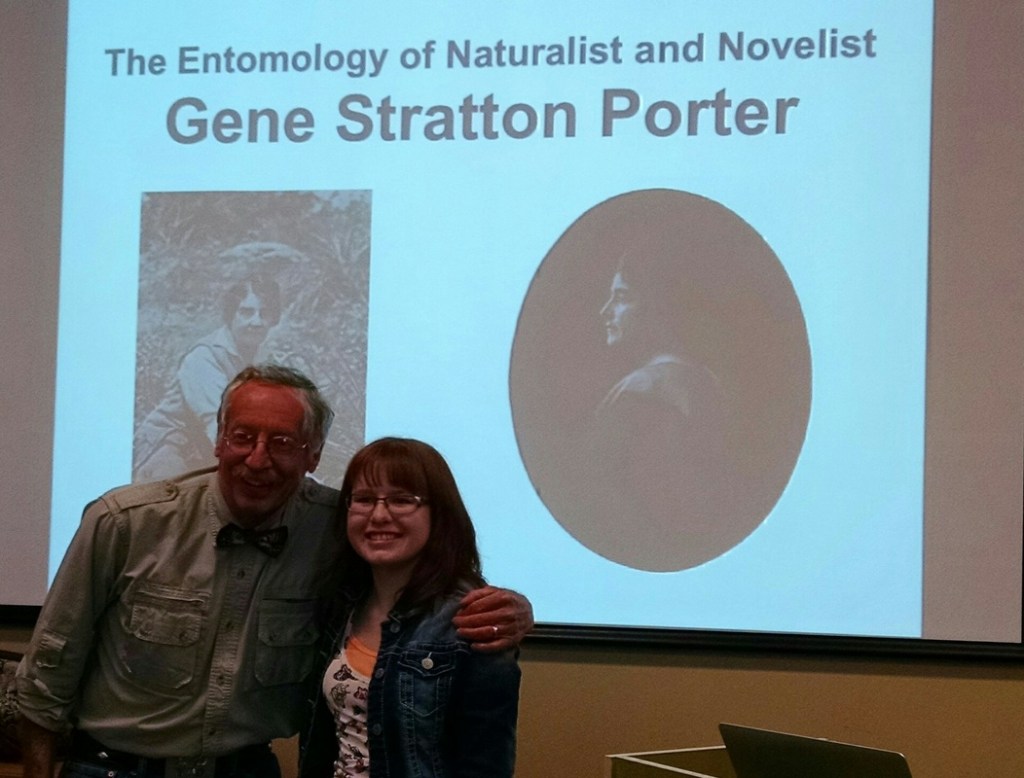
The inaugural Indiana Dunes Birding Festival took place over the weekend, and Limberlost’s own Randy Lehman was asked to be a featured speaker at the event. Over 240 people attended the conference and Randy had a packed crowd, eager to learn more about Gene Stratton-Porter and Limberlost.
Randy spoke passionately about Gene’s life, her work, and all that the Friends of the Limberlost have done to keep her work alive and relevant in today’s world. He shared with them Limberlost’s unique programs and example-setting restoration efforts. He discussed the Herculean efforts of the Friends of the Limberlost and their dedication to preserving Gene’s legacy.
The audience was captivated by the information Randy provided, not only about Gene’s life and work, but by the flora and fauna that have returned to the Limberlost. They were thrilled to see that the area was transformed from drained croplands to a now-rare wetland. It is returning to the state it was in when Gene was writing about it: beautiful and full of life. The attendees were awestruck by the amount of work that has gone into the restoration efforts, and although they all live hours away in the Chicago area, several of them are planning trips to visit Limberlost and they inquired about lodging in the area.
I have attended Randy’s presentations before, but each time I hear him speak, I learn something new. He is so knowledgeable and has so much to teach us, it is impossible to fit into one program. Every time, I learn more and gain a deeper appreciation for Gene, the Limberlost restoration and the Friends’ work.
Randy is a dedicated spokesperson for Gene and Limberlost. We are fortunate to have such a sought-after speaker available to spread the word, not only near Geneva, but across the midwest.
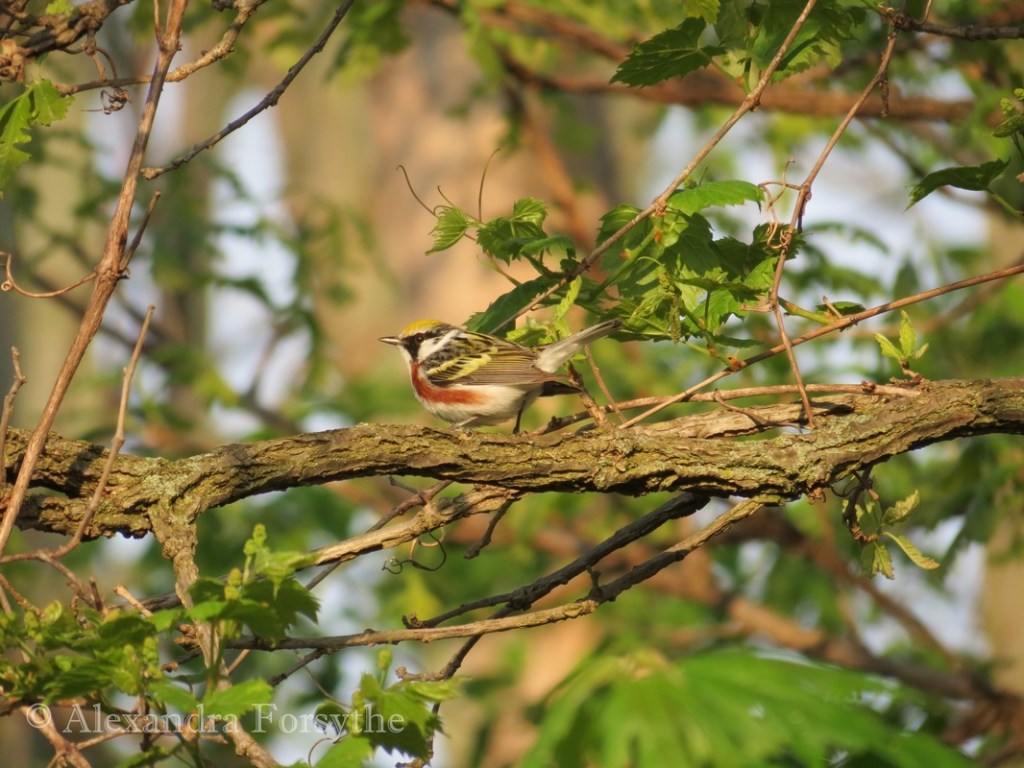
I love this photo, mostly because of the memories and emotions that accompany it. This little Chestnut-sided was one of the happiest birds I’ve encountered. It was early morning and I had just finished my chores. I decided to celebrate and reward myself with a quick walk around the yard before diving into my textbooks. The weather was perfect. The sun was shining brightly, and there was a slight breeze. I soon found that I was not the only one celebrating. In front of me, this warbler seemed to be dancing in celebration, not even stopping for a bite to eat. His bright eyes and happy demeanor brightened my day more than the sunshine. We celebrated together for a while, reveling in the perfect day. He made me smile from ear to ear then, and I still smile every time I look at his photo.
When gathering together photos to use for Alexandra’s Outreach (our series of programs for Amish, public and private schools at Limberlost State Historic Site), this was the first photo I chose. This little bird deserved to be admired for his wonderful attitude, and I hoped he would bring the students joy. He has. The children enjoy hearing about him and learning about the many ways he and our other feathered friends help us. After the program, most of the children want to learn more about the ways they can help birds and their habitats. I can think of no better tribute to the little bird that outshone the sun!
We are fortunate to see Chestnut-sided Warblers in Indiana. It is rumored that they were rarely seen during the lifetime of John James Audubon; people believe that Mr. Audubon only saw one once.
For your best chance of spotting the Chestnut-sided, look for them in overgrown shrubs and bushes at the edge of a woods. To determine when to start searching for them in your area, you can use this animated map that tracks the Chestnut-sided Warbler’s movements: http://ebird.org/content/ebird/occurrence/chestnut-sided-warbler/ You’ll note that their migration patterns differ in spring and fall. In the spring, they approach from Texas. When they head south, they travel further east, hugging the coastline into Florida.
The Chestnut-sided has other interesting behaviors, as well. They have two styles of song: accented-ending and nonaccented-ending. According to a study done by the University of Massachusetts (“Geographic variation of song form within and among Chestnut-sided Warbler populations”, Byers 1996) the type of song depends on the bird’s location and mated status. Accented-ending songs are used when the male is stationary, securely within his own territory or when interacting with females. The unaccented song is used when the bird is near the border of the territory, near other males, or when the bird is in motion. Of course, males singing only unaccented songs had difficulty attracting mates.
Additional interesting behaviors are displayed during courtship. In December of 1965, the Wilson Bulletin discussed the results of a research project that studied the courtship behavior and territorial defense of Chestnut-sided Warblers compared to that of Redstarts, Yellow Warblers and Black-throated Green Warblers (“Comparative ethology of the Chestnut-sided Warbler, Yellow Warbler and American Redstart”, Ficken 1965). There were several differences in behavior among the species, and the Chestnut-sided particularly stood out. While the other warblers had frequent territorial disputes, male Chestnut-sided Warblers were more friendly and sociable. They were observed feeding closely together – as little as ten feet apart – even while establishing territories in the spring. When a territorial dispute did occur, their actions were very different from those of the other warblers. While the other warblers had an intense, ritualized pattern of behavior involving circling, chasing, displaying and sleeked postures to chase away opponents, Chestnut-sided Warblers seemed to be more civilized. The male that was defending the territory rarely initiated a chase. Instead, the invader would realize he had trespassed and voluntarily fly away, while the original owner pursued the trespasser only to the spot where the invader had been perched. It’s as if the owner of the territory politely told the invader that he was sitting in his chair, the invader apologized and vacated the seat, and the owner simply reclaimed his chair.
I must say that the results of the study didn’t surprise me. Chestnut-sided Warblers always seem cheerful, so their civility even when defending their territory fits their happy-go-lucky attitude.
On your next perfect day, head outside and celebrate with a Chestnut-sided Warbler. You’ll be glad you did!
Gene Stratton-Porter’s parents, Mark and Mary, produced a large family of twelve children whose births spanned more than a score of years. Gene’s oldest sister, Catherine, was 24 years older than her. At the time of Gene’s birth on August 17, 1863, her father was 50 and her mother 46. Gene was a bit unexpected due to her parent’s ages and the previous child having been born over five years earlier.
The names of the twelve Stratton children, in the order of their birth, are: Catherine, Anastasia, Mary Ann, Louisa Jane, Jerome, Samira, Irvin, Florence, Leander, Lemon, Ada, and Geneva. Sadly, Mark Stratton outlived five of his offspring, and Mary outlived four, with two of them dying as children. Louisa Jane and Samira died when they were 9 and 6 respectively, one of scarlet fever and the other of whooping cough. Leander, or Laddie as he was known, drowned in the Wabash River when he was a young man of 19. The year 1872 was a bad one for the Stratton family; Mary Ann had just turned 32 when she died a few months before Leander did, as a result of injuries she had sustained in a railway accident a few years before. Anastasia died in 1883 at the age of 45 from cancer, after her mother’s death but before her father’s passing. Mark Stratton died in 1890. His wife had died 15 years before in 1875.
The other seven children outlived both of their parents. Their first-born, Catherine, married and eventually moved to California. She lived to be 88 years old and, coincidentally, died the same year as Gene, the youngest, who was killed in Los Angeles in 1924 in a streetcar and automobile collision. Jerome became a lawyer practicing in Fort Wayne and then Kansas, but he too made his way out to California to retire. Jerome died in California at the age of 82. Irvin followed in Jerome’s footsteps by becoming a lawyer in Fort Wayne, then also moving out to Kansas. He had gone to California in 1902 on business and also to consider moving there, when his buggy was hit by a Southern Pacific electric streetcar and he was killed at age 54. Railway and streetcar accidents seemed to be a curse of the Stratton family.
Although her father feared she would become an old maid, Florence married eventually and lived in Michigan for many years before moving to Fort Wayne. She died in 1940 at the age of 89. Lemon was “ornery” as a child and went from job to job as an adult. He had drinking problems (as did Jerome for a time) and was married three times. He died of a heart condition in 1916 at the age of 59. Ada married in Wabash, Indiana but eventually moved with her husband to California for a time before returning to Wabash. Like Florence she ended up in Fort Wayne where she died in 1950 at the age of 92, the last of the Stratton children to pass. From the death of the first child to the death of the last, over 99 years had passed.
Gene fictionalized and immortalized her parents, brothers, and sisters in her best-selling autobiographical novel Laddie, A True Blue Story published in 1913. It was made into a movie three times.
Gene Stratton-Porter developed many friendships with naturalists, writers, and artists. One such artist was that of Carl Arthur Faille (pronounced Fy). He credits Gene with launching his career as she was the first person of note to appreciate his large paintings. He said that Gene referred to him as “her painter man.” She noticed two of his large landscape paintings in an Indianapolis art store in 1916. They had been left there to be framed. She did not meet him at this time as he was painting that summer at Long’s Peak in Colorado. It is believed that she purchased one of his large mountain scenes at this time.
In the spring of 1916, the H. Lieber Company of Indianapolis had a painting in its gallery of C.A. Faille, which is how he signed his name professionally. The large canvas was of pine trees, mountain peaks and clouds.
C. A. Faille was a native of Detroit. He was born Charles Failles to French parents who had immigrated to Canada before coming to the United States. His father was Charles Failles (the son dropped the “s”). When he was a boy, the family moved to Indianapolis where his father owned the Charles Failles and Son Ostrich Feather Dye Works. It was the only one like it in the state. Carl had four sisters, two of whom remained in Indianapolis. He moved and lived between the east and west coasts with frequent visits to Indiana. He also roamed the Rocky Mountains to paint and be among the wildlife.In 1919, Gene commissioned her “painter man” to create a large painting entitled “Song of Cradle-Making” to illustrate the poem Constance Lindsay Skinner had dedicated to Gene. Sometime in late 1919 or early 1920, he created a sketch for Gene. She must have been pleased with it because a 32×60 canvas was created. On Sunday, March 14 1920, Gene came with friends to Laguna Beach where Carl was living. They came to celebrate the completion of the large painting on canvas that brought the poem “to life.” They had a luncheon on the beach. Gene was planning her first book based in California and collected many specimens of seaweed, shells and wild flowers to take with her.
Laguna Beach made an impression on Gene. She said, “Laguna is one of the most beautiful places she has ever seen and expressed a hope that the land along the front will be preserved for a park, not only for the present, but for the future generations.”
David Buchanan, with the Indiana State Museum, produced a black and white photograph from the museum’s collection. It is of the fireplace and mantel in Gene’s Rome City home. A little over half of the painting was showing but it was enough to establish that it was C.A. Faille’s painting. This confirms that Gene owned the painting and it once hung in her home.
The writer and poet Constance Lindsay Skinner won a literary award in 1913 for the “Song of Cradle-Making” which was about an Indian mother on the British Columbian coast as she weaves the cradle for the child that is coming. Constance was a native of British Columbia. Gene and Constance both had books published by Doubleday and Page. Gene admired her poetry and the two women became friends. In Gene’s book, “Michael O’Halloran,” she quoted a poem called “Song of the Search” by Constance. When Gene’s secretary, Lorene Miller married Frank Wallace, Constance wrote a “Wedding Song” for the occasion. Gene read the poem at their wedding which took place in her home at Wildflower Woods in 1915.
Carl was an artist who shared his knowledge of painting and wildlife with others. He taught young women to paint at a time when art was considered a “man’s profession.” Like Gene, he was a conservationist. Gene encouraged him to give wildlife talks. He became well known for his lectures. One was titled “The Reasoning Powers of Wild Animals” about saving wildlife.
The artist lived a full and interesting life of travel and artistry. He died in January 1956 in Newport Rhode Island and was buried in Wisconsin. He lived most of his life between California and the east coast. Carl was married Joanne Mutschmann who survived him.
The painting titled “Song of Cradle-Making” was sold sometime after Gene’s death in 1924. The meaning of the painting and the connection to Gene had been lost. When the painting was last sold it was titled simply “Indian maiden on shore.” The story behind the painting gives one pause to look closer and deeper. It would be nice if this painting one day made its way back to Indiana.
Writer’s Note: The first article on C.A, Faille was found on 1 Mar 2014. Seven months of research from NY to CA followed. Article completed 25 Sep 2014.
 Friends of the Limberlost