Ken wanted to be an ornithologist but his high school counselor talked him out of it. What kind of a career was that – looking at birds? Farming was a more practical and stable profession.
In the mid 1970s, Ken, an Ohio native, moved to what was once the edge of the old Limberlost swamp in Jay County and became a dairy farmer. In the spring of 1976, Ken watched his neighbors’ farms flood. As a boy, Ken enjoyed seeing fields with standing water because they seemed so “full of life.” Wetlands were fascinating to him.
Ken studied old maps and discovered his land was surrounded by the old Limberlost Swamp that Gene Stratton-Porter made famous in her novels and non-fiction books. Ken credits Gene with keeping Limberlost alive in the hearts and minds of people. Ken was inspired by her writings of over one-hundred years earlier.
The Limberlost was once 13,000 acres and was created by the glaciers. At the turn of the 20th century it was drained and tiled for agricultural and oil wells. By 1982, Ken thought that someone should put some of the farm land that floods every year back into wetlands. Within a couple years, he decided that he was the one to do it.
Ken continued to be a dairy farmer but with the help of his wife and kids began sowing native grasses and planting trees on his land. He soon began sharing what he was doing with his neighbors.
Fast forward to 1993, Ken with the help of a number of other people founded Limberlost Swamp Remembered. He went back to college to earn his degree and volunteered his time to make the wetlands a reality. He spoke with all 40 land owners to come up with a plan. This is where the Loblolly Marsh is today. His first fund raising was “selling” one foot of “swamp” for $10. The first land was purchased in 1996 and the Limberlost Swamp Remembered became a committee of the Friends of the Limberlost State Historic Site.
Early on he sought the advice of Jane Dustin, who was one of the founders of ACRES Land Trust. Jane told Ken to aim high with trying to restore part of the old Limberlost. She encouraged him to dream big.
The IDNR created the east central regional ecologist position for Ken. Ken loved creating wetlands and teaching the next generation about the cycles of life there. When Ken retired in December 2013, there were almost 1800 acres of restored wetlands around Geneva. He has also encouraged and helped Ben Hess who took Ken’s place as east central regional ecologist. Naturalist Curt Burnette called him “The Keeper of the Limberlost” and penned a poem in his honor at his retirement.
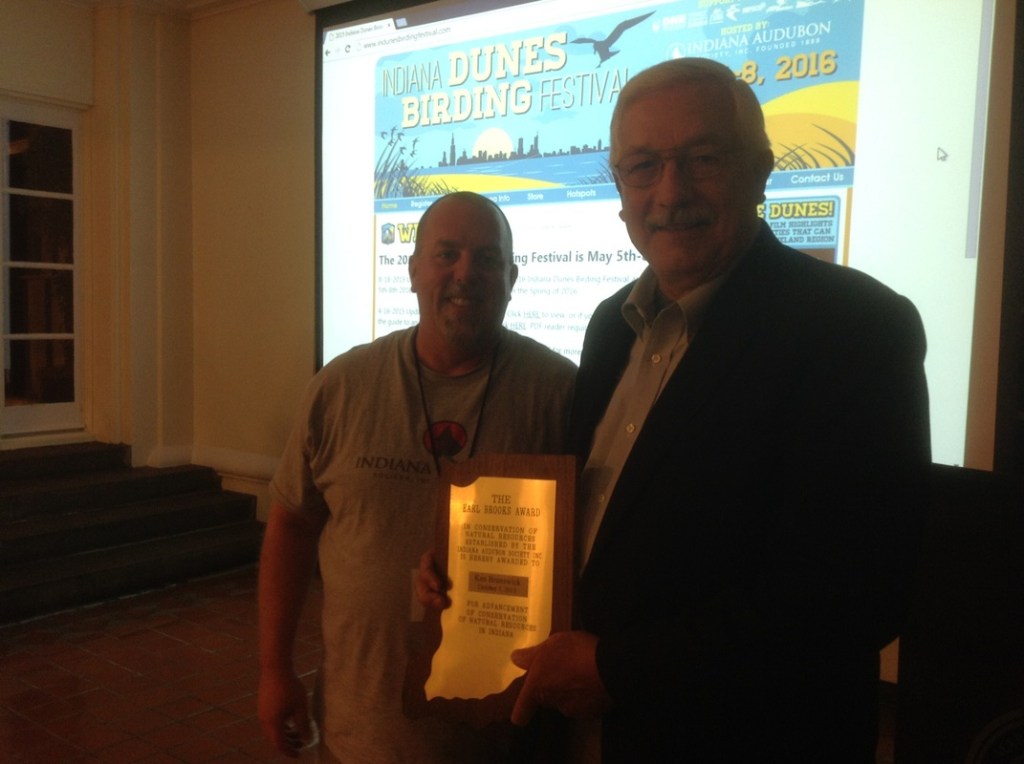
On October 3 2015, Ken was honored with the Earl Brooks Conservation Award by the Indiana Audubon Society. It was an award richly deserved.
Where is Ken today? He still lives on the farm facing the now restored wetlands of the Loblolly marsh (Ken had the honor of naming the preserves around Geneva). He is currently on the Friends of the Limberlost board and chair of the Limberlost Swamp Remembered. Like the cycles of life, Ken has come full circle.
Gene Stratton-Porter would be pleased to know that her Limberlost Lives Again!
The Annual Meeting of the Friends of the Limberlost was very well attended and guests were treated to a host of surprises! We saw the new building, heard about the new trails, received an official Project Legacy Seal, and even saw a large check in terms of amount and size! With so many fantastic events, only a few of the topics can be discussed here.
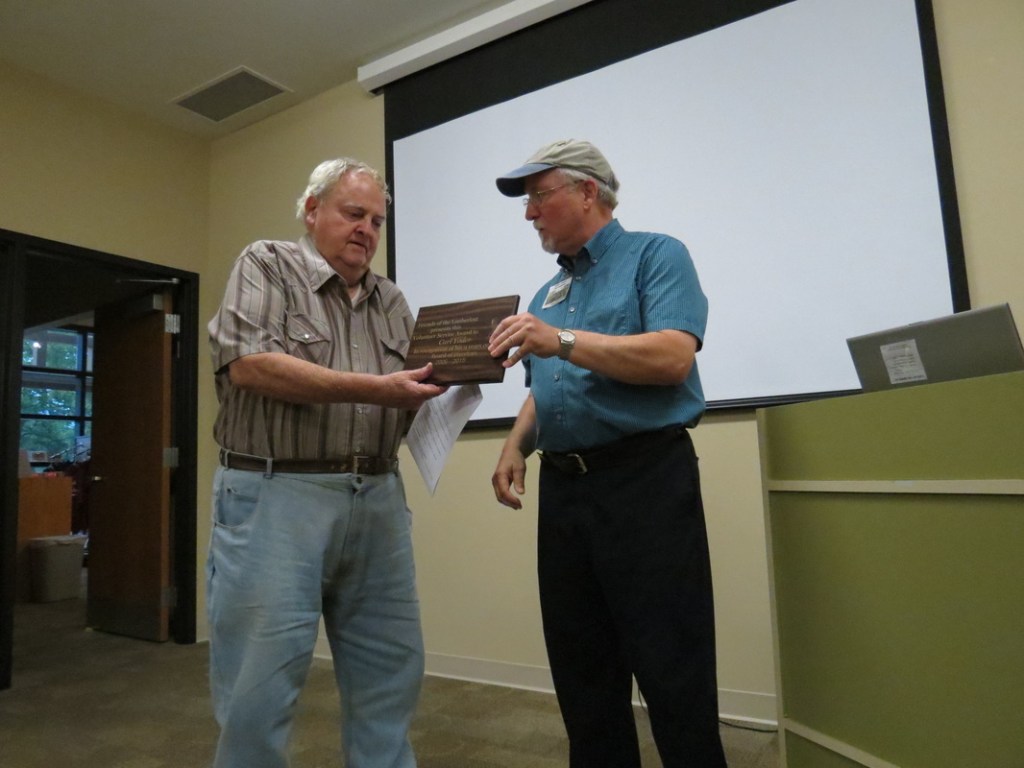
After visiting the new Maintenance Building and dining on a scrumptious meal courtesy of the Palmer House of Berne, the Friends held their Board Election. Carl Yoder was presented with the Limberlost Service Award for serving on the Board for the maximum allowable amount of time (9 years). With a mixture of new and familiar faces, the newly elected Board stands ready to take on the exciting challenges of the coming year.
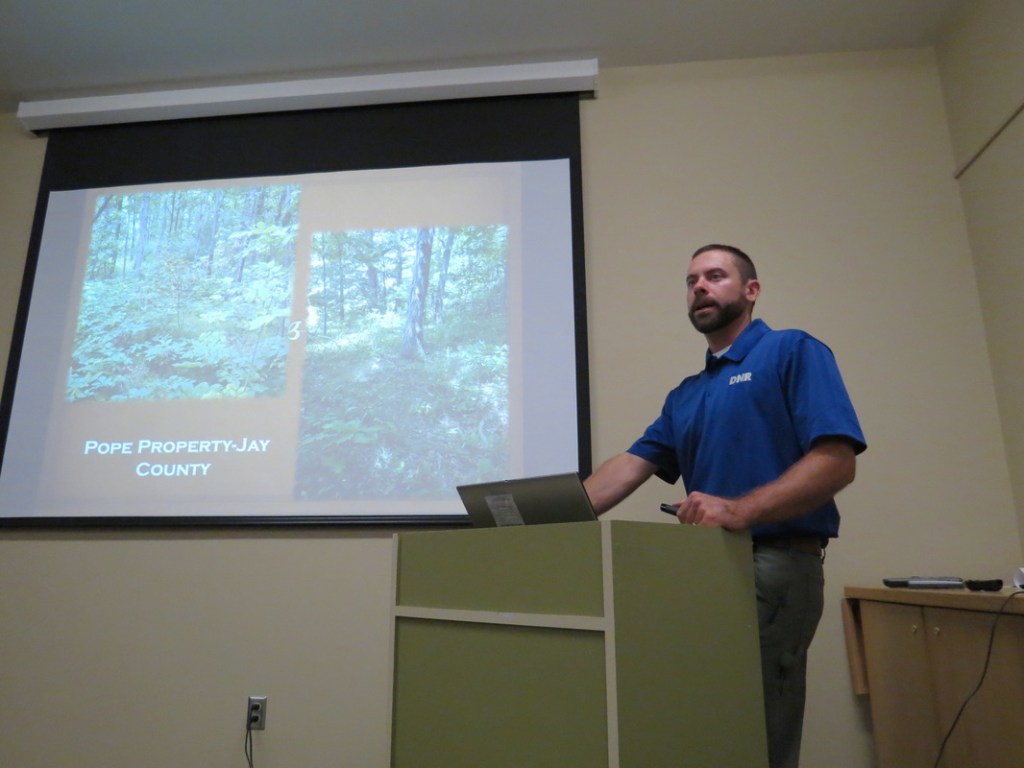
We heard from Ben Hess about the beautiful new trails that will allow visitors to see some of the most diverse habitats in the area, particularly in the Music of the Wild, Bird Sanctuary, and County Line Road areas. He has worked tirelessly to install the trails, the final touches of which were completed on Thursday. Do be sure to check them out! We also saw the new property boundary signs that will assist conservation officers in keeping hunters, horses, and other violators from inappropriate use of the property.
The Friends have become members of the Indiana Parks Alliance that offers grants, assistance with trail projects, and provides more widespread visibility. New benches have been installed for the comfort of visitors, and progress is being made to pursue the 39 acres around White Oak Cemetery. This area is unusual for many reasons, not the least of which is the presence of the rarely seen Firepink Shooting Star, a beautiful wildflower with five brilliant crimson petals that end in sharp notches.
Randy Lehman showered us in good news! Not including the volunteer hours on the DNR side of the park, we’ve had 1788 volunteer hours in 2014 and 1640 hours in 2015! The number of Facebook followers has risen by about 60% largely due to the efforts of Terri Gorney. Her interesting and timely posts have attracted the attention of about 300 new people in a very short period of time.
The attendance at Limberlost events has continued to grow. The three Jamborees brought 526 people to the site, 275 came for the egg hunt, 113 attended on July 4th, 85 came for the Christmas event, and 70 attended the Peregrine Falcon program. About 200 schoolchildren will be visiting in October, a large crowd is expected for the final leg of the Jay County 5K series which ends at Limberlost with an awards ceremony, and many people are expected at the Animalia creature feature sponsored by Bixler Insurance.
An historic 2.5 ton safe from the Bank of Geneva is on display in the Visitor’s Center. This ornate treasure has been a popular attraction! Another new attraction is in the works. A slice of the trunk from a very old Ash tree (attacked by Emerald Ash Borer) was spared from the wood chipper thanks to Randy’s quick thinking. He plans to label the growth rings to create a timeline of Gene’s life.
The website has continued to grow thanks to our webmasters: 16-year old Alexandra Forsythe and her 18-year old brother Scott Forsythe. Alex has been performing the day-to-day operations while Scott has been working on the Teacher’s Resources section.
Literary talent reigns supreme amongst the Friends! Curt Burnette, Bill Hubbard and Terri Gorney have all written books. Each has a different flavor, from hilarious anecdotes and outstanding photography to moving words from previously unknown naturalists. The books are available in the gift shop and would make the perfect Christmas presents to anyone with an appreciation of the natural world. Curt also has monthly column called “Limberlost Notebook” in the Berne Tri-Weekly Newspaper that are must reads.
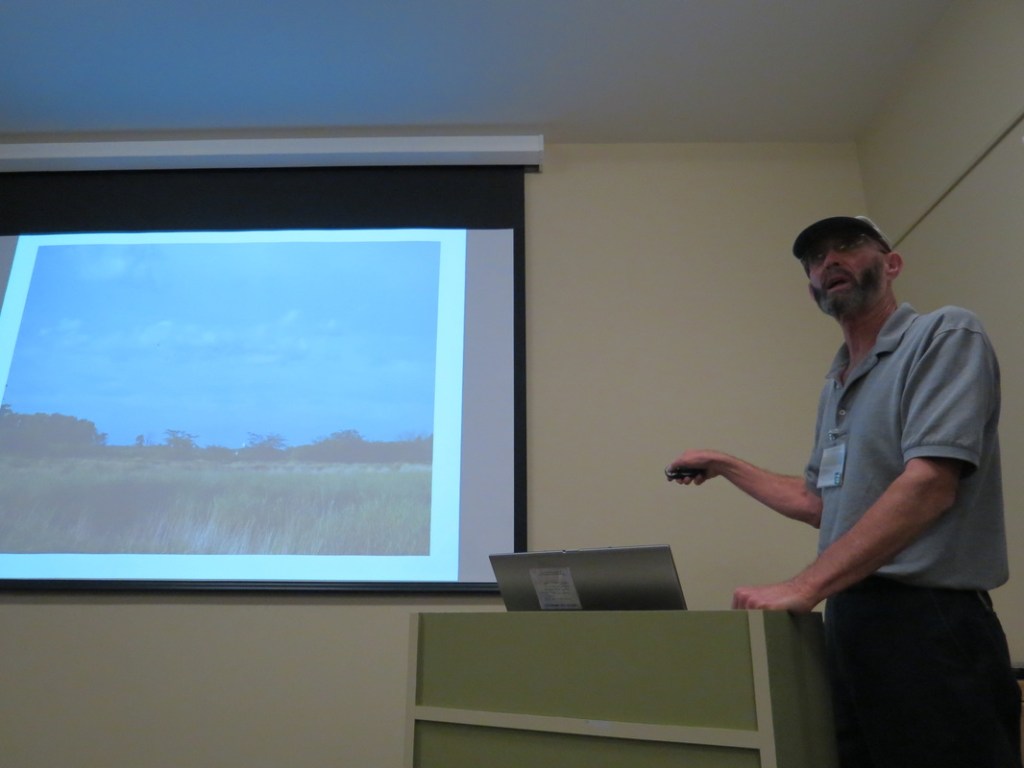
Curt gave the Friends a spectacular slide show of the “Little Known Limberlost”. Curt has ventured more deeply into the Limberlost than most of us dare, and he showed us his photos of the Heron Rookery, huge Sycamore trees with trunks so large you’d think they were Redwoods, minks with luxurious coats, and graceful Tundra Swans that number in the 70s. The final “Hidden Place” he shared was from the Indiana State Fair, where he spotted a veterinary science 4-H project by our own Alexandra Forsythe which had won the Grand Champion Sweepstakes for all age groups at the state level.
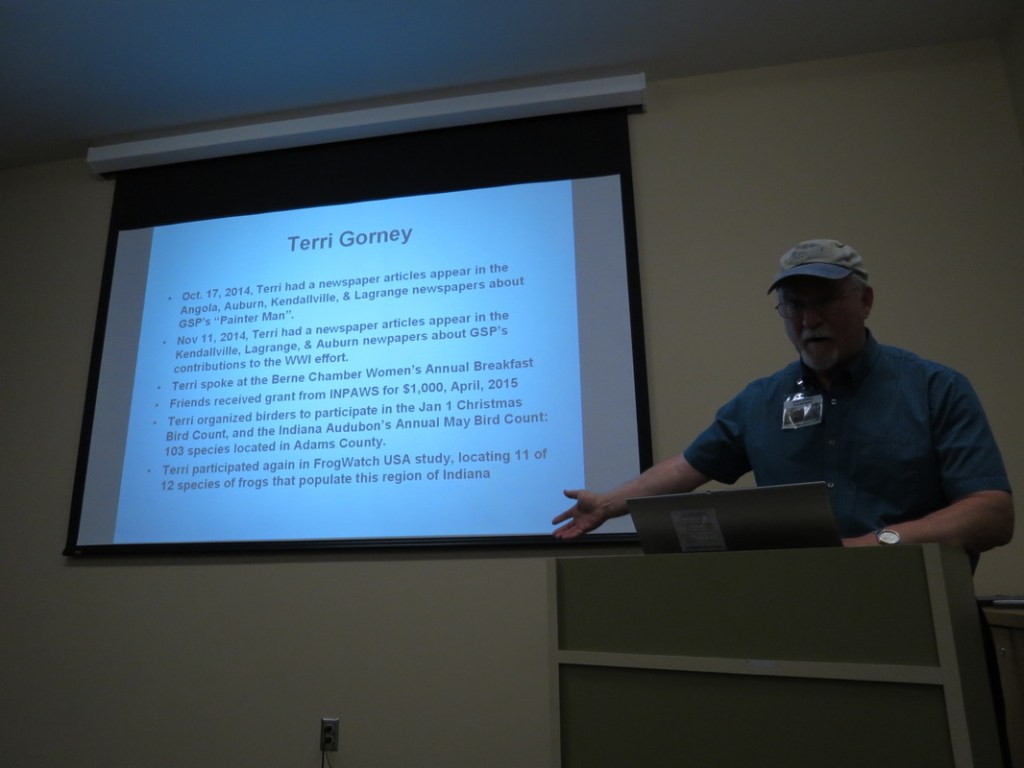
Terri Gorney has been as busy as ever this year! She received a $1,000.00 INPAWS grant for Limberlost for the planting of native plants. Grants are difficult to come by these days and competition is fierce, so the receipt of any grant money is testament to Terri’s hard work and her ability to convince organizations of Limberlost’s worthy causes. In addition, she has written numerous newspaper articles (including Angola, Auburn, Kendallville, Lagrange) about the area and its historic naturalists, she has spoken at the Berne Chamber Women’s Annual Breakfast, and she participated in the FrogWatch USA study during which she discovered 10 of the 11 species of frogs thriving in the area. It is unusual to find an area with so many frog species, and it’s a sign that the Limberlost ecosystems are healthy.
Terri has organized bird counts in Limberlost for the Audubon Christmas and May Day events (103 bird species seen in a matter of hours!) and she has kept a list of rare birds that visit the Limberlost. Many birds that disappeared for decades have recently returned to the area thanks to the restoration of the Limberlost. The Friends can take pride that due to their efforts, many of Gene’s favorite birds can now be seen here again, and they are attracting many new visitors to the area. Rarities such as the Yellow-headed Blackbird and Glossy Ibis brought birders in from far and wide.
Some of the most unexpected surprises came during Scott Forsythe’s presentation. Scott is developing an app for Android and Apple devices: Birding with Gene Stratton-Porter at Limberlost. The app will contain information about Limberlost, include maps and GPS directions, and a link to our Events page. All of the commonly seen birds will be included. For each bird, there will be a photo, description, season and location within Limberlost where you’re most likely to see the bird, and a quote from Gene Stratton-Porter herself about that particular bird or its habitat. “I wanted to honor Gene by creating an app that allows people to feel as if they are birding alongside Gene, with Gene herself describing the bird to them in her own poetic words.” The app should be ready in time for the bicentennial. At the end of his presentation, Scott gave a heartfelt thank you to his mentor Terri for her support, he thanked Randy, Curt, Bill and Ben for their help, and he thanked his sister Alex for her birding knowledge and photography.
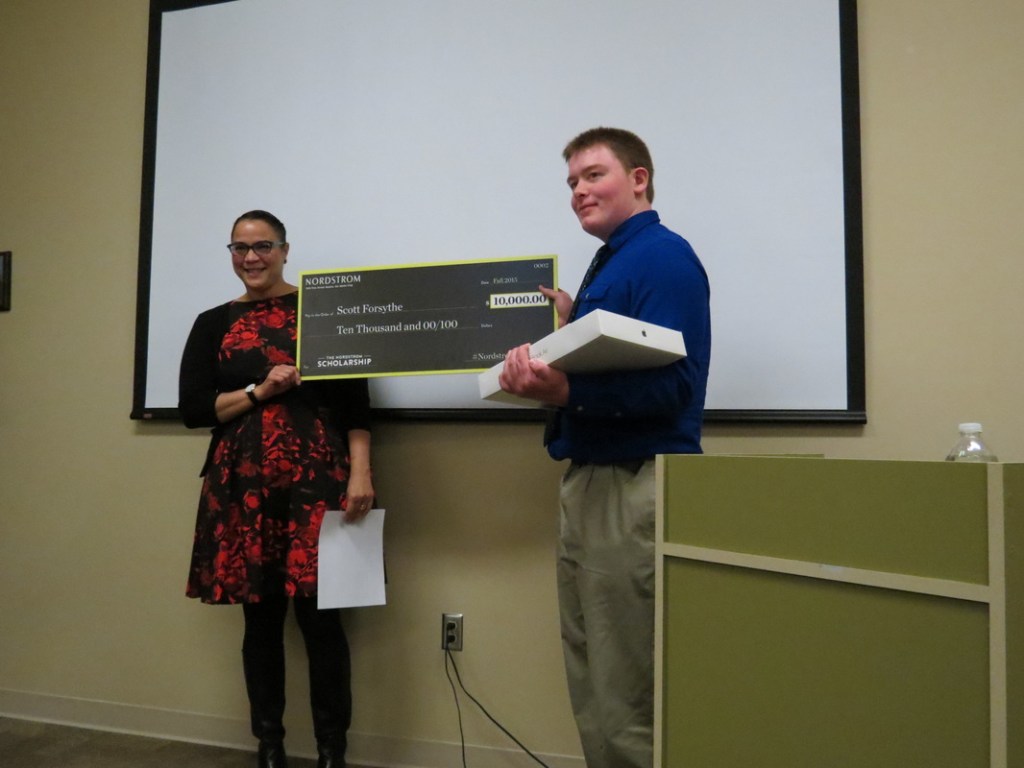
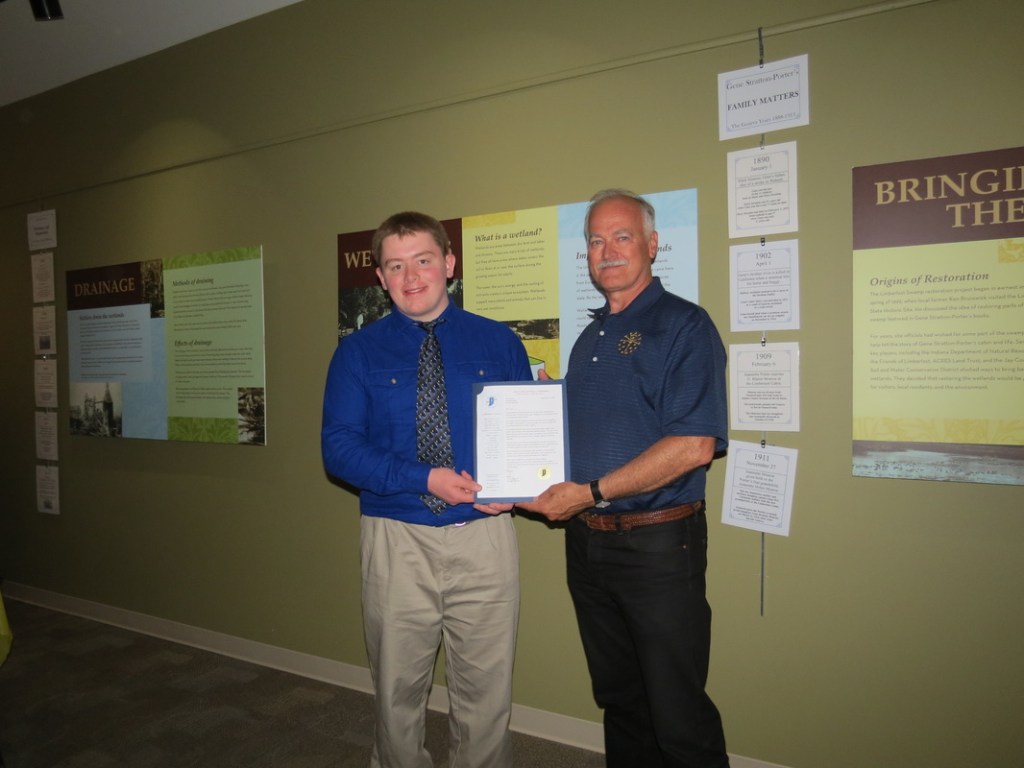
After Scott’s talk, Perry Hammock, executive director of the Indiana Bicentennial Commission, surprised Scott by presenting him with the Bicentennial Legacy Project Seal, indicating that the app has been approved as an official Bicentennial project. Seconds later, Natanja Tabb from Nordstrom presented Scott with a Macbook Air and a huge 3-foot scholarship check in the amount of $10,000.00! Thousands of students were considered for this national award, but the scholarship committee was impressed with Scott’s grades and test scores (top 2% in the nation), dedication to community service (in addition to his work with Limberlost and his volunteer work for other organizations, Scott runs a global nonprofit that benefits learning disabled children and annually hosts the only dyslexia conference in northeast Indiana). Scott will be entering college next fall and majoring in computer engineering.
Topping off a sweet evening were tasty cupcakes, courtesy of Nordstrom. It was a memorable night, full of excitement, surprises, and the promise of a fantastic coming year!
Last Mother’s Day, my mom had one request: find her a Scarlet Tanager close enough that she could see it. That’s a tall order! They are typically found high in the treetops in forest interiors, and we live in an area in which field corn is usually the tallest plant around! We drove to the next county and found not one, but four male Scarlet Tanagers and 2 females, all down low and easy to see and photograph! It was quite a memorable Mother’s Day! Since then we’ve managed to attract them to our yard. They dine from a mealworm feeder that I set out for Bluebirds. I’ve also noticed that when I take my mom with me on a birding hike, we now find Scarlet Tanagers more often than not. I think they know she loves them and they appreciate the attention!
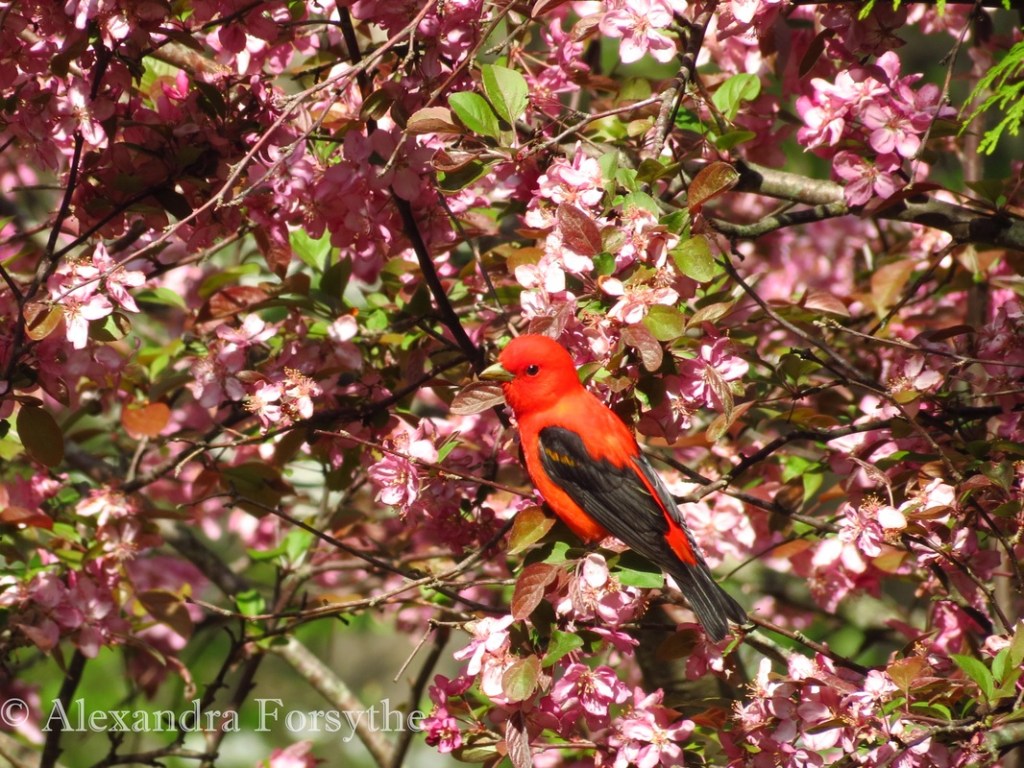
My mom loves the Scarlet Tanager primarily for its color. The male is a beautiful crimson with black wings and tail, while the female is equally gorgeous with a yellow-green body and dark wings. Both the male and female sing, but the female’s song is quieter and less harsh than the male’s song.
Gene Stratton-Porter loved Tanagers, too. She raised and released a Scarlet Tanager while she was writing “Friends in Feathers”, and she included the experience near the beginning of that book. The Tanager’s nest had been destroyed by a storm and the bird was in danger of either drowning or being trampled by cattle. She took the chick home and dutifully fed it every 15 minutes for ten days. Then she gradually and patiently taught the bird to be self-supporting. She released it in her orchard, feeding and watering it for a while after it fledged, then she slowly reduced the bird’s dependence on her. She was sad to see it go, but she knew it was the right thing to do.
The Cornell Lab of Ornithology conducted extensive studies on the Scarlet Tanager in the 1990’s resulting in a comprehensive report: “A Land Manager’s Guide to Improving Habitat for Scarlet Tanagers and other Forest-interior Birds”. It was Cornell’s first publication in a series of habitat management guidelines. From 1993 to 1996 over 1,000 volunteers studied Scarlet Tanagers at over 2,000 study sites across North America. At the time, it was one of the largest datasets ever collected on forest fragmentation and birds.
The study found that forest fragmentation negatively affected Scarlet Tanagers, but surprisingly the importance of forest-patch size and isolation of the patches depended largely on the region. In the Midwest, including Indiana, Tanagers are far more affected by fragmentation and require larger tracts of forest in order to survive. According to the study, “roughly 66 acres are required to achieve High Suitability [for Tanager habitat in the Midwest]. As the amount of forest in the surrounding block decreases, the minimum area required by tanagers increases sharply, roughly doubling for every 10% reduction in surrounding forest. Note that in sparsely forested landscapes, the minimum areas required for high and moderate suitability are sometimes impossible to achieve.” The study recommends protecting existing forests, reclaiming forest areas, and establishing forested corridors to reconnect isolated forest patches.
Another cause of concern is the Brown-headed Cowbird. If a Cowbird discovers a Tanager’s nest near the forest edge, it may lay its egg in the nest, securing the survival of its chick at the expense of the Tanager’s chick. Historically, the Brown-headed Cowbird followed the buffalo herds across the plains. As a nomadic species, it could not remain in one location long enough to build a nest and raise its brood. Instead, it was forced to rely on other bird species to raise its young, depositing its eggs in another bird’s nest in what is known as “brood parasitism”. The Cornell Tanager study points out that the expansion of the Cowbird’s range was and is caused solely by humans. With the destruction of the buffalo herds, introduction of cattle and ranches, deforestation of the land, and the ever-increasing agricultural lands, the Cowbirds moved into territories of birds that had no mechanisms for rejecting Cowbird eggs. In addition, the study found that many species require forested areas that are at least 330 feet from a a forest edge; the edge causes an increase in the rate of nest predation and parasitism. The larger the forest patch, the less likely it is for a Cowbird to find a Tanager nest.
Hopefully land owners will adopt the recommendations in Cornell’s study. With proper forest management, Scarlet Tanagers could be available on Mother’s Day for many years to come, making beautiful memories for moms like mine.
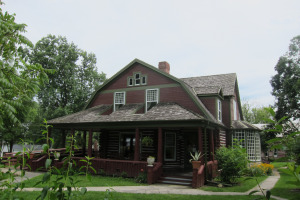
The Limberlost cabin has been a part of Geneva for 120 years but most are probably unaware of its beginnings. According to the “Geneva Herald” April 20 1894 issue, it reported that excavations were being made for the new residence of C.D. Porter. The article stated that the “two-story frame building of modern design and the estimated cost is over $8000.” Another article in the “Decatur Democrat” put the price of the home around $5,000 and with the price of the lots would have put the home at about $7,000. The home was begun around Charles and Gene’s 8th wedding anniversary.
Charles Porter took his wife Gene to the Chicago World’s Fair in 1893. The Forestry Building made a lasting impression on Gene. It inspired her to build a home in the rustic Queen Anne style built of Wisconsin red cedar logs.
The Porters chose a young and capable architect named William “Will” Christen of Decatur to design their home. At the time, Will had an office in Decatur over Peter Holthouse’s Clothing Store. Gene Stratton-Porter worked with Will on the design of the home. It would be the first of several homes that she would build.
In early 1895, Will moved with his wife Ada to Rockford Ohio. He built homes and business in that area. In his 40s, he served as mayor of that town. Besides the Limberlost cabin, Will’s second most noteable structure in Adams County is the two-story school built in 1913 for the town of Bobo. Today it is a private residence. In 1922, Will was the architect for the new high school in Rockford.
During Will’s long career, his buildings would make a lasting impression on the Melbourne Florida landscape. He was an architect and builder there for thirty years. In 1919, he created the new high school in the Neoclassical style. Today it known as the Henegar Center for the Arts. In the early 1920s, he was the architect for the Indialantic hotel and casino. A historic marker there bares the name of William Christen as the architect.
The masonry contractor for the cabin’s construction was awarded to John Schupp. John listed stone mason as his profession in the 1870s and 1880s when he was living in Decatur. It is possible that he created the stone fence around the cabin. A contractor of “fee simple” was Henry Fred Linn who was a carpenter by profession.
At this time, Geneva was prospering from oil money and the town was booming. Charles Porter was a well-respected man in the community. In an 1895 article in the “Geneva Herald” he was described as a man of “mature experience in financial matters.” He was co-owner of Porter and Deitsch, founder the Bank of Geneva, and he owned several properties in town as well as a 239 acre farm in Hartford Township that had oil wells on it. This home showed that Charles was a successful member of the community.
Gene and Charles were living in the cabin by February 1895. Charles wrote that the logs of the cabin were oiled. After the cabin was sold to their friends, Corwin and Chloe Price in 1920, the logs were painted as they remain today. Chloe Price would sell the cabin to the Limberlost Conservation Association December 31 1946 and donate it to the state.
We tip our hats to Will Christen, John Schupp and Henry Fred Linn who so long ago created the Limberlost cabin and to the Porters and the Corwins that loved the home.
Gene Stratton-Porter was a prolific writer who produced a large body of work. She wrote articles for several well respected magazines. She was encouraged to write her first book which was published in 1903 when she was forty. For the next twenty-one years, she never looked back. She would become the most widely read female Hoosier author.
Very little has been written about the books and authors that she read. We know that she was an avid reader and read fiction, non-fiction and enjoyed historical fiction. In some of her letters, she mentioned and discussed books that she had read.
In the spring of 1894, she co-founded a women’s literary society with Mary Beall. About a dozen of Gene’s female friends in Geneva belonged to this club. Each member took turns hosting the club in their homes. The literary society was first called the Wednesday Club then later that year it became the Saturday Club when the meeting day was moved to Saturday.
In 1919, the New York City’s “The Sun” newspaper carried an article which asked several well-known people what were their “best books of the past twelve months” Gene was one of those asked. The books she read demonstrate the depth of her interests.
Her three favorites were:
“The Education of Henry Adams” by Henry Adams. Henry was the grandson of John Quincy Adams and the great grandson of John and Abigail Adams. Henry served in the Congress during the Civil War. The book was published in 1918 after his death. It would win a Pulitzer Prize in 1919. This book would become a classic.
“The Great Hunger” by Johan Bojer. Johan was a Norwegian writer. The story is about a young man named Peer who is “hungry” for knowledge.
“A Russian Schoolboy” by Sergei Aksakov. This book was written in 1856 and was about his youth and Russian country life. As a child, he collected butterflies and liked to fish. Sergei was known for his prose and warmth of writing.
Gene’s three book picks of 1919 would be good reading. In today’s digital world, it is easy to download free copies of the books. I hope that you will consider reading one of these books.
My husband Tom and I are Indiana Master Naturalists who frequently volunteer at both Gene Stratton-Porter State Historic Sites. We recently traveled to northern Minnesota to attend the Wildlife Research Institute’s Black Bear Field Study Course. The course is led by Lynn Rogers, Ph.D. who is world-renowned for his trust based research. He is called the “Bearwalker” because of the many years that he has spent walking with the bears, observing and recording data for every aspect of their lives. The bears are so used to his presence that they completely ignore him as they go about their daily routines. Dr. Rogers is also known as the “Jane Goodall” of black bears based on their trust of him. He has been featured in full-length documentaries produced by the BBC, and by Animal Planet. Marlin Perkins did a segment with Dr. Rogers on “Wild Kingdom” many years ago.
The Wildlife Research Institute is located at a large cabin in a very remote forest near the Boundary Waters area. The nearest town is Ely, Minnesota. Course participants are immersed in black bears at the WRI site. They learn about vocalizations, body language, social organization, ecology and how people can better coexist with bears. They take field trips to visit and explore bear dens, are taught how to read bear signs in the forest, and how to analyze bear scat for the foods eaten.
Dr. Rogers has been studying black bears for over 40 years. His current research is centered around 28 year old matriarch Shadow’s clan. Black bear mothers share their territory with their daughters. Shadow and her female descendants have been studied in all aspects of their lives and relationships for over 10 years as the longest and most in-depth bear study ever done. People from all over the world have followed along via live web cams in dens, showing the birth and rearing of cubs. Many misconceptions about black bears have been disproved by the 24/7 coverage of the den cams, and by Dr. Roger’s research.
The black bears in Dr. Roger’s research are all named. One of the perks of participating in the field study course is the opportunity to help choose names for this year’s cubs born into Shadow’s clan. I asked if he would consider naming one of the female cubs “Geneva” in honor of Gene Stratton Porter. He had a lot of respect for her, and for all that she contributed to the knowledge of the natural world in her writings and her photography.
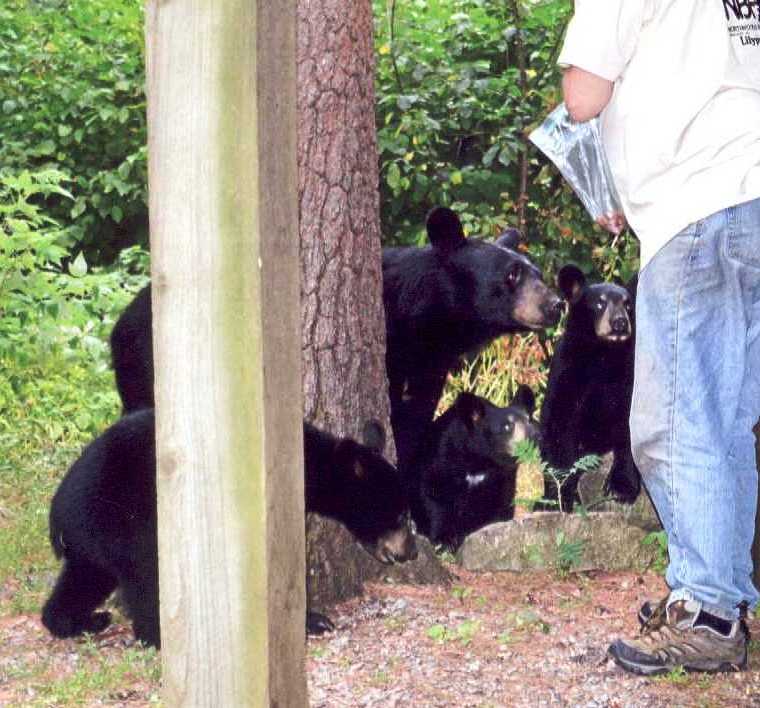
None of the research clan’s cubs had been named this year because they had not gotten close enough to determine their genders. The last morning of the field study course, Braveheart showed up at the WRI with her 3 cubs. It was the first time she had been seen this year. Her cubs got right up into the feeders at the observation windows, and the group quickly identified them as one female, and two males. The female had a moth shaped white blaze on her chest.
At breakfast, I asked Dr. Rogers if the female cub looked like “Geneva” to him. He said “Yes, she did”. I then asked if the name theme of Braveheart’s litter could be completed by naming her brothers “Stratton” and “Porter”. Dr. Rogers loved the idea. In his subsequent daily updates, he has informed the world of the cubs’ names, has explained the significance of the names and Gene Stratton-Porter’s great accomplishments a century ago.
I think that Gene Stratton Porter would have enjoyed coexisting with black bears had they lived in the Limberlost, and that she would have studied them diligently, and included them in her writings. Hopefully, she would appreciate having these three adorable cubs named in her honor.
Indiana is now proudly represented in the Northwoods by black bear cubs in the most extensive bear research program in the world. They are going to make people who follow the program aware of Indiana’s beloved Gene Stratton-Porter, and how much she contributed to the world of nature studies.
The term “Bucket List” is everywhere today. I have several. Recently, along with writer and friend Susan Braun, I was able to check a newly added site off my “Literary Places Bucket List.” I am late to discovering the joys of fellow Hoosier, Gene Stratton Porter’s writing. As I said before, her books were out-of-fashion when I was in school in the 1970s. Thanks to my reading from the Ambleside Online book lists though, I found a new go-to author. I’m pretty sure I will work my way thru all of her books. When I was in Indiana for the Ambleside Online “At Home” Retreat, I made a detour on my way home to visit the Limberlost site maintained by the State of Indiana. Mrs. Porter, her husband and daughter all lived her for a few years. After they moved out they allowed local teachers to live there rent-free.
The visitor’s center helped to make this a great “Charlotte Mason” outing for all ages. Inside were displays explaining the real cost of the “progress” that drained the Limberlost back in Mrs. Porter’s day and the efforts to restore the wetlands to their original state at least in part. This focus on nature, which of course extends into Mrs. Porter’s books and home, makes this an educational as well as fun trip.
The house itself is a log Queen Anne and as lovely a home as I’ve ever seen. The many, many personal touches made it instantly homey to any visitor. I, naturally, especially enjoyed the library, which is at the front of the house and has the big window where Mrs. Porter often sat to write. Though the typewriter shown is simply “of the period” and not her own, it gave me the feel of her working day. What a setting! Imagining looking out the window to the yard, with it’s local-stone fence designed to allow wildlife access–yes, access, and enjoy the warm sun on her shoulders as she wrote in the winter; it must have been a wonderful “office.” Note in the background the display cases for various artifacts collected by Gene and, not seen on another wall, the Native American artifacts collected by her husband, banker Charles Porter.
As I said though, it is the personal touches, that make this a true home. Here are a few of my favorites. This is the Porter’s bed in the master bedroom. It’s exactly the type bed I envision my own characters, Alva and Meg, sleeping in in my historical novel Meat, Potatoes and Pie: A Midwestern Love Story, albeit without the wonderful personalization. Gene had this bed made for the house and the owls were hand carved by a craftsman. Yet another homage to her life as a dedicated naturalist and lover of birds. I personally think owls are among the most fascinating birds, so I really liked this detail.
Above one fireplace is Gene’s Moth collection. In addition to being the “Bird Lady,” in Freckles, she was also quite a “Moth Lady” and naturalist, even publishing on the subject. The display case was created for the space and the glass, in an era when panes so large were still rare, must have been a major expense. The specimens are so fragile today that the case cannot be opened–the woosh of air it would cause would shatter the nearly century old dried insects. You can read her book, Moth’s of the Limberlost, here.
Trivia: Did you know Mrs. Porter’s name was really “Geneva?” Well, this house is in Geneva, Indiana!
It was a bright day so photographing the conservatory with just my phone was a challenge. This lovely room was, again, custom built for its purpose with drains in the floor and water available. Readers of Freckles may recall the moment when this room is featured in the story:
“The night was warm, and the Angel most beautiful and kind. A triple delirium of spirit, mind, and body seized upon him and developed a boldness all unnatural. He slightly parted the heavy curtains that separated the conservatory from the company and looked between. He almost stopped breathing. He had read of things like that, but he never had seen them.
The open space seemed to stretch through half a dozen rooms, all ablaze with lights, perfumed with flowers, and filled with elegantly dressed people. There were glimpses of polished floors, sparkling glass, and fine furnishings. From somewhere, the voice of his beloved Bird Woman arose and fell.
The Angel crowded beside him and was watching also.
“Doesn’t it look pretty?” she whispered.
“Do you suppose Heaven is any finer than that?” asked Freckles.
The Angel began to laugh.”
There were other treasures too– her ‘darkroom’, i.e. the bathroom, where she, like the “Bird Lady” developed the glass plates of her nature photographs. Then there were the stuffed birds and the photograph of them dressed up for a playtime tea party as Gene’s daughter once did to them. Currently the kitchen is not yet restored, but the separate “room” for the icebox is still there and just outside it, now for display only, is the hollow tree smokehouse from the Limberlost. The upstairs, which features a large gathering spot and the bedrooms that were later used by the teachers, is not decorated, but can be toured.
At the Visitor’s Center, in addition to the wetlands display, you can also see the safe and desk from Mr. Porter’s bank as well as buy copies of Gene’s books and books on local wildlife.
Trivia: Did you know Mrs. Porter wrote a book on “Birds of the Bible?”
These little ladies were created to represent some of Gene’s best loved characters. The dresses are hand made, hand embroidered. They were so lovely.
Our guide, author Curt Burnette, is himself a naturalist. You can purchase his book on the wetlands from the Friends of the Limberlost, who run the gift shop at the Visitor’s Center. Sorry, it is not available for Kindle, though we both encouraged him to do so! The Friends also have nature programs which in June featured a Wildlife Safari, a guided nature hike of the Limberlost Restoration and a night out watching Swifts–a local bird. Homeschool students will be interested, too, in their Early Native American Culture courses designed for homeschoolers. Their website has an excellent webliography of free resources on the natural history of the area. Finally, The Friends hold Bluegrass Jamborees that usually feature (all volunteer and all amateur) musicians playing blue grass, folk music, gospel and other types of music.
I hope you enjoyed this little tour of Gene Stratton Porter’s “South Cabin,” and the Limberlost area. Leave me a comment with Literary Journeys you have made.
Mrs. Porter’s nature books are available in many forms–print, kindle format, e-book. Her photography is included in several of her books, though not in all versions. Here are links to a few:
And, if you are interested in Nature Study, Natural History stories or Nature Journaling with your children, check out Amblesideonline’s great list of Natural History stories (see the topic in each year’s curriculum) or on nature journaling as Charlotte Mason intended it. (If your children are interested in nature, ecology or science, Ambleside. Please note: Some books recommended on Ambleside Online have copyright use restrictions–please be courteous and abide by them.
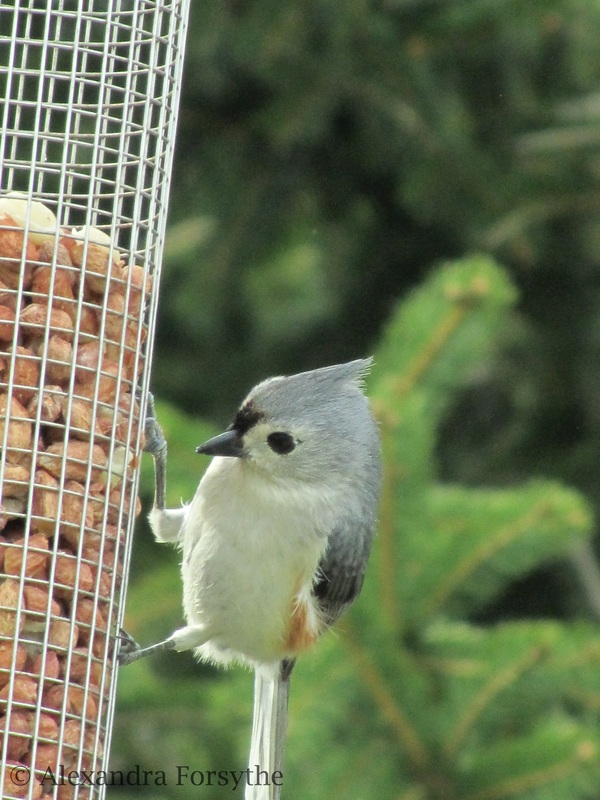
Often we can hear a bird before we see it, so knowing the calls a bird makes allows us to know what to look for in terms of color, shape and location. When birding in new territories, it helps to know if the birds have a different language or accent than the ones to which you are accustomed. The Tufted Titmouse is one of those birds that can sound very different depending on the region in which it is found.
Gene Stratton-Porter perfectly described the call of the Titmouse in the Limberlost area in “Homing with the Birds”: “Another extremely interesting small bird sometimes seen in the summer, but constantly with us in winter, is the titmouse. His soft, delicate plumage, his sharp crest, his bright eye, and his gaudy vest make him a beautiful creature, reminding me of the cedarbird in form. Clear and high, when food hunting around the Cabin and especially in spring, he calls: ‘Hewit, hewit!’ very seldom repeating the words more than once, each time making them clearly words, as I should speak them; at other times he drags his utterances. His song is high, clear, and beautifully musical in the winter woods, but so nearly like the wren’s in bubbling spontaneity that I again confess myself unable to put it into syllables or give it sympathetic description.”
Sibley’s website contains a variety of recordings of Tufted Titmouse calls, beginning with the typical “peter-peter-peter” call. In different states and regions, the Titmouse has a very different call, sometimes sounding like a revved up version of “peter-peter-peter”, other times sounding like the recording is being played at half speed, and other times sounding nothing like “peter-peter-peter” at all. Listen to the variety of the calls here: http://www.sibleyguides.com/bird-info/tufted-titmouse/the-under-appreciated-variation-of-tufted-titmouse-songs/
Adding to the confusion, in particular areas of Texas and Oklahoma there is an abundance of Tufted and Black-crested hybrids (“Current and Historical Extent of Phenotypic Variation in the Tufted and Black-crested Titmouse”, Curry and Patten, 2014). The hybrids have their own interesting calls.
Another interesting difference to watch for in Tufted Titmice is the black patch on the forehead. Scientists have discovered that the larger the forehead patch on a Tufted Titmouse, the more likely he is to be the dominant male (“The Forehead Patch of Tufted Titmice: A Possible Status Signal”, Moses and Ritchison, 2000).
The next time you see a Tufted Titmouse, take note of his unique call (or accent) and his forehead patch. Those two pieces of information might tell you more about that individual than you previously believed!
When Gene Stratton-Porter is discussed, she is usually mentioned as an author, a photographer, and a naturalist. The label “musician” is not generally ascribed to her, but a review of her life and works makes clear the appropriateness of adding this word to describe her.
We need look no further than at titles of her books such as The Song of the Cardinal and Music of the Wild to know that Gene perceived the world in musical terms. Music is featured in other ways in her works as well – for example, many songs are quoted in Laddie and the main character of Freckles is described as a fine singer. In The Girl of the Limberlost, the violin music Elnora creates is like the Limberlost itself. Says Elnora, “I can make it do the wind in the swamp, the birds, and the animals. I can make any sound I ever heard on it.”
Gene herself loved music and played the piano, banjo and violin. According to biographer Barbara Olenyik Morrow’s book Nature’s Storyteller: The Life of Gene Stratton-Porter, as a teenager Gene became interested in music of Schubert, Wagner, Liszt, and Mozart. She enjoyed concerts at the Chautauquas at Sylvan Lake in Indiana, and during her visit to the 1893 World’s Columbian Exposition in Chicago with husband Charles, she may have also attended musical performances.
In her Limberlost Cabin in Geneva, Indiana, there is a room dedicated to music, with ornate plaster work incorporating musical images decorating the walls. A photograph in that room shows the banjo that daughter Jeanette played, as well as the piano now located at Gene’s home called Wildflower Woods which is located on Sylvan Lake in northern Indiana and, like Limberlost Cabin, also an Indiana State Historic Site.
Being a musician myself, it will be with great pleasure and a sense of privilege that I return for the third time to perform music at Limberlost Cabin on August 1st as part of the Geneva’s Geneva event. Site Manager Randy Lehman has been instrumental (pun intended!) in providing me with this opportunity. Curt Burnette, the site’s naturalist, has kindly nicknamed me as Songstress of the Limberlost. I hope you will come visit me in the cabin to hear music of Gene’s time period – including pieces by Carrie Jacobs-Bond, a composer whose works she enjoyed. I’ll also perform some original compositions I’ve created over the years inspired by her life and work and premier new selections setting some of Gene’s poems to music.
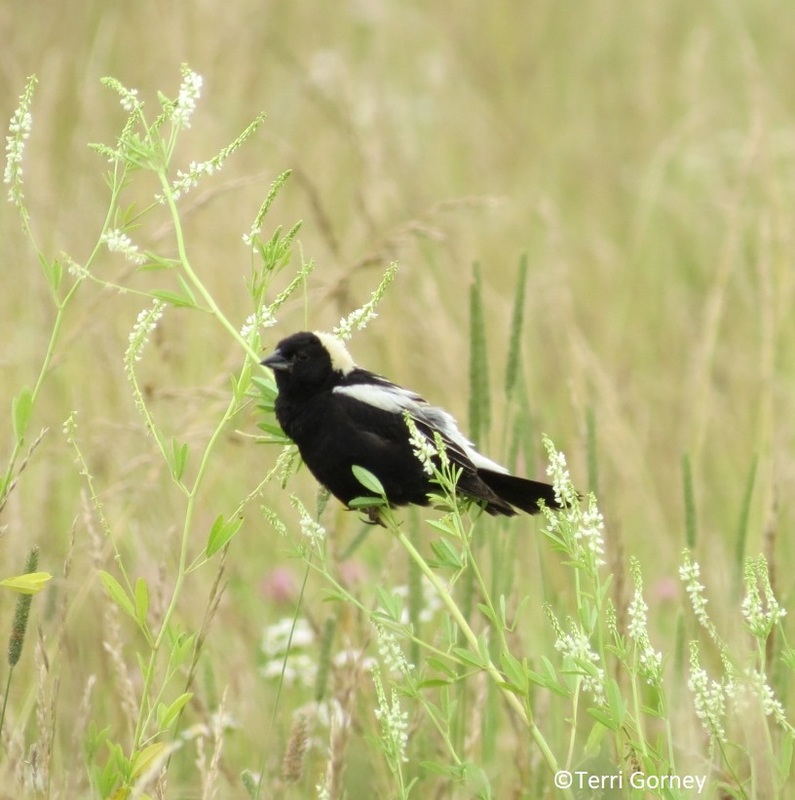
Gene Stratton-Porter commented that she enjoyed hearing a Bobolink every summer. “This veritable music box pours out his song, the whole of which is an interrupted run, interspersed with his call note and ravishing variations which run high and drop again in a sort of fantasy of irrepressible, spontaneous clearness.”
In May 1908, Gene was very pleased to show T. Gilbert Pearson the male Bobolink in his breeding plumage on the Stanley farm on the east side of Geneva. Gilbert would go on to lead the National Audubon Society.
The male is distinctive in his breeding plumage and perches on low vegetation while singing. He frequently sings in flight also. The Bobolink is black underneath and white on the back making him look like he is wearing a tuxedo backwards. After the breeding season, he returns to drab coloring, similar to the female, and remains that way until the following spring.
Bobolinks are a good bird to have around open fields as they eat mostly seeds from what are considered weeds at this time of year.
The Bobolinks like to nest in open fields of alfalfa, hay or clover. They are a ground nesting bird and the nests are made of grasses and are hard to locate as they are well hidden in vegetation cover. The female will leave the nest and run before flying. A female will typically lay 4-7 eggs. Their populations have been decreasing due to habitat destruction and a pair will raise only one brood a year. According to Don Gorney, a bird expert from Indianapolis, Bobolinks are a grassland specialist that are sensitive to habitat size. He estimates that they need a minimum of 50 acres to nest.
Ken Brunswick has seen as many as four males at one time at Limberlost this year. Ken’s boyhood recollections of it in the 1950s on his family farm in Ohio is “etched in his mind.” They nested in the hay fields on the family farm.
Jane Brooks Hine, a female ornithologist from DeKalb County, was given credit by the Indiana Academy of Sciences for the first sighting of a Bobolink in Noble County in 1883. By 1886 she writes that there was a pair nesting on her farm in northwest DeKalb County.
It is very gratifying to see these beautiful birds back at Limberlost. Gene Stratton-Porter would be very pleased to know that her singer has now chosen to nest and spend the summer season back at her beloved Limberlost. She enjoyed watching them nest in the summer. She commented that “the Bobolinks danced and chattered on stumps and fences, in an agony of suspense, when their nests were approached, crying pitifully if they were destroyed.”
After about a nine week stay in our area, Bobolinks typically congregate in marshes before the long journey back to their winter home in central South America. They usually migrate in large flocks which they will be doing shortly. May they have a safe journey and return to the Limberlost next spring!


 Friends of the Limberlost