Kindred Spirits: Gene Stratton-Porter and Constance Lindsay Skinner

By Terri Gorney

Gene Stratton-Porter met and became friends with fellow writers. She found a true kindred spirit in writer and poet Constance Lindsay Skinner. Constance was a British Columbia native. Constance, like Gene, loved the outdoors and nature and both were born in a rural setting. Constance was very much her own person, and loved to wear jewelry and to dress in bright colors.

Constance, like Gene, wrote poetry, novels, and non-fiction books. Later she evolved into a historian on pioneer life and wrote articles for newspapers. One of her novels “Good Morning, Rosamond” was adapted to a comedy that was performed at the Shubert Theatre in New York City. For a short time, she lived in California and in her later years in New York City where she became a U.S. citizen in 1935.

After reading Constance’s poetry in “Poetry” magazine, Gene wrote to Constance. She wrote, “in my estimation all of this work is wonderful.” She was especially fond of the poem “The Song of the Search,” and stated “in my estimation the finest piece of work of poetical quality that I ever have seen from the pen of any woman living or dead and at the present minute I recall nothing from the pen of any man which makes so strong appeal to me. This may be because from my life and work in the woods, I am peculiarly and particularly receptive of such work as yours, and it may be, and I think it is, because it is the finest thing of the mind I ever have read.” Gene asked for permission to use it in her next book. She wanted to help Constance’s career and “put the poem before millions.”

In her book “Michael O’Halloran” Gene quote “The Song of the Search.” Her character, Douglas Bruce, loved the poem and recited it. Constance’s maternal side, the Lindsays, have a long and famous Scottish pedigree which also may be why Gene gave the Douglas Bruce, one of the main characters, a Scottish surname.

Constance, like Gene, was an early environmentalist. She wrote many poems about nature and Native Americans. She wrote a poem called “The Song of Cradle-Making” about a Native American woman weaving a baby cradle for her child that is coming. She won a literary prize for it in 1913 and she dedicated the poem to Gene.

Gene commissioned Carl Arthur Faille, who painted under C.A. Faille, to bring Constance’s poem “Song of Cradle-Making” to “life.” In March 1920, he completed the painting. Carl said that Gene called him her “painter man.” He credits her with launching his career. He specialized in large nature landscapes. The painting hung in her Rome City home and later in one of her homes in California. It was sold after her death.

When Gene’s secretary, Lorene Miller, married Frank Wallace at Wildflower Woods, Constance wrote a special “Wedding Song” for the occasion. Gene read the poem at the wedding. The Fort Wayne “Journal-Gazette” wrote that “no setting could have been more appropriate for this exquisite song beginning.”

The poem began: “The pine trees shadow blessings.
The cedars drop odours.
Where love is the depth of the waters
And the light of the prairie’s smile.”

Constance and Gene shared a friendship until Gene’s accidental death at the age of 61 in Los Angeles in 1924. Constance died after a brief illness in New York City in 1939 at the age of 61. We will never know what more these two creative and engaging women would have accomplished had they been granted longer lives.

Writer’s Note: A special thank you to historian, and Constance’s biographer, Jean Barman for your generousity and support of my research. Thank you to Dave Reichlinger for editing suggestions.


Gene Stratton-Porter and the Great War

By Terri Gorney

One hundred years ago, the Great War began in Europe. Gene Stratton-Porter was a supporter of the war effort when America entered WWI. She purchased a $5000 Liberty bond from the Allen County Chapter of the Liberty Loan Club. Dr. Miles Porter, her brother-in-law, was chairman of the first aid committee for the Red Cross Chapter in Fort Wayne.

Under Indiana native Ernest Bicknell, the National Red Cross developed three committees: a National Relief Board, an International Relief Board, and a War Relief Board. According to the “Fort Wayne Sentinel” Gene was on one of the national committees. In 1935, Ernest wrote down his experiences in a book called “Pioneering With The Red Cross.” Before the war, the Red Cross had 17,000 members by the end of the war, there were 20 million members.

She watched while the men in her life were affected by the war. Her son-in-law, G. Blaine Monroe served as a dentist. Her nephew Donald Wilson served in the army aviation. Nephew Dr. Miles Porter Jr was according to Gene “a fine surgeon, who is to have charge of a base hospital near Paris.” He spent eighteen months in service. Another nephew, Dr. Charles Porter Beall, served as a doctor in France as did Dr. Corwin Price, a Geneva friend who would buy the Limberlost cabin in 1920.

Joyce Kilmer who wrote the “Tree” poem had corresponded with Gene. He was killed by a sniper in the war. In 1915, Kenyon Nicholson who became a playwright and screenwriter won Gene Stratton-Porter’s prize in literature while he was attending Wabash College in Crawfordsville. He served in France during the war. Gene’s own driver, William “Bill” Thompson, enlisted.

During the war years, Gene and her friends were knitting wool socks so that they could be sent to the troops overseas. Gene encouraged the average citizen to do what they could for the war effort whether it meant knitting socks or donating time, money or books.

There were book drives across the country to send books to American service men in Europe. There was a 1918 report from Kingston, New York newspaper about a copy of “Freckles” that was donated to the book drive. In it was the following inscription, “My mother gave me this book to send to those who read it keep courage like Freckles did. I have two cousins and one uncle at the front some place. I am only 10 years and you don’t know how I wish I was old enough to help you catch the Kaiser.” James G—Port Angeles, Washington.

In 1915, Queen Mary of Great Britain wrote to Gene to ask her permission to use her writings in a book that would be a collection of different popular writers of the day. The book was known as the “Queen’s Book” and was sold to benefit wounded soldiers and sailors (England was already in the war by this time). Unfortunately for Gene, in the end, it was decided to use short stories by English writers only.

Gene penned a poem called “Peter’s Flowers” that was hauntingly beautiful. It was first published on pages 3 and 4 of the April 1919 “Red Cross” magazine. It was illustrated by Thomas Fogarty. The story is about the World War I tradition that the first flower to spring from the soil of a battlefield is the red poppy. The poppy is a living sign that they will not be forgotten. Gene could have been inspired by the poem “In Flanders Fields” by Lt. Col. John McCrae.

At the time Gene’s poem was published, John Sanburn Phillips was the editor of the “Red Cross” magazine. With the war over, Gene sent him a cheery Christmas greetings by writing, “I think “Peter” would want me to wish you all the joys of peace for the coming Christmas and all the blessings of prosperity for the New Year.”

Gene was sensitive to the soldiers and veterans. Her book, “The Keeper of the Bees” was about an injured veteran of the war named Jamie MacFarlane who left a military hospital without proper discharge. She had it completed at the time of her death in December 1924. In a letter to her publisher, Nelson Doubleday, she wrote about a “Harvester type” character that she was developing. It is possible that she was referring to this book.

In 1921, the “Brooklyn (NY) Daily Eagle” carried an article about President Harding appointing a woman as a delegate to a disarmament conference. In the article, Gene insisted that one woman is not enough to be appointed by President Harding as delegate to the disarmament conference. She wanted an equal number of men and women. She wrote, “After twenty years of experience in business with men, I have lost my awe of a man as an infallible business proposition. I have yet to find the time or the place in which a big-hearted, well-educated, commonsense woman could not be of the very greatest assistance in any business proposition of any nature that any man or body or body of men might attempt.”

Limberlost Influences Artist

By Terri Gorney

Gene Stratton-Porter made the Limberlost Swamp famous in her novels. Gene’s writings influenced several generations of people from all walks of life in a number of countries. Because Gene paints Limberlost as a magical place, some even today believe that it was a place born of her imagination. Not so, the Limberlost Swamp was once 13,000 acres in Southern Adams County and Northern Jay County. Today, 1800 acres have been returned to wetlands.

Clarise Cliff, of Tunstall, England was ten years old when “A Girl of the Limberlost” was first published in 1909. She was inspired by Limberlost. Clarise would grow up and become one of the most influential and renowned ceramic artists of the 20th century. A ceramic pattern created in 1932 by Clarise would be called Limberlost.

Clarise had a similar background as Gene. She came from a large family that lived in a small village of Tunstall. She would have a productive career and marry a successful man who was a number of years older than herself.

The modern Jazz Age and the Art Deco style influenced her designs, but her Bizarre patterns and shapes were all from her own creativity. She called it Bizarre as she said, “because it is intended to surprise people.” In 1930 she stated, “Women today want continual change, they will have a color and plenty of it. Color seems to radiate happiness and the spirit of modern life and movement, and I cannot put too much of it into my designs to please women.”

The 1930s was a busy and creative time for Clarise. She loved nature and taking long walks in the woods. This was reflected in her art. Her landscape designs became some of her best known works of art and are very collectible today. In 1932 the pattern “Limberlost” was one of these landscape designs. It was a tree with tan foliage and white flowers, with a green plain background.

Clarice’s career as a ceramic designer was just beginning when Gene died in a car accident in California. Her mentor, Colley Shorter, was the owner of the pottery in which she worked. For over twenty years, she devoted herself to her career. In 1941, Colley and Clarise married. Today, there are Clarice Cliff Clubs in a number of countries and her pieces are considered works of art. A number of her pieces are in museums. In her lifetime, she created over 2000 patterns.

If you would like to learn more about Clarice Cliff, go to: http://www.ClariceCliff.com There are several good books about her life and her art. I enjoyed reading “Clarice Cliff: The Art of the Bizarre” by Leonard Griffin.

Emma Lindsay-Squier Meets Gene Stratton-Porter

By Terri Gorney

“I was to meet Gene Stratton-Porter and I was scared to death,” wrote young nature writer Emma Lindsay-Squier in 1922. Both women were native Hoosiers and living in California. According to Emma, “A New York editor had asked her to give me some advice concerning nature stories.” At the time of this meeting, Emma was a journalist for the Los Angeles Times and wrote a society column under her own byline.

Emma was born to Russell and Ada Squier in Marion Indiana in 1892. When she was a young woman, she read Gene’s books about the Limberlost and to Emma, Gene was “a wielder of high magic, a maker of big medicine.” Emma loved nature and began writing short stories on the subject. Before she was 13, she was writing a weekly newsletter in Terre Haute. Eventually the family moved to Salem Oregon, then Glendale California.

Gene thought it was splendid that she was writing about nature “because the [WWI] brought people closer to nature than ever before.” Gene told her tales of the Limberlost that Emma had not read. It was a place she loved to hunt flowers, mosses and birds. She was happy with the “companionship of the out-of-doors.”

At this meeting, Gene gave Emma a copy of her latest book, “The Fire Bird,” and autographed it: “For Emma Lindsay Squier from Gene Stratton-Porter. A high place in the mountains. Great magic. Many blue shells.”

In 1922, Gene wrote an eleven page introduction for Emma’s first book “Wild Heart.” Emma’s book came out to great reviews. “To anyone who knows the field and woods the book carries the conviction of truth.” Nineteen years after the Gene’s first book, “Song of the Cardinal,” came out Gene was a well respected author and naturalist. She was at a place in her life where young authors were asking her for advice and wisdom. Gene’s advice was to be humble and sincere in her writing. Gene told Emma, as she did her publisher, Nelson Doubleday, she felt that her best writings were still to come.

At the close of the interview, Gene told Emma that the Limberlost “belongs to me – and – I belong to it.” She would be forever linked to the Limberlost with her books. It was a place that she made famous.

Emma would have a second book published that year called “On Autumn Trails.” She would write a number of short stories and books. One of her short stories, “Glorious Buccaneer,” was produced as a Hollywood film.

She married John Bransby, a movie producer, who also did the photography for a couple of her books. In the 1930s, the couple moved from California to New York City. Emma she died at Saranac Lake of tuberculosis at the age of 48. John lived until 1998 and died at the age of 97.

Writer’s Note: Emma Lindsay Squier wrote about her meeting with Gene Stratton-Porter for the Los Angeles Times.

American Tree Sparrow

by Alexandra Forsythe

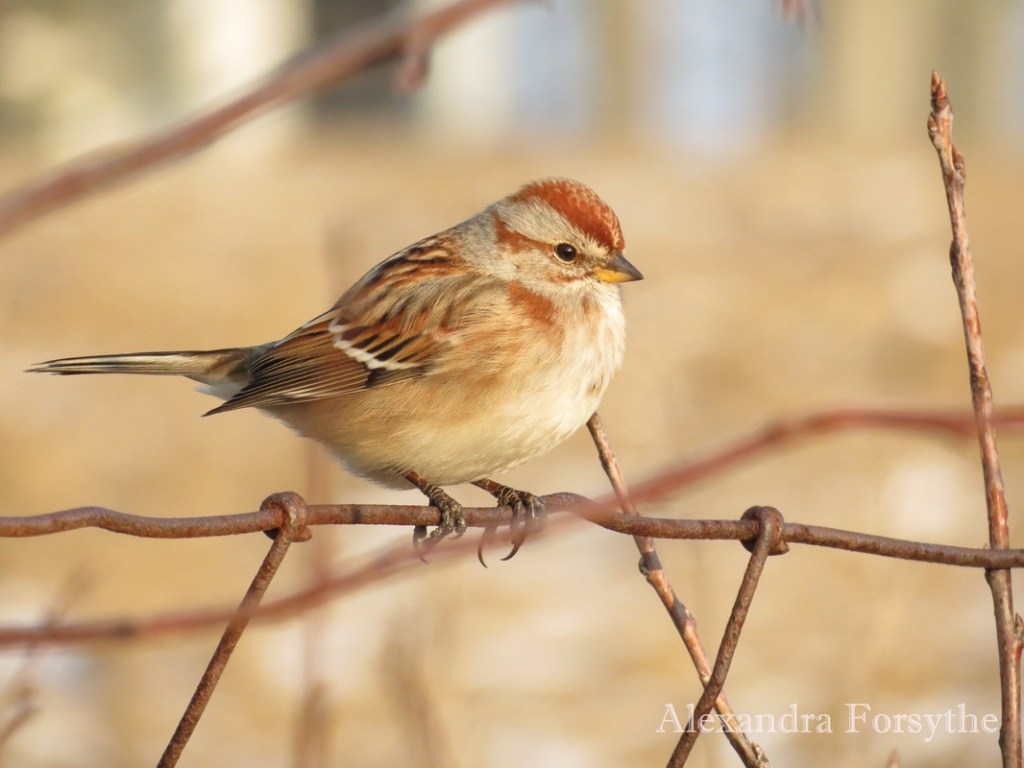
Are you right- or left-handed? Are you right-handed when you write, but left-handed when you perform other tasks? How about your vision? Are you right- or left-eyed? American Tree Sparrows have a preference when watching for predators: they use their left eye.

Researchers from the Department of Life Sciences at Indiana State University studied American Tree Sparrows to determine whether the birds preferred to use one eye over the other when watching for predators (“Laterality in avian vigilance: Do sparrows have a favorite eye?”, Franklin and Lima, 2001). Feeders were placed on the ground next to an obstruction, forcing the birds to choose which eye to orient away from the obstruction and toward predators. The Tree Sparrows typically turned so that their left eye was facing the predators. Interestingly, the Dark-eyed Juncos that were also included in this study used their right eye to watch for predators. Since these two species tend to forage together, favoring opposite eyes may be advantageous, allowing them to watch for danger from all sides.

In another study conducted by Indiana State University, the American Tree Sparrow was found to prefer shade over sunshine while feeding, even in the blustery winter months when the sunshine could warm them (“Wintering birds avoid warm sunshine: predation and the costs of foraging in sunlight”, Carr and Lima, 2014). Researchers placed food on a pad and controlled the amount of sunlight would reach each area of the pad. The scientists found that the birds preferred to eat in the shade, implying that the cold conditions of the shade were preferable to foraging in the sunlight where they would be more visible to predators. The birds also preferred to face south. The researchers believe this may be in response to the tendency of some predators to attack “out of the sun” to avoid detection.

In addition to being fascinating subjects for researchers, American Tree Sparrows have other interesting facts associated with them. For example, despite its name, the American Tree Sparrow spends very little time in trees, preferring instead to forage and nest on the ground or in brushy areas. Its coloration reminded European settlers of their Eurasian Tree Sparrow, and the name stuck. In the summer the American Tree Sparrow is an insectivore; in the winter it is an herbivore. Every day, it must eat about 30% of its body weight in food. If it fails to find that amount of food and water in a 24-hour period, it will likely die; going without enough food in just one day is a death sentence.

Marguerite Baumgartner studied the American Tree Sparrow extensively and contributed to the “Tree Sparrow” issue for the Smithsonian’s “Bent Life History” series. In addition to her detailed observations, she noted how much she admired these birds. She wrote: “Since the earliest days of nature lore in America, writers of the winter fields have thrilled to the cheerful warble of these hardy little visitors from the North. I shall never forget my first flock of tree sparrows, feeding companionably at the weedy border of the marsh, hanging on the weed tops like animated Christmas tree ornaments, dropping lightly to the ground and etching their delicate tracery of claw prints in the snow.”

Birding with Gene Stratton-Porter at Limberlost: a mobile app and interactive iBook

By Scott Forsythe

As all of you know, Gene Stratton-Porter was a naturalist, a scientist, a researcher, an author, and a champion of Limberlost Swamp and its flora and fauna. She dedicated her life to educating others about the importance of wetlands.

The Friends of the Limberlost have honored Gene in the most fantastic way – by restoring Gene’s Limberlost Swamp to its former glory. I wanted to help, too, by using my abilities and knowledge of technology. I approached Ms. Terri Gorney and asked whether Limberlost would be interested in a birding app (in the case of Apple, we ultimately decided on an iBook, rather than an app, for purposes of cost savings).

I chose to focus on birding because Gene loved birds and she hoped to inspire others to help her protect those birds. In “What I Have Done With Birds”, she made a solemn promise to the birds: “I shall try to win thousands to love and shield you.”

I also felt that an app and iBook would encourage more birders to visit Limberlost. According to the U.S. Fish and Wildlife Service, there are 47 million birders in the U.S. Annually, birders spend $41 billion in birding trips and equipment. Over 23% of Hoosiers spend an average of 122 days per year birding, making Indiana 8th in the nation for the number of days we spend birding. Limberlost is a birder’s paradise, with a wide variety of habitats and birds.

In addition, bird watching is an ideal way for teachers to introduce the natural world to their students. Many of Indiana’s Academic Standards are satisfied by the study of birds, from kindergarten through high school.

Thus, a birding app and iBook were born!

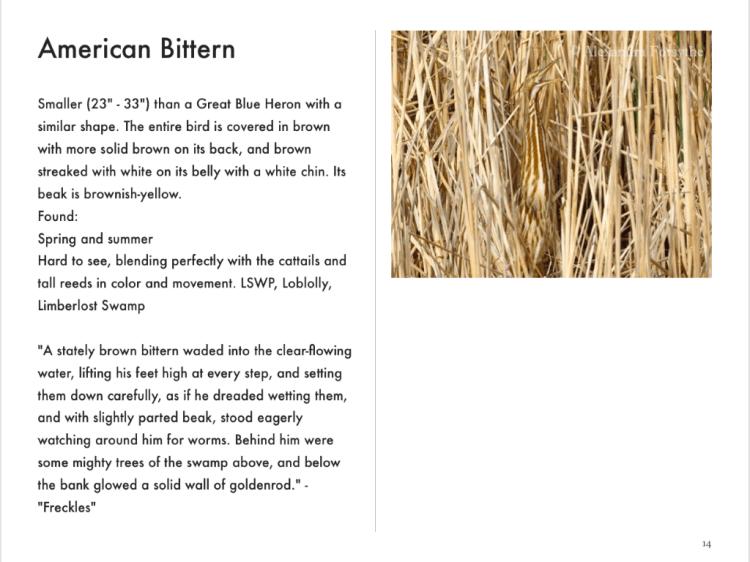
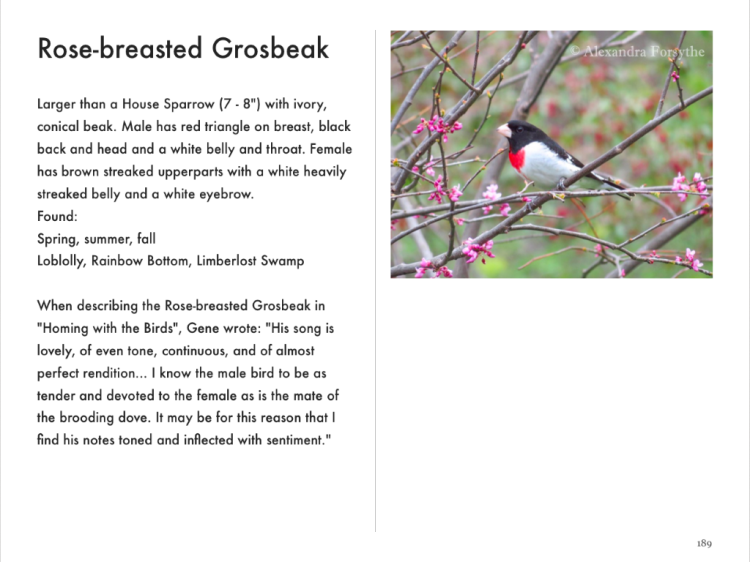
When designing the app and iBook, I wanted to include a description of Limberlost, a short biography about Gene, photos of the common Limberlost birds, a description of the birds, and where to find them. Most importantly, I wanted the reader to hear about each bird, learn more about the habitat, or discover a bit about Gene’s life from Gene herself.

Gene Stratton-Porter’s love of the plants and wildlife of Limberlost was reflected in her books. It seemed fitting to include her quotes regarding these birds and their habitats. These quotes were included on the pages of corresponding birds so that Gene herself can guide users through Limberlost and give her own personal account of each bird or the area.

There is also a link to the Events section of the website, a Contact section that allows people to email or call Limberlost straight out of the app or iBook, and a Maps section that contains an area map, trail maps, and a GPS option that will give you directions to Limberlost from your current location.

It has taken almost a year, but the project is finished! The mobile app is a free download from Google or Amazon. The 258-page interactive iBook is a free download from Apple. (links below)

One final note: I would not have been able to complete the project without the help of several people. My sister, Alexandra Forsythe, provided the bird descriptions and most of the photos. Additional photos were provided by Jim McCormac, Bill Hubbard, Randy Lehman, and Mike Linderman. Information about Limberlost was provided by Terri Gorney, Randy Lehman, Curt Burnette, Bill Hubbard, and Ben Hess. I am very grateful to all of these wonderfully talented people, and to everyone in the Friends, for their support!

Amazon: http://www.amazon.com/Scott-Forsythe-Engineering-Birding-with/dp/B017NYDTSK/ref=sr_1_1?ie=UTF8&qid=1453676699&sr=8-1&keywords=birding+with+gene+stratton-porter

Google: https://play.google.com/store/apps/details?id=com.scottaforsythe.scott.helloworld

Apple: https://itunes.apple.com/us/book/birding-gene-stratton-porter/id1078051558?ls=1&mt=13

Gene Stratton-Porter and the Izaak Walton League

By Terri Gorney

Gene Stratton-Porter was an environmentalist long before it was popular. She was a founding member of the Izaak Walton League of America. The League was established by 54 men in 1922. The League is still one of the oldest and most respected conservation organizations in the country. It is concerned with the conservation of soil, woods, air, waters and wildlife. Gene was in very good company. In 1923, League members included Zane Grey, Herbert Hoover, Gov. Pinchot of Pennsylvania, and Gov. Price of Minnesota. By 1928, the League had over 100,000 members.

This organization was named for Izaak Walton (1593-1683) an English writer and the father of fly fishing. It was begun in Chicago by a group of fisherman who wanted to make sure that future generations would have non-polluted waters in which to fish. Charles and Gene were avid fisherman. It was one of their favorite recreational activities. In the October 1923 issue of the League’s magazine “Outdoor America,” it contained five pages of Gene’s writing between its covers. Her first article was on fishing. It was titled “My Great Day.” She wrote about a fishing trip that she and Charles took to Indian River which is near the Straits of Mackinac, Michigan. She is so descriptive in her writings of the area that the reader feels like they are there with her “in the cool, clear air, perfumed with dank odors and the resin of pine.”

In this same issue, Gene wrote an open letter to President Calvin Coolidge. The letter was written in opposition to the drainage of the upper Mississippi River bottoms. It was a plea not to allow this to happen. She was sure that if the President examined the facts he would not allow this to happen.

In September 1928, Adams County had a memorial celebration to honor Gene Stratton-Porter who lived in the county from 1886 to 1913. A boulder, called “Elephant Rock,” was moved from the St. Mary’s River to the courthouse square and a plaque was attached as a tribute to Gene. She was so well thought of by the Izaak Walton League of America that the president of the national organization, Dr. Henry B. Ward of Champaign Ill, came to the memorial and spoke. His entire speech, along with his picture, ran in the Decatur Daily Democrat in the 11 September 1928 issue.

Dr. Ward told of Gene’s work in promoting careful study of bird and plant life and conservation of natural resources. He quotes Gene, “This world has never known a country equal to ours in size, having greater natural beauty of conformation, diversity of cenery and wealth of animal and plant life.” She was determined to save our natural resources and to “save every brook and stream and lake.” He stated that “No one has ever done more to promote widespread interest in nature study throughout our country.”

In 1961, Gene was elected posthumously to the Izaak Walton League Hall of Fame along with Aldo Leopold and Grace O. Beach. Gene and Grace were the first women so honored. To quote the Aug-Sep 1961 issue of “Outdoor America,” she received this award because she “was an advocate of the outdoor life and wrote many articles and several books, all inspired by her love of nature, wide open spaces and the wildlife that man abandoned when he began his quest for progress.”

At the time of her death in 1924, Gene was on the national stage in regards to environmental issues. If Gene’s voice had not been silenced at the age of 61, one wonders what else she would have accomplished if she had been granted another twenty years.

Writer’s Note: Thank you to Dawn Merritt, Director of Communications, and Leila Wiles, Librarian, of the Izaak Walton League of America for their help in my research.

Snow Bunting

By Alexandra Forsythe

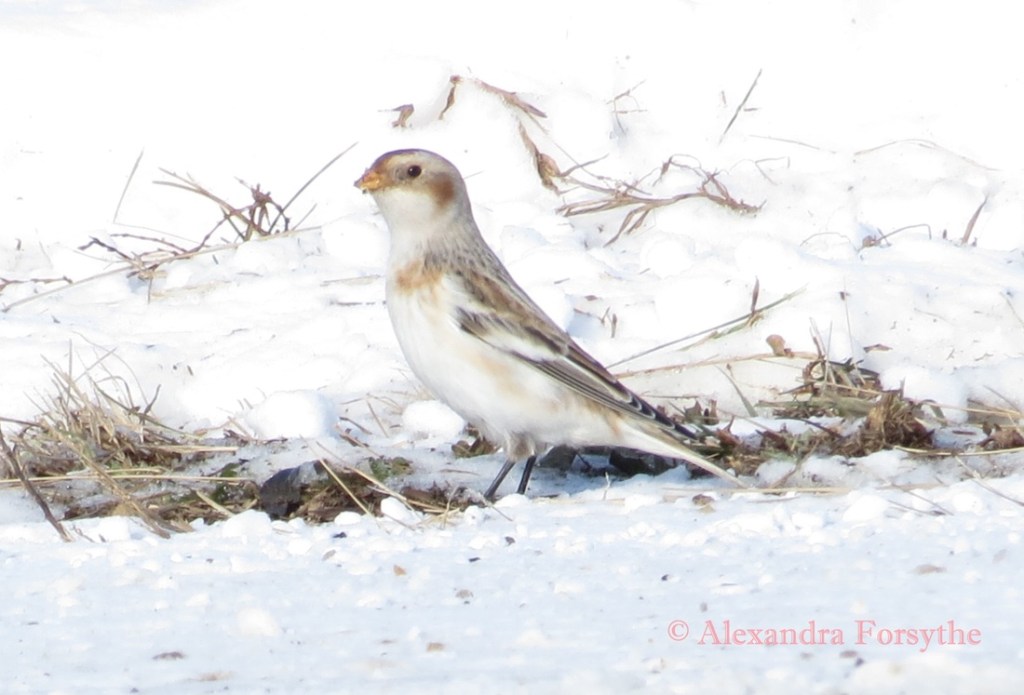
As I write this, it is 17 degrees Fahrenheit outside. The eggs that my chickens and ducks laid in their heated coops are near the freezing point. Can you imagine a songbird trying to incubate an egg in such frigid temperatures? Imagine no more! Meet the Snow Bunting! These tough birds will play and sing in temperatures of -22˚F, and they choose to raise their young above the Arctic Circle. Their cheerful song and demeanor despite such harsh conditions has earned the respect and admiration of generations of birders.

“In his far polar home,… the only sound that breaks the all-enveloping silence for months at a time, is the snow-bunting’s sweet vibrant song, happy and musical as the tinkle of the mountain brook. Along in August…, the snow-buntings don their warmer buff and brown plumage, and begin to assemble in considerable flocks on the grassier slopes for the journey southward. Quiet and still, as if sad to leave their northern home, they feed about the rocks, lingering even until November, when the night comes on, and the sun no longer shines even at noonday. Then the North is silent until they come again.” – The Wilson Bulletin (June 1919).

In winter, most birders look for the brightly-colored winter finches and elusive owls. However, there are several species of incredible birds that visit Indiana in winter that are often overlooked. The Snow Bunting is one of these winter birds. Its simple but elegant brown-and-white coloration makes it very difficult to spot in the snow-covered fields which they usually inhabit.

Snow Buntings are typically found in Indiana in winter. They breed in the northernmost parts of Canada and Alaska – further north than any other songbird! They are also one of only four bird species that has been spotted near the north pole (the other three are Black-legged Kittiwake, Northern Fulmar and Arctic Tern). The males will migrate north to establish their territories long before the females migrate. The females do not migrate until four to six weeks later. When the males reach their breeding grounds, the nighttime temperatures will still dip below -22˚ Fahrenheit! To help keep the clutch warm, the nest is built in deep crevices within rocks and they line the nest with fur and feathers.

The Snow Bunting only has one molt per year. They molt in late summer at which time they get the brown-and-white coloring we are accustomed to seeing in winter. Their beautiful black and white breeding plumage is hidden underneath the brown coloring. To achieve his striking breeding plumage, the male Snow Bunting will scrape the brown feather tips off by rubbing them on the snow. By the time breeding season begins he will have his immaculate black-and-white coloring.

During 2013-2014’s Christmas Bird Count, 1,948 Snow Buntings were reported in Indiana, with the bulk of them (1,745) found in the Pokagon State Park vicinity. Snow Buntings were the sixth most plentiful bird in Canada’s Christmas Bird Count the same year, with 101,541 individuals reported.

The cheery Snow Bunting has been loved by people for many years. Theodore Roosevelt wrote of the Snow Bunting:

“One bleak March day,…a flock of snow-buntings came…Every few moments one of them would mount into the air, hovering about with quivering wings and warbling a loud, merry song with some very sweet notes. They were a most welcome little group of guests, and we were sorry when, after loitering around a day or two, they disappeared toward their breeding haunts.”

To learn more about Snow Buntings, the banding and tracking efforts and other studies, check out the Canadian Snow Bunting Network on the web or Facebook via the Ruthven Park Bird Banding Station and Nature Blog.

The SANJO Christmas Bird Count hosted by Limberlost

By Terri Gorney

On January 1, Limberlost State Historic Site hosted a Christmas Bird Count (CBC). It was a great way to start the New Year and one that would sure have pleased Gene Stratton-Porter. This is the oldest citizen science program in the world. The data collected will become part of a national database that helps provide data on bird population trends. This was the 116th National Audubon CBC and the first time that the Limberlost area was part of a national count. Twenty-eight birders, some first timers and some old hands helped with the count.

This was formerly the Adams County CBC that was begun in the 1970s. It was a county count that was turned into the Indiana Audubon Society. There were five of the original counters who participated, they were: Larry Parker, Janet Parker, Earlene Moser, Dorothy Moser, and Elaine Bluhm.

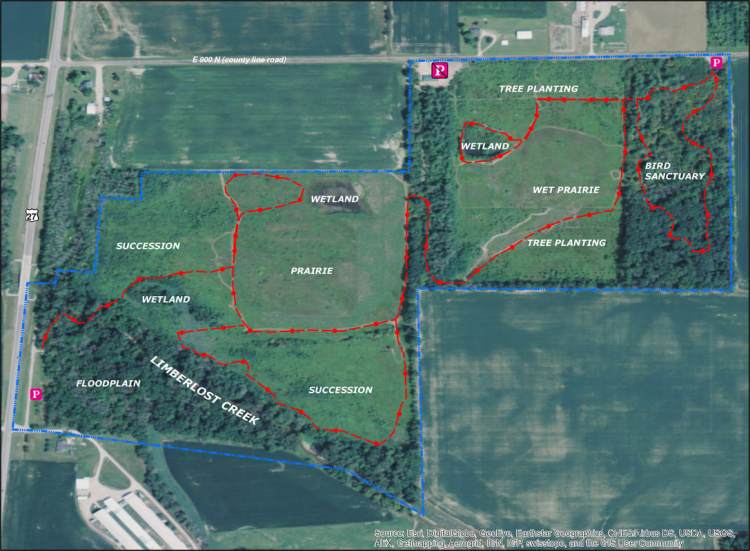
The National Audubon Society requires that a circular area with a diameter of 15 miles be surveyed. The new CBC is called SANJO and was named by Site Manager Randy Lehman. SANJO stands for “S”outhern “A”dams County, “N”orthern “J”ay County, and “O”uabache State Park. The new circle includes the Loblolly Marsh, Limberlost Swamp Wetland Preserve, Ouabache State Park, Munro Nature Preserve, a lot of the Wabash River in Adams and Wells Counties, Limberlost Creek, Loblolly Creek, Music of the Wild Nature Preserve, the Limberlost Bird Sanctuary, Rainbow Bottom, Rainbow Lake, Lake of the Woods, the old stone quarry, the old gravel pit, Fields Memorial Park and many Amish farms.

Participants came from Fort Wayne to Indianapolis to Marion to help with the count. The Mississinewa, Stockbridge, Robert Cooper and Amos Butler Audubon Chapters were represented along with the Indiana Audubon Society and the Limberlost staff.

With the unseasonable warm temperatures in December, we had some unusual birds that are not normally in Northeast Indiana in the winter. Becca James found four killdeer, Don Gorney located a woodcock at the Loblolly Marsh. There was a single cedar waxwing and a flock of robins in Geneva. This year there is a flock of about 400 Sandhill Cranes in and around the Limberlost Swamp Wetland Preserve. With the waters open, there were herring gulls, ring-billed gulls, a pied-billed grebe, a hooded merganser and northern pintail ducks that were seen. Our winter birds were also counted: dark-eyed junco, northern harriers, horned larks and Lapland longspurs.

A tradition with many CBC is a chili lunch. Limberlost hosted the chili luncheon. Many of the Mississinewa counters brought covered dishes, including the great ham sliders by Cheryl Bell and the wonderful owl cupcakes by April Raver.

A special nod to Don Gorney who tallied an incredible 313 species of birds in Indiana in 2015 and began his 2016 list at Limberlost. Alexandra Forsythe, who was the first Indiana Young Birder of the Year in 2013, participated and is a shining example of the next generation of birders. Thank you to all that participated from ages 16-89; each of your efforts made a difference.

Pine Siskin

by Alexandra Forsythe

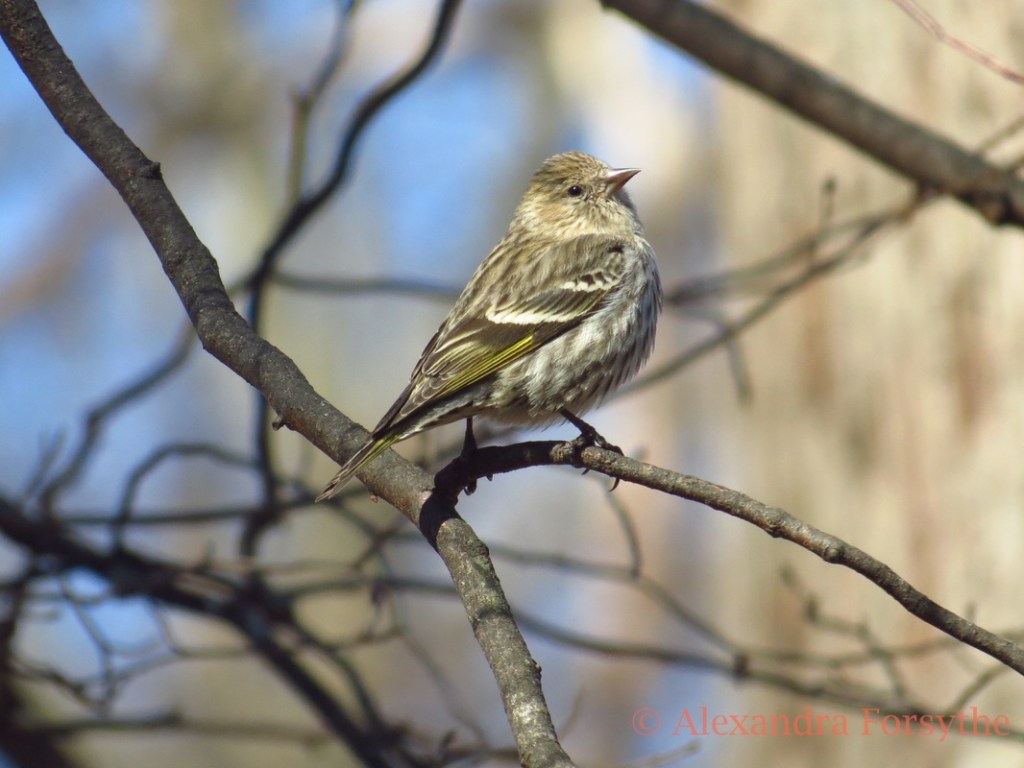
This finch dressed like a sparrow can be seen in abundance one year, then rarely the next. The migration patterns are variable. During irruption years Pine Siskins travel further south and east in the winter in search of food. Normally seen in the northern states, some irruption years have resulted in large flocks of Siskins in places as far south as Louisiana, Alabama and Florida. In the winter of 2007-8 there were Pine Siskins reported at only 24% of the Project FeederWatch Sites. The following year was an irruption year, with 50% of the Project FeederWatch sites reporting flocks of Pine Siskins. Their movements are variable, with some migrating from northeast to northwest, while others migrate from north to south. A Siskin banded in Pennsylvania was later recaptured in Washington, while another bird banded in Texas was recaptured in Minnesota. They migrate in flocks of a half dozen to hundreds, often stopping at nyjer feeders along the way to dine alongside goldfinches.

They consume a variety of insect and weed pests, including aphids, scale insects, and thistle. As the flock forages through the trees, parts of the flock “leapfrog” over one another. “Often when feeding, there are no birds in flight; at other times part of the flock may take wing and pass over those still feeding to other food trees. As the birds thus go “leapfrogging”, the entire mass of the flock of busy, lisping birds appears to flow through the forest. Then all of a sudden the lisping ceases and the flock is silent; it takes flight with a very audible whirring of wings and flies rapidly away” – A. C. Bent, “Life Histories of Familiar North American Birds”.

The courtship is a sweet combination of a song and a dance on the wing. Louise de Kiriline Lawrence, naturalist and frequent contributor to National Audubon Society’s magazine “Audubon”, described the courtship beautifully: “With a beam of sunshine illuminating his golden flashes, the male rose into the air with tail spread wide and wings in a blur of rapid motion. To the accompaniment of a flight song which seemed to express far more musical adoration than could be contained in so small a body, he described circle after circle around his chosen mate. That the female reflected none of her partner’s emotion in no way seemed to dampen his ardor and, after he dropped on to a twig from pure exhaustion to catch his breath, a few moments later he rose again in a repeat performance no less ecstatic than the first… In the midst of all this sweet singing, two birds swing into the air in an extensive ‘cloud chase,’ their movements tightly synchronized as they alternate in the roles of pursuer and pursued… The female sat on a twig. Presently the male alighted on the same twig, hopped up to her and offered her a small particle, of what I could not see. She crouched and, with trembling wings, accepted the offering.”

Siskins are often thought to be rather tame. E. R. Davis studied the Siskins in 1926 and wrote: “In a short time the birds came to regard me as their friend, and in the days that followed grew to be exceedingly sociable and to lose every vestige of fear. Whenever I would appear at the window, or step outside the door, down they would come and, settling upon my head, shoulders, and arms, would peer anxiously about for the food that they had learned to know I held concealed from them in a box, dish, or other receptacle.”

Pine Siskins may be tame, but they are also tough. They can withstand temperatures down to -94˚ (that’s 94 degrees below zero!) by increasing their metabolic rate up to five times their normal rate for several hours! They also put on large fat deposits to help insulate themselves, and they store 10% of their body weight in seeds inside their crop to sustain them for up to 6 hours in subzero nighttime temperatures.