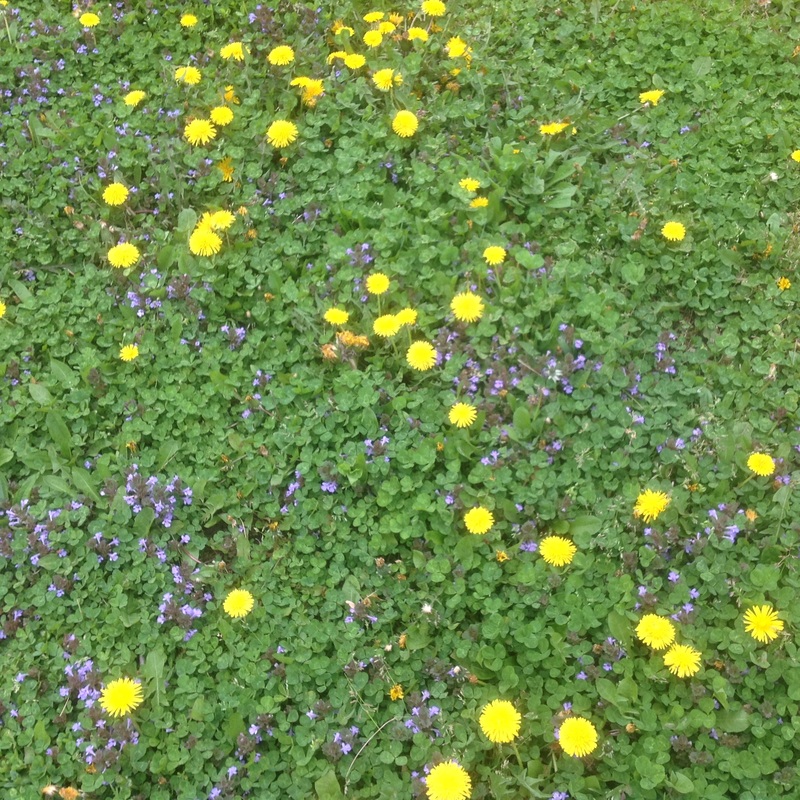
If the little yellow flower were imported and cost us $5 a plant, we would all be growing it in pots and exhibiting it as something rare and beautiful. But because it grows in field and wood and is the universal flower of the soil, few people bother about it or take the trouble to notice how pretty it is. It is useful too, for the roots are a fine blood purifier and the wine of our grandmothers is justly famous. Properly cooked, there is nothing better to eat than the leaves, and honey gathered from the flowers is delicious.
The leaves gave it its name. They are long and slender with a lovely rich green color and ragged edges which have reminded scientists of the tooth of a lion- dent de lion – or lion’s tooth. The bloom is a flat round disk of gold, thickly petaled and lightly dusted with pollen. After a day or two of bloom the disk folds up for the seed to ripen, and in a few days lifts itself again, except that this time it is a ball of misty white. It stands only for a little, while before the wind harvests the seed and scatters them to the four corners of the earth.
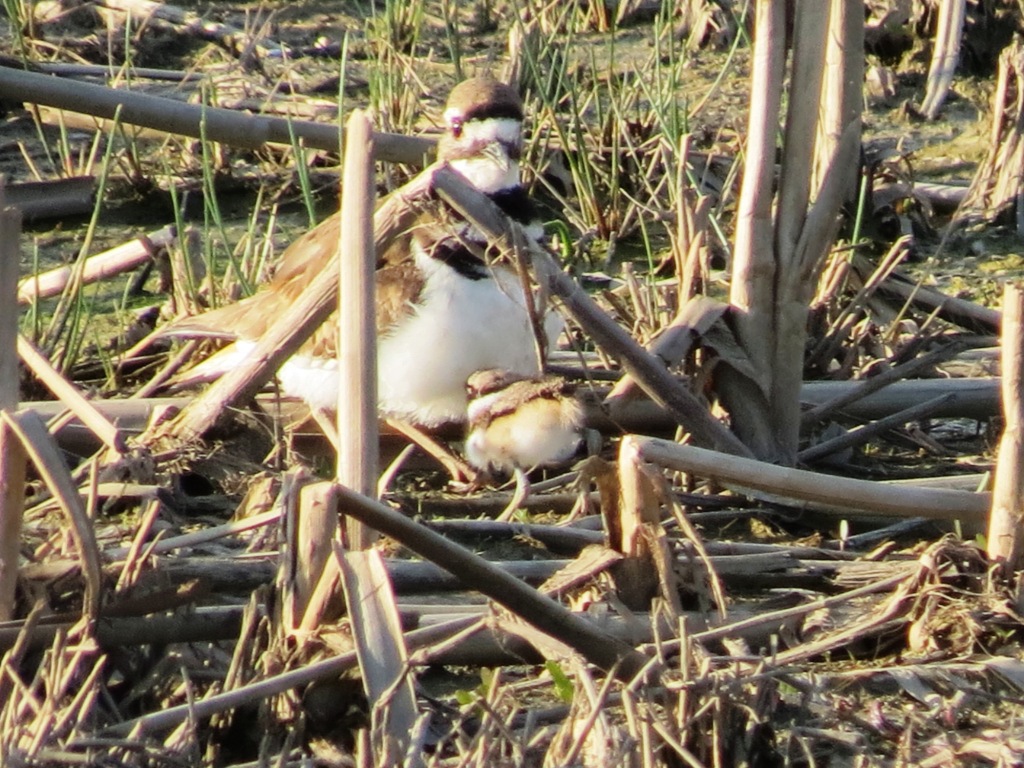
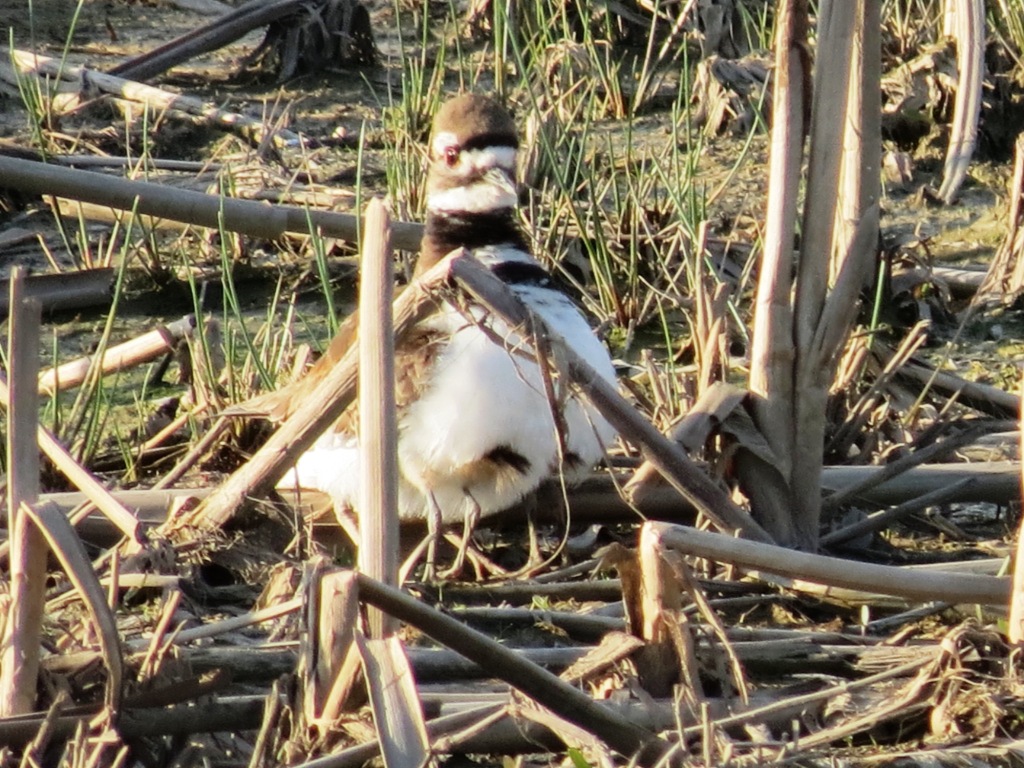
The killdeer nest was in the middle of a cornfield. It was not much to boast of. The four tan-colored eggs sprinkled with dark brown and black lay on the bare earth surrounded by a few bits of bark and cornstalk. The mother bird was young and extremely shy and nervous, and though I dreamed of having her perch on my hand like other killdeers I have known, it was only with the greatest difficulty that I was able to take a picture even of the young birds.
After a week or so of patient waiting I was compelled to miss one day’s visit to the nest and when I went back it was deserted. Before I could decide whether or not there had been a tragedy I heard a faint cry which I recognized as that of one of the young birds. We gave chase, my daughter and I, and finally, breathless, hot and disheveled, secured a picture of him as he mounted a rock.
He was the quaintest baby bird I have ever handled, with his downy black and white, pink and tan suit, his slender beak, his long legs and the big, prominent eyes, which showed plainly that he was able to fly by night as well as by day.
I attended the Indiana Master Naturalist (IMN) Gathering at McCormick’s Creek State Park on April 8, 9, and 10th. The activities started with a tour of the Blue Caverns near Bedford. It was a great trip underground riding in boats. We then walked to and from a sink hole that was tied into the same underground cave system. Both studies were great teaching moments.
The evening program at the state park was about the Start of the Indiana State Park System Storyteller Bob Sander presented his new program on Col. Richard Lieber and his efforts in starting the Indiana State Park System. This is the Centennial Year of the Indiana State Parks.
[Thanks to a grant from the Indiana Humanities this program will be presented at Limberlost State Historic Site on July 9, 2:00 pm].
Saturday was started with a bird walk followed by classes related from frogs to salamanders. There were other classes covering many areas in nature. There were around 110 IMN members in attendance.
Several groups were formed. Twenty-three of us walked to Wolf Cave in the park. Most of us crawled through a small hole in the Wolf Cave and traveled about 70 feet to another opening. We then walked back to the next class which was on snakes.
The Saturday evening program on “There is More to Milkweed than Monarchs” by Jody Heaston, the DNR Volunteer Coordinator. She provided at least three types of milkweed seed samples for each attendee.
The Sunday program was a visit to Cataract Falls, both high and low. These falls are the largest in Indiana. There is the Cataract Covered Bridge located near the high falls. I spoke about details about details of the Cataract Covered Bridge to each of the four groups.
All four groups visited the Ponderosa Aqua Farm.
That ended the IMN Gathering and the post trip!
Notes:
Ellsworth Smith is an Advanced Indiana Master Naturalist. He is serving his second term on the Friends of the Limberlost board. He volunteers for state historic sites, the state parks, ACRES Land Trust and other places round the state.
Friends of the Limberlost Secretary Melissa Fey also attended the IMN Gathering.
Limberlost State Historic Site has been asked to host the 2017 Indiana Master Naturalist Gathering with Ouabache State Park. We are pleased to be asked and look forward to hosting this group.
When Gene Stratton-Porter wrote “Freckles” in 1904, one wonders if she could imagine how beloved the character of “Freckles” would become. Over one-hundred years later, generations have read and re-read the book. “Freckles” has become woven into the rich history of Limberlost.
The character of Freckles was based on a real man named Ray Boze, who worked for Gene and her husband, Charles Porter [see Blog 9/9/2014]. Freckles was an orphan who did not know his family history. He came to Limberlost to work for Mr. McLean and to guard his lumber tract. He soon grew to love the beauty of the nature in the Limberlost.
A few years after the book was published by Doubleday and Page, it was made into a comedy- drama for the stage in Great Britain. Shortly afterwards, Neil Twomey’s “Freckles” came to American stages. The play would tour the country and be performed numerous times in a number of cities over the next decade.
Critics gave wonderful reviews of the play and of Gene Stratton-Porter’s book. One who wrote for the Leavenworth Post (Kansas), stated that, “He has transferred the spirit of the wild-wood, visualized the delightful characters of the story and woven incidents into a play of tremendous power, the bright particular star of which is the little, one-handed, freckle faced, red headed waif of fiction fame, who has enshrined himself in the hearts of millions of people who have followed him through the pages of Gene Stratton-Porter’s remarkable books.
Some other praises for “Freckles” the play from New York newspapers:
New York Press—-The piece fairly abounds in what has been termed “the punch,” in the drama.
New York Sun —Stirring scenes and strong, gripping, dramatic situations.
New York Evening Journal—“Freckles” scores success by its naturalness.
New York Telegraph—-The unique nature of the settings and the story are both attractive, interesting and well acted.
New York Herald—A novelty.
New York Times —-Tremendously successful.
New York American—Interesting at all times.
During this time period, Gene was inspired by the Limberlost and created some of her best loved characters. A number of these characters were based on people or were composites of people who lived in Geneva. Over one-hundred years later, she is still being “discovered” by new audiences who have become fans of her writings.
Several of Gene’s books were made into plays and movies. Not too many authors today can claim that.
Gene Stratton-Porter drew inspiration from the Limberlost Swamp that was around Geneva. It was her outdoor classroom for 25 years. She wrote both fiction and non-fiction books. Even in her fiction books, she put facts about herself and others she knew in her writings.
Gene made herself the Bird Woman in both “Freckles” and “A Girl of the Limberlost.” The Limberlost cabin that Gene and Charles built in 1894-5 was the Bird Woman’s home in those books. Gene was proud of the home that she created with the help of an architect.
When Freckles met the Bird Woman, “she was staggering under a load of cameras and paraphernalia” and she also carried a gun. Gene carried a gun to the swamp and she owned four cameras plus the equipment.
Freckles lived in the swamp and did not want to call at the Bird Woman’s front door, so he used the conservatory door. Once inside he “parted the heavy curtains that separated the conservatory from the company.” Freckles was surprised that while entertaining the Bird Woman wore “silks and laces” and her neck and arms “flashed from rare jewels.” Gene did have finery and jewelry given to her by her husband, Charles. The inspiration for the character of Freckles was her stable boy Ray Boze. Gene saw Ray frequently at that same door.
In “A Girl of the Limberlost,” Elnora sees a sign in the bank window in bold black letters that stated, “Wanted: Caterpillars, cocoons, chrysalides, pupae cases, butterflies, moths, Indian relics of all kinds, highest scale of prices paid in cash.” Gene’s husband, Charles, founded the Bank of Geneva and this sign was in the bank window. Charles and Gene did purchase items. Charles would sometimes run an ad for Indian relics in the “Geneva Herald.”
Elnora decides to call on the Bird Woman. The Limberlost cabin was a short walk from the bank. There is a good description of the entry hall and dining room of the cabin in “A Girl of the Limberlost.” “Elnora followed down the hall and entered a long room with high paneled wainscoting, old English fireplace with an over mantel and closets of peculiar china filling the corners. At a bare table of oak, yellow and gold, sat a woman Elnora often had watched and followed covertly around the Limberlost. The Bird Woman was holding out a hand of welcome.”
In Gene’s book, “The Harvester,” the Dream Girl’s porch is the porch off the east side of the cabin. Gene wrote about what she knew and loved. We hope you will visit the Bird Woman of Geneva’s Limberlost Cabin.
Gene wrote, “Character Sketches of Twelve Birds” as part of the Biennial Report of Game and Fisheries of Indiana, 1908. These sketches were taken from the book “What I Have Done with Birds” by Gene.
Gene Stratton-Porter wrote, “The greatest thing possible to do with a bird is to win its confidence. In a few days’ work about most nests the birds can be taught to trust me, so that such studies can be made as are here presented of young and old, male and female.”
The Limberlost Swamp which surrounded the town of Geneva was her inspiration and “outdoor classroom” for 25 years. With her photographs and writings she made the Limberlost famous.
Gene was proud that in all her field work studies she never caused a bird harm, nor did she ever damage any eggs or nests. She wrote about carrying “a notebook, handful of wheat and soul of a poet” as being good characteristics for doing this type of work.
She photographed numerous birds perching, with their young and on their nests. According to Gene, “my closet contains hundreds of negatives.” She believed in using “nature’s background which has strong contrasts of light and shade……I use four cameras suited to every branch of field work, and a small wagon-load of long hose, ladder, waders, and other field paraphernalia.”
“I was born in the country and grew up among the birds in a place where they were protected and fearless. A deep love for and comprehension of, wild things runs through the thread of my disposition, peculiarly equipping me to do these things.”
The twelve birds she wrote about were: cardinal, vulture, king rail, great blue heron, dove, barn owl, quail, purple martin, robin, cuckoo, blue jay and shrike. Each sketch included a photograph of the bird by Gene. They were all photographed at Limberlost. Gene went into detail about the birds, their habits and their habitats. She was interested in learning all aspects about the birds.
Ten of the twelve species Gene named visited Limberlost in 2015; only the barn owl and quail were missing. Today, the great blue heron are a common sight at the wetlands, lakes and river; there is a heron rookery at Rainbow Bottom. The cardinal, purple martin, dove, vulture, and blue jay are also commonly seen. Limberlost has a few yellow-billed cuckoo and there has been evidence of a shrike.
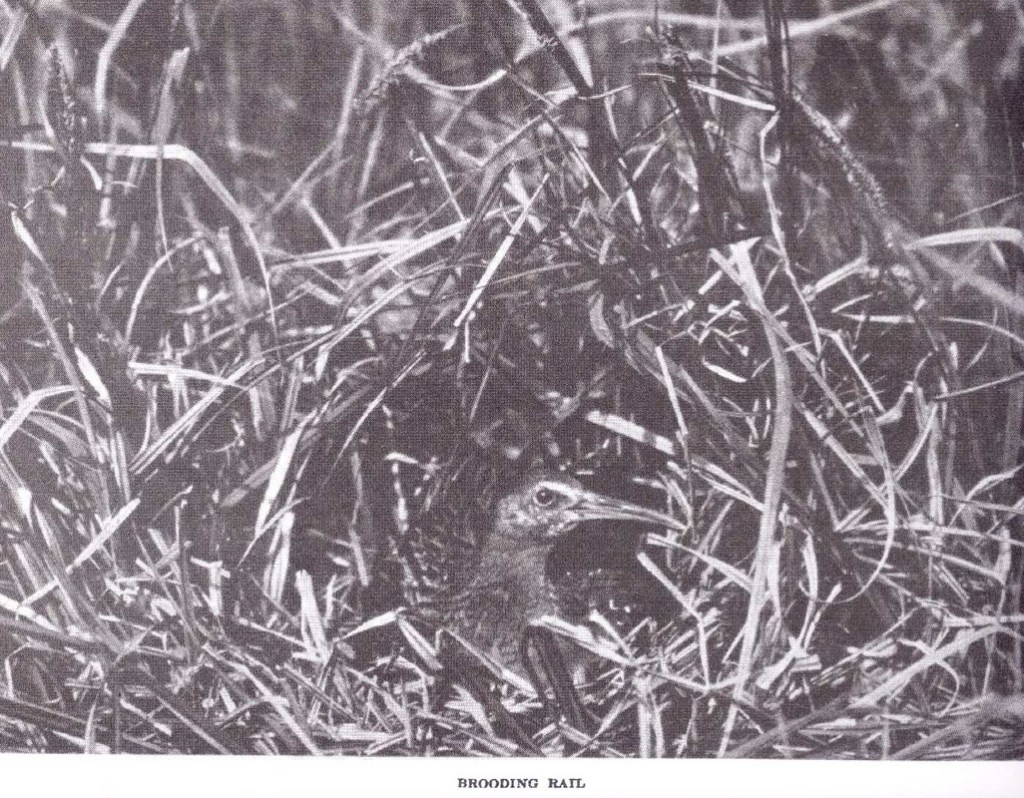
The king rail was rarity in Geneva during Gene’s time just as it is today. It is a bird that is mostly heard and not seen. Not only did she see a pair of king rail, she photographed the “queen” rail on her nest. Gene had extraordinary patience to be able to do this. We are pleased that there have been king rails in Geneva the past two summers.
Gene would have been amazed at how many rare birds have visited Limberlost in the past year: avocet, Hudsonian godwit, glossy ibis, glaucous gull and a lesser black-backed gull to name a few. The bald eagle was extirpated from Geneva when Gene lived here. Today it is unusual if you do not see at least one eagle at the wetlands.
Jane Brooks Hine, another Indiana Bird Woman who was a generation older than Gene, wrote “Game and Land Birds of an Indiana Farm” for the Biennial Report of Game and Fisheries of Indiana, 1911. Jane wrote about a lifetime of observations of birds. On the USGS Bird Phenology website, Jane is given credit for over 400 bird sightings.
Cheers to these two bird women of northeastern Indiana!
Gene Stratton-Porter met interesting people throughout her life. Some became dear friends besides business associates. Gene’s second book “Freckles” was published in 1904 by Doubleday, Page & Company. Gene would become close to the Doubleday family.
Neltje Blanchan DeGraff was born into a prominent Chicago family in 1865. She was of the same generation as Gene. Both woman would marry in 1886. Neltje married Frank Doubleday who would found the publishing dynasty that would remain in the family until the 1980s. Frank and Neltje were often written about in the Society columns in New York. They owned a home in Manhattan and one on Oyster Bay.
Neltje and Gene were kindred spirits in nature. Neltje wrote under the pen name of Neltje Blanchan. She was the author of eleven books with a focus on birds and wildflowers. One can imagine the lively conversations these two women had with one another. Gene thought highly of Neltje and referred to her books as “invaluable.”
Gene and Neltje visited each other several times. In 1911, Frank and Neltje visited the Limberlost Cabin in Geneva. Gene’s cook, Mary, was in England visiting family. Gene and her secretary, Lorene Miller, worked together to make their guests feel welcomed. By all accounts it was an enjoyable week.
In the fall of 1916, Gene visited the Doubledays. Neltje questioned Gene about some of her unusual experienced with birds. Gene told her some of her stories. She suggested that Gene write about her birding experiences. Gene did in her book “Homing with the Birds” which was dedicated to “Dorothy and Nelson.” These were Frank and Neltje’s two children.
Neltje was involved in philanthropic work. Neltje, like Gene, was a great supporter of the American Red Cross. Neltje made trips on behalf of the American Red Cross. It was on one such trip to China in 1918 that she died suddenly at the age of 52. It was devastating to Gene to lose this dear friend. In a letter that Gene wrote to a friend, she stated that she was upset with Frank for marrying so soon after Neltje’s death and she would have to get over it before she would visit him in New York again.
Her granddaughter, Neltje Doubleday Kings, created the Neltje Blanchan Literary Award in 2010. It is now called the Blanchan Doubleday Writing Award. A nice tribute to the grandmother she never knew but was named in her honor.
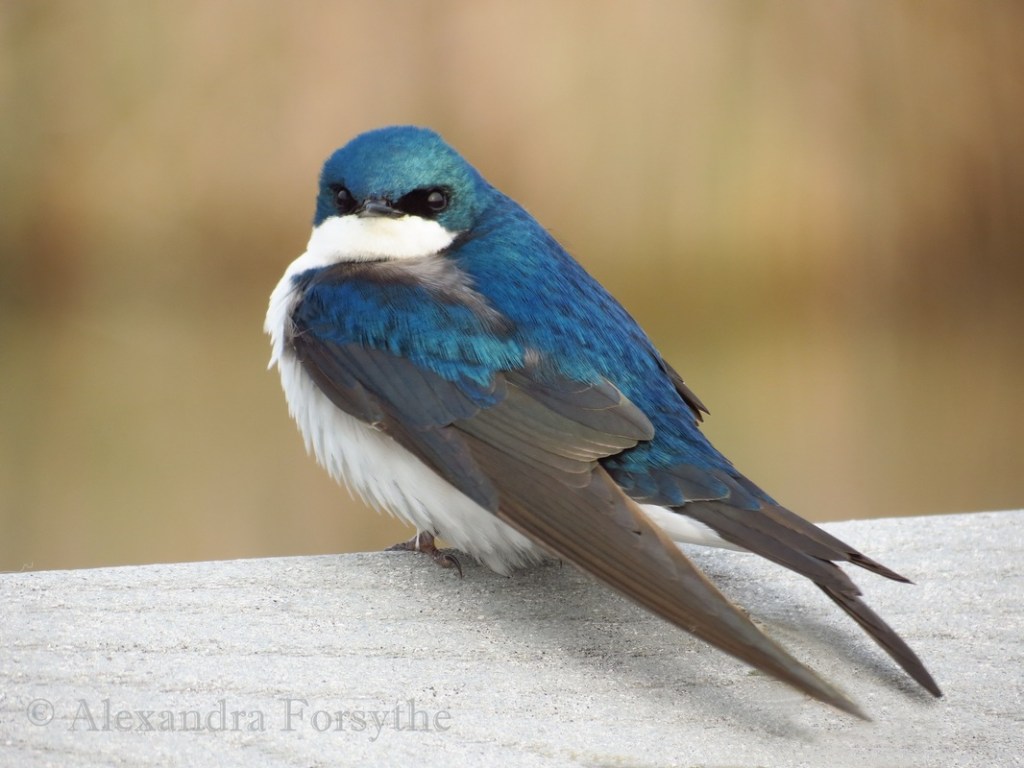
“The swallows have the air for their province. On tireless wings, with open mouths, they sieve the air, taking millions of tiny gnats, mosquitoes, and flies, that would make life altogether unbearable for us were we compelled to live and breathe among them in their unchecked development” – Gene Stratton-Porter, Homing with the Birds.
Tree Swallows have long been admired by authors, and they have been a favorite subject of scientists. There have been more scientific studies published on the Tree Swallow than on cardinals, chickadees, bluebirds and robins combined! Since 1980, over 500 professional journal articles focused on Tree Swallows, so if you look in the right place, you can find tons of information about ornithology, ecology, environmental science, conservation, and a host of other subjects thanks to the Tree Swallow. A 40-year study has made a possible link between climate change and the significant change in laying dates, a 30-year study is investigating the relationship between weather, food supply and reproductive success, and box nesting allowed scientists to determine the effect of parasites on nestling growth and survival.
One study conducted by the United States Geological Survey focused on environmental contaminants which are byproducts of industry and agriculture. Tree Swallows usually nest near water and eat emergent aquatic insects. Contaminants found in the water are absorbed by the insects and when eaten by a swallow, the contaminants remain in the swallow and have harmful effects. Scientists determine the extent and type of contaminants found in the water by examining the eggs and other tissues. They also study the survival rates of the young, and they measure the percentage of banded adults that return to a contaminated nest site each year versus a clean nest site.
Cornell scientist David Winkler regularly studies a set of over 400 nest boxes, 60% of them occupied, near experimental ponds. Winkler has been studying the birds for over 20 years and has written dozens of papers. He is currently trying to develop a swallow network of scientists across the globe for the Golondrinas de las Americas project. He hopes the comparative studies will help us better understand the life history of the swallows and ways in which birds respond to climate change. On his website, Winkler says that he enjoys working with Tree Swallows because “they have a ton of gumption and a lot of character. They are tough birds, and they don’t hold a grudge. They don’t abandon their nests. You can just pick them like fruit. You can create your own populations.”
Want to learn more about Tree Swallows? Or are you looking for a particular case study? Check out this lengthy Tree Swallow Research Bibliography: http://www.treeswallowprojects.com/bibliog.html
Having been raised on a farm, I am acquainted with cows and horses, but not sheep. We never had one ‘baa’ in our barnyard.
Maybe that’s why I find sheep fascinating. References in the Bible about them are not complimentary (‘all we like sheep have gone astray’), but I love to see them with long, furry coats, knowing that furry stuff will eventually be shorn and made into clothing and other warm items.
The how-to’s for taking the wooly stuff from long hair to felted caps, socks and scarves will be available at this weekend at the Jay Co Fiber Festival / Spin-Inin Portland, Indiana. Portland is located about one hour north of Muncie and 1.5 hours south of Fort Wayne.
Everything yarn-related from a multitude of animals is represented at the fair.
On Thurs, Friday and Saturday, March 10-12, crafters will show visitors how to take raw fibers straight from a sheep’s back and process it into yarn. Hint: Having seen the demo I’ll admit there were more steps involved than could be imagined!
Visitors can watch a sheep shearing – it’s amazing how the sheep stands still for this, but I always wonder how the shearers keep from nicking the animal’s ears!
Spinning wheels have always fascinated me and the festival will be filled with experts offering hands-on classes in spinning, quilting, knitting, needle felting, and something called ‘rigid-heddle weaving’.
I’m tempted to sign up for a class on Navajo Spindling. Just like the name, Navajo spinning is a method of making yarn on a type of spindle native to the Americans. It is supposedly an easy form of spinning and low-impact since it can be done while sitting down. This is the real ‘spinning’ that can’t be found in a work-out room!
Another temptation for me is the Needle Felt Alpaca Hat class. As a lover of British TV series like Miss Marple, I would love to make my own warm, soft hat and look like I belong to that era! Having it made from alpaca fiber would make it even more fun! All of the materials needed to create a hat are included in the cost of the class.
A guest lecturer, Susan McFarland from Wisconsin will talk about how she has become one of the few breeders of Teeswater sheep in the US. Teeswater is a rare breed from the UK. Their wool can be used for doll hair and Santa beards and silky yarn.
Vendors selling all things fiber will be on hand, as well as food booths. The festival has grown in popularity so it fills two buildings. The cost should not keep visitors away—only $1.00 per day!
Note from the editor: Limberlost thanks everyone who visited our booth, staffed by Curt Burnette, at Fiber Fest!
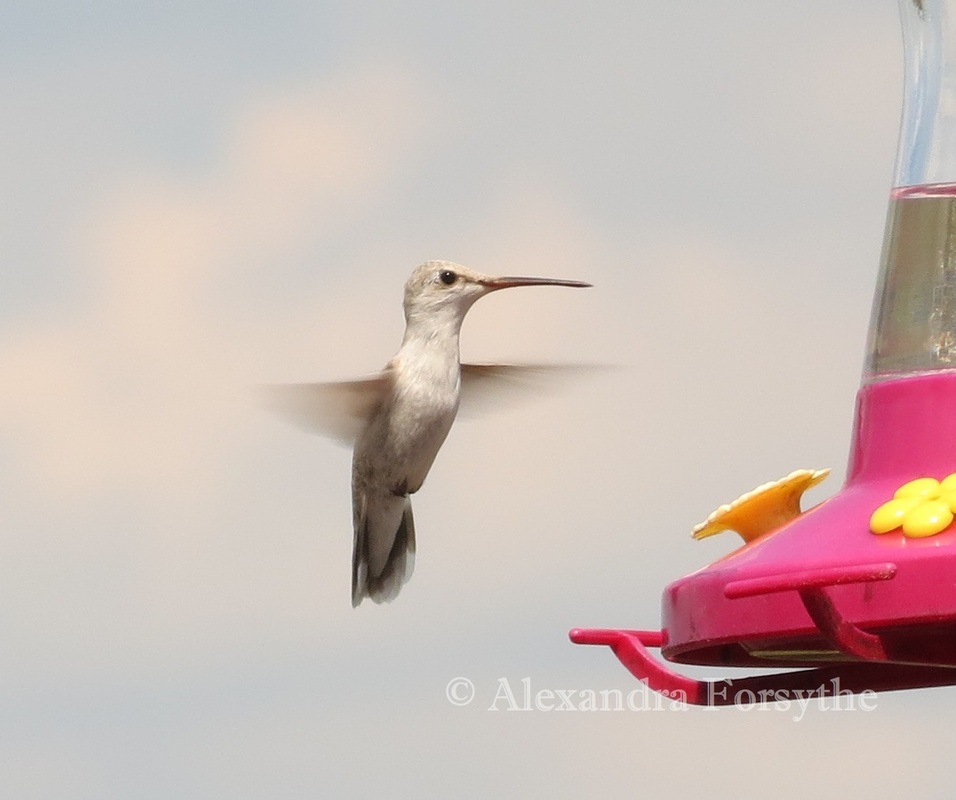
Is this hummingbird an albino? Or is it suffering from leucism? Or perhaps it is displaying signs of dilution? Or maybe it has a condition causing progressive greying? The answer might depend on whom you ask.
There has been some confusion and disagreement in the scientific community about the exact nature of each of these conditions. For example, is leucism caused by a lack of pigment? Or by a significant reduction in the amount of pigment deposited in the feathers? We aren’t completely certain. However, the basic cause and definition of each condition is generally agreed upon.
Albinism is caused by a genetic mutation that results in a complete absence of tyrosinase in pigment cells. Tyrosinase is an enzyme that is located in melanocytes. Melanocytes produce melanin, which is the substance that gives your skin, hair and eyes their color, and it gives color to a bird’s feathers. With no tyrosinase, no melanin is produced, so a bird’s feathers will appear white, and the eyes will appear pink. Albinism also affects the bird’s eyesight, causing the bird to have difficulty spotting predators and shortening its lifespan. Since albinism is an all-or-nothing condition, there is no such thing as “partially albino”.
Leucism is a reduction, rather than a complete lack, of pigment. Birds with leucism may have a few white feathers (partially leucistic), or be predominantly white, depending on the extent of the condition. Leucism is inherited, but it usually displays differently in the parents than in the offspring. A parent may have white feathers on the wings, while the offspring has white feathers on the tail, for example. It is an inherited trait, but it is recessive so it can skip generations.
Dilution is a condition that causes the feathers to appear more pale than normal. The bird may appear to have been sprayed with a fine mist of white paint and look washed out. In these birds, the melanin is present, but the cells are not producing as much pigment as normal birds.
Progressive greying or vitiligo results in white feathers, but the change occurs over time. The bird may have normal coloring when young, but the bird turns whiter as it ages. It is caused by the progressive loss of pigment cells with age.
So which condition does this hummingbird have? I’ll let you be the judge!


 Friends of the Limberlost