Great Blue Heron

By Alexandra Forsythe

The Great Blue Heron is the largest heron in North America. It has been documented eating a wide variety of prey from fish and frogs to gophers and birds. This varied diet allows the Great Blue to winter further north than most herons, even in locations where the water freezes completely. They breed in colonies which can have 75 nests or more. The Nanjemoy Creek colony in Maryland boasts over 1,100 nests! Colonies of almost 400 nests have been reported in Indiana.

Gene Stratton-Porter was rather fond of herons. They appear frequently in her writings. In “Homing with the Birds” she admired the heron’s mating dance: “I have seen a few measures of the stately dance a blue heron executes for the charming of his beloved.” In “Laddie”, when describing her idea of the idyllic location, she included the solemn herons: “Crossing our meadow there was a stream that had grassy banks, big trees, willows, bushes and vines for shade, a solid pebbly bed; it was all turns and bends so that the water hurried until it bubbled and sang as it went; in it lived tiny fish colored brightly as flowers, beside it ran killdeer, plover, and solemn blue herons almost as tall as I was came from the river to fish; for a place to play on an August afternoon, it couldn’t be beaten”.

It is difficult not to love and respect the Great Blue Heron. It has a distinctive look and is easily identifiable to even the most novice birder. It stands so very still, like a beautiful statue, for long periods of time patiently watching and listening to its surroundings. When it moves, it has an elegant, purposeful stride. When it flies, it uses such slow, powerful wingstrokes, yet it seems to fly effortlessly across the sky.

While Great Blue Herons are fascinating to watch, as a wildlife rescuer who deals with everything from Cedar Waxwings to Great Horned Owls, I must caution anyone who happens upon an injured Great Blue Heron. They may not be raptors, but they can be deadly. Herons rarely understand that you are there to assist them and they will defend themselves with their only weapon: that long, sharp spear mounted to the front of their face! If you do not take the proper precautions, that bill can pierce through your eyes or temples. Always call an experienced wildlife rehabilitator if you encounter a heron that needs assistance.

I’ll leave you with this bit of wisdom: “Advice from a Great Blue Heron: wade into life; keep a keen lookout; don’t be afraid to get your feet wet; be patient; look below the surface; enjoy a good reed; and go fish!”

Gene’s Limberlost Invitation to Indiana

By Terri Gorney

Limberlost Invitation

By Gene Stratton-Porter

Come where the chewink chewunketh,
Come where the wild grapevines swing;
Come where the craw-dads are crawling
Over the bed of our spring.

Come where the sun in red glory
Tops Kestler’s tamaracks gray,
Come where the black bass are leaping
And the red-wings are calling all day.

Come where the rattlesnake rattles
While the kingfisher rattles also.
Come where the horned owl is hooting
And it rains at the call of the crow.

Come where the harebell is ringing
While the bluebell its worship call tolls’
Come where the vireo preaches,
And the Hermit his vesper song rolls.

Come where the polecat’s perfuming
Mingles with flower-scented air,
Come to our swamp in its glory,
Its joys we invite you to share.

This is a poem that Gene Stratton-Porter gave to Indiana for the state’s Centennial in 1916. It was published in “An Invitation to You and Your Folks from Jim and Some More of the Home Folks” compiled by George Ade. It is the first time that it was published; parts of this poem were written at an earlier date but not published. She wrote this beautiful poem that blended parts of both of her Indiana homes into it. In 1916 she owned both homes.

The Limberlost Cabin is in Geneva and where she lived and wrote for twenty-five years. She did her kingfisher studies here at the old gravel pit. There are “craw-dads crawling” in the creeks and wetlands still today. She wrote about the dangers of rattlesnakes and polecats in the swamp. Charles made sure she that he or a male guide went with her when she was out in the swamp.

Gene loved the Limberlost Swamp which she lived at the edge of in Geneva. She made the swamp famous and would be forever tied to it. When she built Wildflower Woods on Sylvan Lake she called the cabin Limberlost North. When she mentioned the tamaracks she is referring to the trees that are around the area of the lake.

When she wrote of the black bass she is referring to both places. In her book “At the Foot of the Rainbow” which takes place at Rainbow Bottom along the Wabash River she wrote of the black bass. While living at Sylvan Lake she enjoyed bass fishing and even “planted” bass there as part of a conservation effort. The lines of the birds, wildflowers, and grapevines she could be referring to one or both places. Her owl studies were done while she lived in Geneva.

It was inspiration from this poem that the exhibit “Limberlost Then and Now” was created and will be up through mid December.

This poem is only one of the things that Gene did for the state’s Centennial. We will share more of Gene’s year in the coming months. We at Limberlost State Historic Site would like to extend a special “Limberlost Invitation” for all our friends to visit the site or attend one of our special Bicentennial events this year.

Mourning Warbler

By Alexandra Forsythe

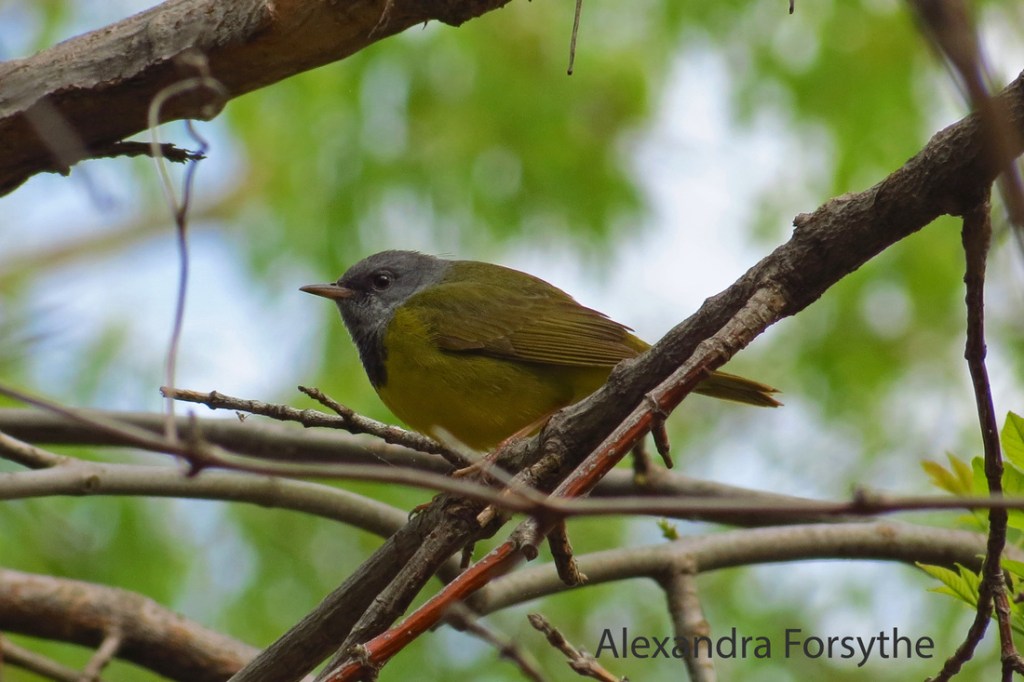
Discovered in 1810 by Alexander Wilson in Philadelphia, the Mourning Warbler migrates through Indiana in the spring on its way to its breeding grounds in Canada and northern portions of the U.S., and again in the fall on its way to the wintering grounds in the tropics. According to Audubon scientists, the Mourning Warbler breeding ground is expected to move much further north over the coming decades, as illustrated by Audubon’s interactive model: http://www.audubon.org/field-guide/bird/mourning-warbler. The change will likely impact the timing of their migration and their appearance in Indiana.

With their subdued coloring, preference for thickets, and solitary nature, it can be difficult to spot a Mourning Warbler. Like most warblers, they have a habit of darting from branch to branch, particularly if you are trying to take a photo! Most Indiana birders struggle to find a Mourning Warbler out in the open, so imagine, if you will, seeing a variety of different warblers, including Mourning, all in a line, holding still, ready to be photographed! Gene Stratton-Porter had that experience and she shared it with us in “Homing with the Birds”:

“In a line on a wire fence, there was a string the length of a city lot, of warblers gathering for migration, while over several bushes before and close behind the fence flocked dozens upon dozens more of these trim exquisite little birds. Of course, the predominant colour was yellow, there being the pure gold of the summer yellow bird and the slightly deeper shade of the prothonotary. There were the deep orange of the Blackburnian and the mottled yellow of the magnolian. There appeared prominently on the wire the yellow head and throat of the blue-wing, the stronger touch of yellow of the redstart, the black-throated green warbler, the yellow pine and the yellow-touched hood and mourning warblers. There were a number of specimens of the black-throated blue warbler and the still paler cerulean. There was at least one specimen of the bay-breasted warbler, with robin-breast colour on the top of its head and all over its underparts, and there were enough chattering, little warblers I could not identify to have made a large flock…As a rare and unusual sight I can think of no experience in field work to surpass the beauty of this picture.”

Veronica’s Trail at the Loblolly Marsh

By Veronica Rambo

My name is Veronica Rambo. I am 25 years old. I was born with Spina Bifida and get around in a wheelchair. When I was in 4 th grade I went on a field trip to the Limberlost and to the Loblolly Marsh. The day that we went to the marsh it was rainy so that meant that the marsh was really muddy. I was asked if I wanted to stay on the bus or go with my classmates to explore the marsh. I told them that I wanted to go with the rest of my class. It took about five people (including my mom) to get me through the marsh because there was no trail there at the time.

About four years after that field trip I got a phone call. It was Ken Brunswick! He was calling to tell me how they made a trail and when he was thinking of what to name it, I popped into his head. Ken told me that he wanted to name it Veronica’s Trail. I was excited about this news. After I told Ken that he could name it after me, he asked if I could come down to the trail to open it. I told Ken that I would love to go open the trail. I have been through a lot in my life and to get a trail named after me was a highlight. When I was going to open the trail up a second time I was in the hospital. I was able to be there for a little bit.

I love the trail a lot. Love the sound of nature there. I try to get to the trail once a year. Every time I go there I see something different each time. Now at 25 years old, I am out of high school and I have started dialysis. Going to that trail help me get rid of what is going on in my life and become one with nature.

I thank everyone at the Friends of the Limberlost who have helped make the trail what it is today. I thank Ken Brunswick for dealing with me at the time. He and others had to carry me through the marsh. I thank you Ken Brunswick for naming the trail after me. I hope we run into each other again someday. I hope you have enjoyed my story. I hope when you go to the Loblolly Marsh that you will feel at peace and enjoy nature! Thank you everyone!

Geneva’s Oldest Business: Briggs Hardware Store – Established 1882

By Terri Gorney

Geneva’s oldest business is Briggs Hardware Store. It was begun in 1882 by Andrew G. Briggs.

The William Briggs family moved to Geneva in 1871. William’s son Andrew Briggs would make his mark in the town of Geneva. Charles Porter would buy his first property in Geneva in 1872. Andrew and Charles would become lifelong friends and business associates.

In November 1883 Andrew married Margaret Day, a native of Celina Ohio. She was the daughter of James Day who was an attorney and judge. Margaret and Gene Stratton-Porter both came to Geneva as young brides. Like their husbands, Margaret and Gene would become good friends. They would be founding members of a ladies literary society and the “The Birthday Club.” In 1894 the Porters and the Briggs would both hire architect Will Christen to build their homes (Limberlost Cabin and the Andrew Briggs home on Line Street).

The Briggs Hardware Store is unique in a modern world. It is a little like stepping back in time. The floors are wood and many of the display cabinets are decades old. It is a place where nails and candy can be purchased by the pound. Whether you have needs for your home or office or party supplies, you can find it at this gem of a store on Line Street in Geneva.

The store is owned by Andrew Briggs, a great grandson of the founder. It is managed by Marvin Schwartz who owns A.B. Schwartz Construction.

May the Briggs Hardware celebrate another 134 years in business!

Gene Stratton-Porter and the Great War

By Terri Gorney

One hundred years ago, the Great War began in Europe. Gene Stratton-Porter was a supporter of the war effort when America entered WWI. She purchased a $5000 Liberty bond from the Allen County Chapter of the Liberty Loan Club. Dr. Miles Porter, her brother-in-law, was chairman of the first aid committee for the Red Cross Chapter in Fort Wayne.

Under Indiana native Ernest Bicknell, the National Red Cross developed three committees: a National Relief Board, an International Relief Board, and a War Relief Board. According to the “Fort Wayne Sentinel” Gene was on one of the national committees. In 1935, Ernest wrote down his experiences in a book called “Pioneering With The Red Cross.” Before the war, the Red Cross had 17,000 members by the end of the war, there were 20 million members.

She watched while the men in her life were affected by the war. Her son-in-law, G. Blaine Monroe served as a dentist. Her nephew Donald Wilson served in the army aviation. Nephew Dr. Miles Porter Jr was according to Gene “a fine surgeon, who is to have charge of a base hospital near Paris.” He spent eighteen months in service. Another nephew, Dr. Charles Porter Beall, served as a doctor in France as did Dr. Corwin Price, a Geneva friend who would buy the Limberlost cabin in 1920.

Joyce Kilmer who wrote the “Tree” poem had corresponded with Gene. He was killed by a sniper in the war. In 1915, Kenyon Nicholson who became a playwright and screenwriter won Gene Stratton-Porter’s prize in literature while he was attending Wabash College in Crawfordsville. He served in France during the war. Gene’s own driver, William “Bill” Thompson, enlisted.

During the war years, Gene and her friends were knitting wool socks so that they could be sent to the troops overseas. Gene encouraged the average citizen to do what they could for the war effort whether it meant knitting socks or donating time, money or books.

There were book drives across the country to send books to American service men in Europe. There was a 1918 report from Kingston, New York newspaper about a copy of “Freckles” that was donated to the book drive. In it was the following inscription, “My mother gave me this book to send to those who read it keep courage like Freckles did. I have two cousins and one uncle at the front some place. I am only 10 years and you don’t know how I wish I was old enough to help you catch the Kaiser.” James G—Port Angeles, Washington.

In 1915, Queen Mary of Great Britain wrote to Gene to ask her permission to use her writings in a book that would be a collection of different popular writers of the day. The book was known as the “Queen’s Book” and was sold to benefit wounded soldiers and sailors (England was already in the war by this time). Unfortunately for Gene, in the end, it was decided to use short stories by English writers only.

Gene penned a poem called “Peter’s Flowers” that was hauntingly beautiful. It was first published on pages 3 and 4 of the April 1919 “Red Cross” magazine. It was illustrated by Thomas Fogarty. The story is about the World War I tradition that the first flower to spring from the soil of a battlefield is the red poppy. The poppy is a living sign that they will not be forgotten. Gene could have been inspired by the poem “In Flanders Fields” by Lt. Col. John McCrae.

At the time Gene’s poem was published, John Sanburn Phillips was the editor of the “Red Cross” magazine. With the war over, Gene sent him a cheery Christmas greetings by writing, “I think “Peter” would want me to wish you all the joys of peace for the coming Christmas and all the blessings of prosperity for the New Year.”

Gene was sensitive to the soldiers and veterans. Her book, “The Keeper of the Bees” was about an injured veteran of the war named Jamie MacFarlane who left a military hospital without proper discharge. She had it completed at the time of her death in December 1924. In a letter to her publisher, Nelson Doubleday, she wrote about a “Harvester type” character that she was developing. It is possible that she was referring to this book.

In 1921, the “Brooklyn (NY) Daily Eagle” carried an article about President Harding appointing a woman as a delegate to a disarmament conference. In the article, Gene insisted that one woman is not enough to be appointed by President Harding as delegate to the disarmament conference. She wanted an equal number of men and women. She wrote, “After twenty years of experience in business with men, I have lost my awe of a man as an infallible business proposition. I have yet to find the time or the place in which a big-hearted, well-educated, commonsense woman could not be of the very greatest assistance in any business proposition of any nature that any man or body or body of men might attempt.”

Memorial Day Remembrance

By Terri Gorney

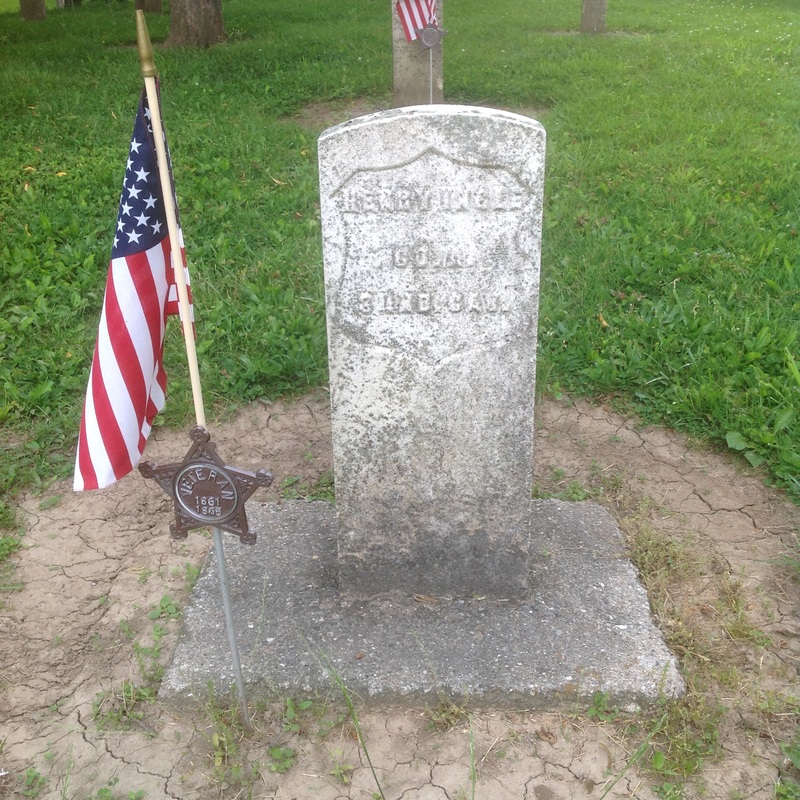
Memorial Day was begun in 1868 to remember and to decorate the graves of the Civil War dead. Gene Stratton-Porter was born during the Civil War era; just one month after the battle of Gettysburg. Her future father-in-law was a surgeon for the Union Army, but Dr. John P. Porter would perish on November 1, 1864.

On July 24, 1882, the Dr. John P. Porter GAR Post #83 was established in Geneva. The post was named in honor of the pioneering doctor of Adams County who lost his life in the war. This was a thriving post for many years. At its peak, almost 200 veterans were members.

One man that was a long time member of the post was John G. Brenner. John fought in the 115th Ohio Volunteer Infantry, Company D. He served the GAR Post in many capacities, including its commander in 1908. He was a trusted friend and employee of Charles and Gene Stratton-Porter. John would spend the last twenty years of his life caring for the Limberlost cabin and grounds. He lived in the carriage house. His room is part of the tour if you visit the Limberlost State Historic Site.

Gene would become a great supporter of the United States Army in WWI. She had a compassion for veterans as shown in her book “Keeper of the Bees.”

Camera and Kingfisher

By Gene Stratton-Porter

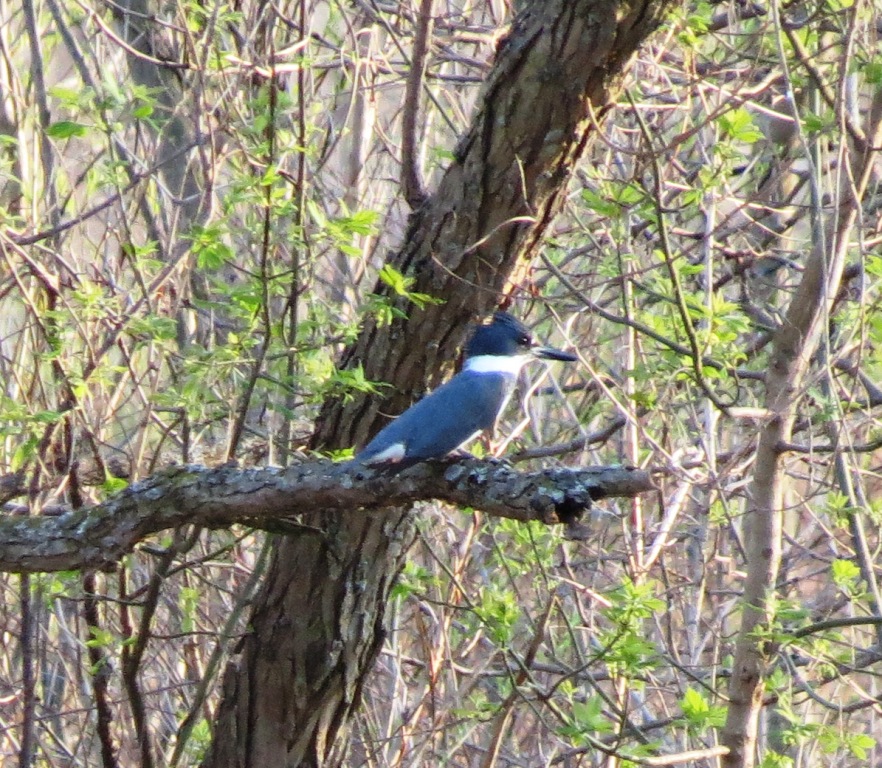
One year while I was making a series of pictures of some little kingfishers that were brought up in a nest in the edge of a pit about a quarter of a mile away from the Wabash [River], I decided to get pictures of the old birds. I never worked harder, and never did I have better luck.

Kingfishers have long, tiresome waits on snags and stumps above the water to catch the small fish and crabs which make up the greater part of their diet. I wanted to snap them in this position. Up and down the river on both sides and back and forth across the swamp I followed them until I located fifty stumps and branches upon which they lighted every day when they came to fish. Then I had to guess on which stump they would light the next time they came and decide where to place my camera and where to hide myself. Luck was with me. Once I got a picture of a male when he was so close that the scars he got on his big beak while helping his mate dig the tunnel for their nest were in plain sight.

Editor’s Note: The kingfisher study was done early in Gene’s career. Gene photographed a family of kingfishers on the east side of Geneva by the old gravel pit. This is by the Limberlost Creek and the Wabash River. Gene might be surprised that there are kingfishers who still perch and fish in this same area today.

A Most Elusive Moth

by Gene Stratton-Porter

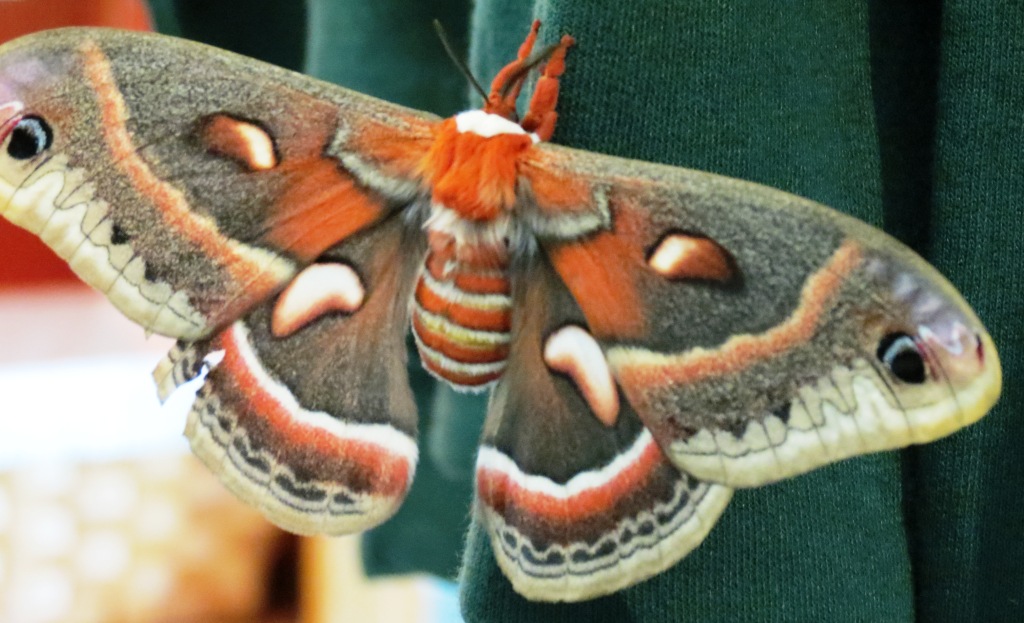
Once when I was a child I brought a Cecropia moth home and kept it for a short time, but not until twenty years afterward did I have one at close enough range to take a picture. I did not see it until one summer morning when a little boy brought me a fine specimen in a pasteboard box with a perforation in the top. I took it out, and found it so numb with cold that it could not cling to a twig. I knew that these moths lived only a short time, and fearing that this one was near death focused the camera on a branch and tried again to make it cling. The fourth effort was successful, though the moth crept so far away before it settled that I had to change the shutter. It took less than a minute, but when I looked around my fine Cecropia was sailing over the top of the elm trees near the orchard!

Some months later, after one of the most trying days I ever spent afield, I came home to find a Cecropia slowly working its wings up and down on the top steps of the cabin. I reached for my net. The moth for which I had waited twenty years was mine!

Editor’s Note: Gene studied moths while she lived at the Limberlost cabin in Geneva. A cabinet of the moths she collected is still on display over the fireplace in the first floor bedroom where it has remained over 100 years. We think her book “Moths of the Limberlost” is one of her best works. The Friends of the Limberlost have it for sale in the gift shop at the Limberlost Visitor Center.