Mrs. Porter and the Centennial

By Terri Gorney

In 2016 we celebrate the Bicentennial of statehood for Indiana. One-hundred years ago, Gene Stratton-Porter contributed to Indiana’s Centennial Celebrations.

Indiana in the late 19th century and early 20th century, was in the Golden Age of Literature. Indiana was second only to New York state in the number of best selling authors and number of books they produced. Gene was part of this special assemblage of literary talent and was recognized as such by the Hoosier state.

Meredith Nicholson wrote the book “The Hoosiers” in 1900. It was about the literary figures in Indiana. This was published before Gene wrote her first book, “Song of the Cardinal” in 1903. For the 1916 celebration, she decided that a new revised edition was in order and called it “The Hoosiers: Centennial Edition.” Gene was included in this edition. Meredith describes her as “one of the most popular American novelists.” Her books that were written about Limberlost have “endeared her to thousands of readers.”

George Ade asked his fellow Hoosier writers to contribute a work of theirs to a book created for the Centennial Celebration. It was called “An Invitation to You and Your Folks from Jim and Some More of the Home Folks.” Gene was pleased to be included and contributed “A Limberlost Invitation” which was a poem that she had written. It was appropriate that Gene had created a poem about the Limberlost because she would be forever tied to the place that she made famous. This Indiana homecoming booklet and issued by Bobbs-Merrill Company, under the auspices of the Indiana Historical Commission. The proceeds from the book benefited the Centennial Celebrations. Others in this book were Gov. Samuel M. Ralston, United States Vice President Thomas R. Marshall, former United States Vice President Charles Fairbanks and other literary celebrities including: Booth Tarkington, James Whitcomb Riley, Meredith Nicholson, the Country Contributor Juliet Strauss, Kin Hubbard, William S. Blatchley and several others. Gene was in very distinguished company.

On June 12, there was a “Telegraph Tea” hosted by the Women’s Press Club of Indiana in Indianapolis held in the Riley Room of the Claypool Hotel. It was advertised as “novel and notable.” Gene participated by sending in a short writing called “A Limberlost View.” Gene wrote about her views of marriage and raising children. She wrote, “I stand for love, by which I mean a proper commingling of respect, admiration and passion….I stand for old-fashioned homes, won by work, love, mutual effort and both man and woman.”

Gene was asked to present a program at “Corn School Week” in LaGrange as part of the Centennial Celebration. Gene’s program was on Friday, October 6. After her program, she presented the Sweepstakes winning boy a gold medal in the corn growing contest with a special bound volume of one of her books.

“On the Banks of the Wabash, Far Away” by Paul Dresser is Indiana’s state song. The Wabash River wraps around Geneva where Gene lived for twenty-five years. We at the Limberlost State Historic Site would like to extend a special “Limberlost Invitation” for all to visit the site or attend one of our special events this year.

The research is a Bicentennial Legacy Project that was the inspiration for the Limberlost State Historic Site’s upcoming exhibit called Limberlost Then and Now.

Article was published in the Berne Tri-Weekly, Limberlost Notebook column, 29 Jan 2016, p. 4.
Gene Stratton-Porter a Fashionista?

By Terri Gorney

Gene Stratton-Porter was in the forefront of the conservation movement. She was an author, photographer, illustrator and movie producer at a time when women did not aspire to have careers.

In 1920, the 19 th Amendment gave women the right to vote. Women’s fashions were drastically changing at this time. Little has been written about Gene’s fashion sense, but it appears that she was a trend setter with her fashion.

Knickerbockers, called knickers for short, became a popular men and boys’ garment in the early 20th century. By 1920, they were on display in all the smart shops on Fifth Avenue in New York City for women. But many women were wary of wearing them. They saw them as too masculine and a little too radical.

Knickers were advertised as a garment that when worn with accessories can create a “jaunty” look and make the woman who wears them feel young.

One woman who was not afraid to wear knickers was Gene Stratton-Porter. It was reported that in 1922 she wore them for an interview. She thought it was just a matter of time and they would be in vogue. Gene stated, “Among a world of other tardy realizations the world has come to realize that every woman has two legs and that these legs in all probability are proportioned to the remainder of her frame. There is no longer any curiosity concerning legs; they are absolutely prevalent– -as common as arms or heads. And the world has consented that she may cover them with skirts, breeches, or Turkish trousers, as she pleases.”

With Gene’s nationwide popularity, one can imagine that she helped sell the wearing of knickers to a number of ladies across the country.

Take a Hike, Limberlost Style!

By Adrienne Provenzano

“To me the Limberlost is a word with which to conjure; a spot to wherein to revel.” – Gene Stratton-Porter, Moths of the Limberlost.

If you are looking for an opportunity to celebrate Indiana’s Bicentennial in the great outdoors, consider signing up for a special upcoming Autumn event at the Loblolly Marsh Nature Preserve which connects nature and literature to Indiana’s 200th Birthday. On October 8th , Indiana Humanities is sponsoring a Next Indiana Campfires event at the Limberlost State Historic Site. The event includes a 90 minute easy hike through the Loblolly Marsh Nature Preserve with Dr. Rachel Blumenthal, an assistant professor of English at Indiana University Kokomo, and Limberlost State Historic Site naturalist Curt Burnette. The hike will be followed by a campfire dinner including Upland Beer for those over 21. As of September 13, there were 20 spots remaining. The cost is $10 and includes food and beverage. The event lasts from 4 p.m. – 7 p.m. and is geared towards those aged 12 and older. There is also an option of a tour of the Limberlost Cabin at 2 p.m. for an additional $10. To register, go to www.eventbrite.com/e/next-indiana-campfires-limberlost-state-historic-site-geneva-tickets-24091929610?aff=es2

Participants are asked to bring a filled, reusable water bottle, sunscreen and bug spray and wear hiking boots or tennis shoes. In case of inclement weather, participants will be notified 2 hours in advance and have the opportunity to apply their fee to a future Next Indiana Campfires event.

For more opportunities to read, learn, discover and talk, go to IndianaHumanities.org/Campfires and sign up to receive a FREE “Trek and Talk Toolkit”in the mail! This creative resource kit includes a guide with text by Scott Russell Sanders, discussion questions and a map of Indiana with literary quotes about natural landscapes. Also in the toolkit are an UGo Bar to snack on while hiking, a patch, a “Gone Trekking” sign, and a card deck including quotes, environmental facts and conversation starters.

Next Indiana Campfires events have been taking place around the state since May, 2016 and you can find more information about past and upcoming adventures at INHumanities#ttrekandtalk on Facebook, Twitter, and Instagram. The program has received support from the Efroymson Family Fund, Nina Mason Pulliam Charitable Trust and Pulitzer Prizes Centennial Campfires. Additional support for this event comes from the Friends of the Limberlost. Indiana Humanities is supported by the Lilly Endowment, Inc. and the National Endowment for the Humanities.

A Heron in Outer Space!?!

By Adrienne Provenzano

On the evening of September 8, 2016, weather permitting – and all systems go – the OSIRIS-REx mission will be launched from Cape Canaveral, Florida into outer space to play a cosmic game of tag with an asteroid named Bennu to collect a minimum of 60 grams (2 ounces) and up to 4.4 pounds of material, and return a capsule filled with what Carl Sagan might have referred to as “star stuff,” to the Utah desert in 2023. The samples will then be delivered to the Johnson Space Center in Houston, Texas, and some sent to JAXA, the Japanese Space Agency. Some of the samples will be studied in the first two years after return, but most will be preserved for study by future generations. So, in a mere nine years, this unique mission will help scientists in their efforts to solve more mysteries of the universe – and likely lead to more questions as well.

Bennu is a Near Earth Object (NEO) with a 500 meter diameter, formed about 4.5 billion years ago. OSIRIS-REx is an SUV sized spacecraft. Bennu was selected to be visited because it is accessible and has a convenient orbit for a sample return mission to Earth, is a useful size for study, and is also rich in carbon, so there is a greater chance for the discovery of organic materials and water-rich materials, such as clay. In other words, the building blocks of life on Earth may be discovered on Bennu!

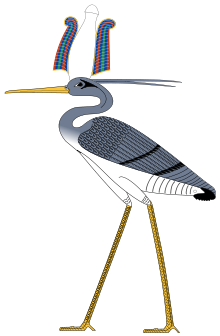
So, what has this to do with herons, a favorite bird of Gene Stratton-Porter? Several years ago a contest was held to name the asteroid, formerly known as 1999R236. Among the 8000 or so entries was one from a third grader who felt the spacecraft resembled a heron in flight, when its long collection arm is outstretched. Bennu was an ancient Egyptian diety connected with the sun, creation, and rebirth – and often depicted as a heron, so the student felt the ancient name appropriate. The mission itself, OSIRIS-REx includes the name of another Eqyptian figure, Osiris, said to have brought knowledge of agriculture – and hence life, to the Nile Delta region. Just in case you’re wondering, the acronym OSIRIS-REx stands for Origins Spectral Interpretation Resource Identification Security Regolith Explorer! OSIRIS-REx carries an impressive suite of scientific instruments – cameras, spectrometers, and an altimeter – to collect images, study the chemical composition of Bennu, and search for pre-biotic and biotic material. The mission is part of NASA’s New Frontiers Initiative, which includes the New Horizons mission to Pluto and the Juno mission to Jupiter.

Objectives of OSIRIS-REx include understanding the formation and working of our solar system, and also a better understanding of Near Earth Objects and their hazards. The Yarkovsky Effect – in which solar energy is absorbed and released by asteroids, effecting their orbits – will also be studied as part of the mission. Scientists estimate there’s a 1 in 2700 chance of Bennu impacting Earth…in the 22nd century. So don’t worry! But consider following the mission!

For more information, go to asteroidmission.org. You can watch the launch on NASA TV at NASA.gov! For more information on the Great Blue Heron of Indiana, check out Alexandra Forsythe’s 7/18/2016 posting on this blog.

Adrienne Provenzano is a member of the Friends of the Limberlost and the Indiana Astronomical Society and is also a NASA Solar System Ambassador – a program of NASA JPL-CalTech.

Teaching Materials from Limberlost

By Alexandra Forsythe

Did you know? Limberlost has an abundance of teaching materials for educators, homeschoolers, families, and visitors of every age! Here’s the best part: each of these resources is free to use!

Our oldest resource is our website. On the Limberlost website, under the “Resources” tab, we have a “For Teachers” page full of information, resources and links. Be sure to check the other pages for even more information and lesson plans.

We have a mobile app for android devices, and an interactive ebook for Apple devices, that allow you to go “Birding with Gene.” Both are filled with Gene’s quotes about her favorite birds and favorite places within Limberlost, Loblolly and Rainbow Bottom.

You can borrow a Birding Backpack filled with equipment and resources from the visitor’s center that will help you to trace Gene’s steps, and find, identify, and learn about her favorite feathered friends.

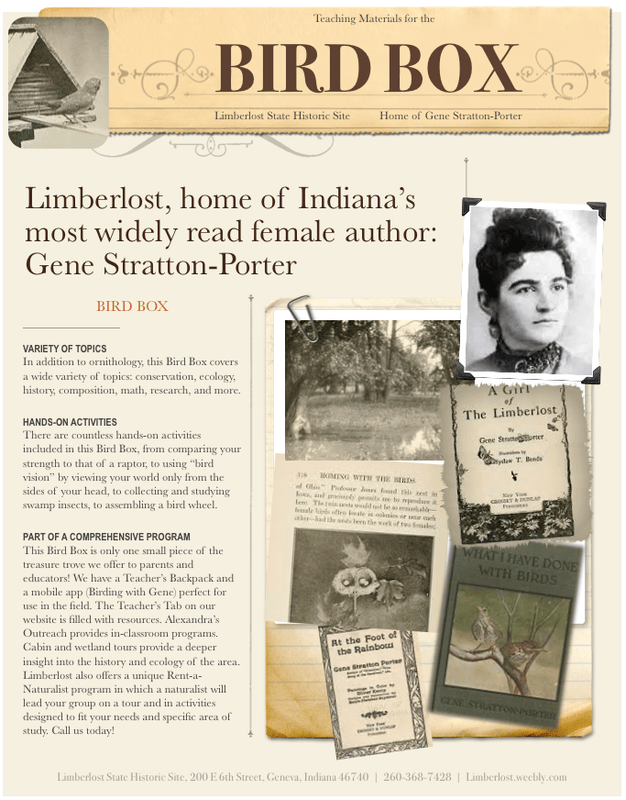
The most recent addition to the educational resources collection is the Bird Box. This trunk is filled to the brim with books, worksheets, hands-on activities, and much more. It is equally perfect for use in the classroom or the family room. Appropriate for all ages, experience levels, and learning styles, you’ll learn more about Gene, Limberlost, ornithology, and the natural world. Lesson plans are inspired by, and revolve around, Gene’s quotes. Call the visitor’s center to reserve the box.

Coming soon is the Wetlands Box. This trunk should be completed by the end of September. Similar to the Bird Box, the contents include lesson plans, hands-on activities, and more. The worksheets and activities are ideal for learning about swamps, wetlands and marshes, the importance of these unique habitats, the plants and animals that depend upon them for survival, and the jewel of Northeast Indiana: the lovingly restored Limberlost Swamp.

Call today to learn more about these and our plethora of other learning resources!

Wherein Mrs. Porter Receives Good Reviews of Her Book “Freckles”

Source: Saint Paul Globe, Saint Paul, Minnesota, 20 Nov 1904, p. 33

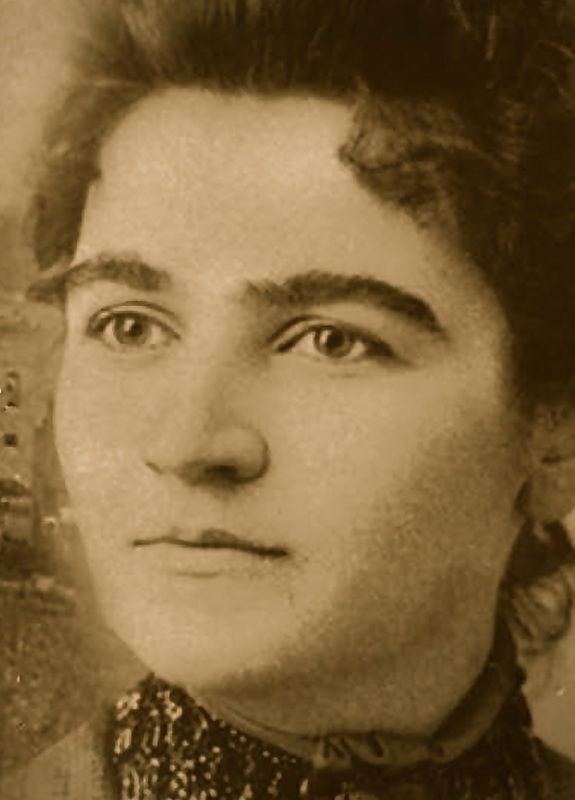
Mrs. Gene Stratton-Porter, whose portrait appears on this page, the author of “Freckles,” just published by Doubleday, Page & Co., is a daring and adventure loving nature photographer. From her childhood she has lived in the country and loved the woods. She is one of the best known and most successful photographers of birds in the United States. She has waded through swamps, risked quick sands, climbed lofty trees and forded swift rivers to get pictures. Her life has been in danger dozens of times. She lives in a fourteen room log cabin at Geneva, Indiana, in sight of the Limberlost Swamp, which figures so prominently in “Freckles.” She is the original of the Bird Woman in this delightful nature novel, which has real sentiment and an exquisite love story.

Prairie Warbler

By Alexandra Forsythe

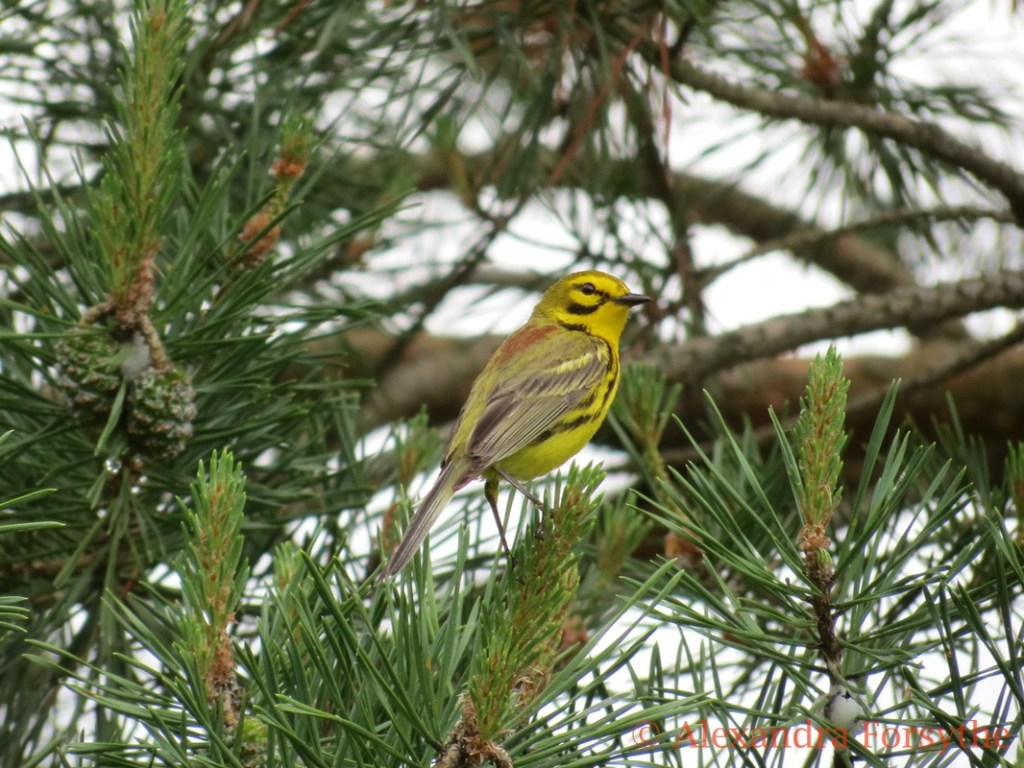
Despite its name, Prairie Warblers are not typically found in prairies or in back yards. As an early successional species, they prefer large brushy areas and young trees. They are not widespread in Indiana, and even the earliest records of sightings are few. Prairie Warblers were first recorded in the northern half of Indiana in 1892, with one recorded in Wabash on May 2, 1892 and two in Lebanon on April 29, 1892. In that year, the Prairie Warbler had only been reported in four locations across Indiana. (Amos Butler, Proceedings of the Indiana Academy of Science, Volume 3, 1893).

This tail-wagging little bird has been featured on several postage stamps, including stamps in Grenada, Barbados, British Virgin Islands, and most recently in St. Kitts. In 1951 the National Wildlife Federation offered Peterson’s illustration of a Prairie Warbler in the form of a collectible conservation stamp, and American Bird magazine offered slides of male, female and nestling Prairie Warblers for $0.50 in 1903. For the more gruesome, barbaric collector, you could buy a Prairie Warbler skin for the low price of just $0.15 in 1895. That was a bargain compared to the cost of a Bald Eagle at $6.00. (Natural Science News, Volume 1, October 5, 1985).

Thankfully we no longer shoot songbirds and sell the skins as collectibles. Nevertheless populations of many birds remain in decline largely due to human activity, loss of habitat, predation, and parasitism. The USGS North American BBS (Breeding Bird Survey) Population Trend Map for 1966-2013 shows an unmistakable decline in breeding Prairie Warblers in several states including Indiana. Between 1966 and 1993, the Midwest had an alarming 44% decline in breeding Prairie Warblers, and an overall 66% decline from 1966 to 2014. By the way, I confess I have a bit of an obsession with these BBS Trend Maps. I am in charge of the BBS for Adams County, and I assist with the BBS in Wabash and Huntington Counties, so I look at the Trend Maps often. Even if you are not helping with the BBS, I would encourage you to take a look at the Trend Maps for your favorite birds. You might be surprised. Incidentally, when the map indicates a percentage decline, that’s not the total decline. It’s a yearly decline. A “-1.5” indicates that the population dropped 1.5% each year from 1966 to 2013. Those declines add up!

Indiana University professor Val Nolan, Jr. studied the Prairie Warbler populations extensively and wrote a book in 1978 about his findings: “Ecology and Behavior of the Prairie Warbler”. His findings were troubling. The nests he studied suffered 24% parasitism by cowbirds, only 69% of the warbler nestlings survived to adulthood, and the annual female mortality was 35%. Using those numbers, he calculated that the population would barely replace itself. The U.S. Forest Service has conducted a more recent study of the Prairie Warbler and found that the biggest cause of the decline is no longer the cowbird, but habitat loss. (Conservation Assessment for Prairie Warbler, U.S. Forest Service 2001).

Fortunately, several Prairie Warbler habitats are being preserved. I found the bird in this photo happily residing at the Indiana Dunes last spring. New Jersey has set up a 1200-acre preserve specifically for Prairie Warblers: the Michael Huber Prairie Warbler Preserve.

If you decide to go in search of a Prairie Warbler, and if you bird by ear, take note: Prairie Warblers have two distinct songs. One song is used for courtship while the second song is used to mark territory. An excellent video of a Prairie Warbler singing his heart out can be found here: https://www.youtube.com/watch?v=XLKLCqN8WS0

Limberlost Essay

By David Smuts

The morning After the Flood, The Song of the Cardinal could be heard in the Music of the Wild. A Girl of the Limberlost sang with her Friends in Feathers as she skipped happily through the swamp. The girl was a Daughter of the Land. She loved all things in the swamp. She looked to the sky to see The Fire Bird and its brilliant Wings overhead. She smiled happily with a Morning Face and skipped along.

As she skipped along, she and a feather and thought to herself that Freckles would love to see this. She put it in her bag and went on her way. As she came to the edge of the swamp, she saw the White Flag and skipped even faster toward it. As she entered the Magic Garden, she saw Laddie and Michael O’Halloran.

She ran to them and yelled, “Guess What I Have Done With Birds? I have sung with them.”

“You have sung with birds!”

“Yes! Yes! I have sung with birds!” she said happily.

The Harvester has told me Tales You Won’t Believe about Birds of the Bible.”

The Keeper of the Bees told me about Moths of the Limberlost Homing With the Birds At the Foot of the Rainbow deep in the swamp.”

She smiled when she heard this news for she too knew of these tales from deep in the swamp. She looked up to the sky deep in thought, “Let Us Highly Resolve These Tales.”

She was Her Father’s Daughter and proud of it. In a kind gentle voice like her father’s she said, “The Limberlost is not just a place of magic but a place of wonder and caring like Jesus of the Emerald.”

The all looked at each other with a smile and skipped off into the swamp.

David Smuts wrote this essay incorporating titles of Gene Stratton-Porter’s books while a student at South Adams High School in the mid 1990s.

Beatrix Potter and Gene Stratton-Porter

By Rowena Godfrey

Beatrix Potter, world-famous author-illustrator of The Tale of Peter Rabbit and twenty-two other little books, was born in 1866, just three years after Gene Stratton-Porter. I believe that her powers of observation and her attitude to nature and conservation were similar to those of Gene.

Both Beatrix and Gene loved the countryside and hated living in towns. From her childhood onwards Beatrix spent long summer holidays with her family in Perthshire, Scotland, or in the Lake District in the north-west of England. During these times she had more freedom than was possible in London, and she roamed the fields and woods, closely looking at everything around her. A watercolor from the drawing book she made when she was eight shows at least twelve caterpillars, and records the subtle differences in their shapes and sizes. She stored all sorts of nature specimens (beetles, moths, birds’ eggs and more) in a collector’s cabinet, and kept a huge variety of animals, big and small, as pets. Before Peter Rabbit was published, she studied fungi in great detail for several years, and she took up photography. She continued to produce watercolor sketches of the countryside into her late middle age.

When Gene’s father formally presented her with all the birds that made their homes on his farm as her own personal property, she selected sixty-four nests, watched what the parent birds were choosing to feed their young, and then found insects for the wrens, grubs and worms for the red-winged blackbirds, caterpillars for the tanagers, and bugs and berries for the robins, thus becoming a third parent for the babies. Her later collection of moths, her novel The Girl of the Limberlost and her non-fiction work Moths of the Limberlost all show that she also was fascinated by these beautiful ephemeral creatures. Her photographs of birds, moths and her Limberlost surroundings were outstanding for that era, and also indicate just how observant and patient she was.

In the 1890s, through the influence of Canon Hawdwicke Rawnsley (one of the founding members of the National Trust), Beatrix became aware that the Lake District could be destroyed by inappropriate development, and her interest in conservation began. When she made money from the sale of her books in the early 1900s, she bought up farms and estates as soon as they became available. When she died in 1943 she bequeathed fifteen farms and over 4,000 acres of land to the National Trust, with precise provisos for how they were to be preserved for all time.

It was when the Limberlost was being cleared around 1900 that Gene realised that unless wetlands and forests are preserved, the land will suffer. In Music of the Wild (published in 1910), she wrote: “It was Thoreau who, in writing of the destruction of the forests, exclaimed ‘Thank Heaven, they can not cut down the clouds!’ Aye, but they can! … Pity of pities it is, but man can change and is changing the forces of nature. I never told a sadder truth, but it is truth that man can ‘cut down the clouds’.” In 1913 when she had made money from the sale of her novels and non-fiction works, she bought land beside Sylvan Lake. At Wildflower Woods she created a new type of garden, planting thousands of wild flower specimens in order to preserve them. Later, at her new home in California, she used the fame which her books had brought her and her work with the film industry to voice her belief in the importance of conservation.

Beatrix and Gene loved and respected nature. They observed creatures and plants closely – Beatrix principally drew and painted them; Gene mainly photographed them. They both used their observations and knowledge to underpin their stories for children and novels and wild life books respectively with hard facts from nature. They were both early conservationists, and they did and said what they could to protect and preserve the land in the way that suits it best – for future generations to enjoy.

Rowena Godfrey is a member of The Beatrix Potter Society. For further information about Beatrix, please go to beatrixpottersociety.org.uk

Song of the Limberlost

By Gene Stratton-Porter

I have read of the streams that flow over India’s golden sands, down Italy’s mountains, through England’s meadows; but none of them can sing sweeter songs or have more interest to the inch than the Limberlost.

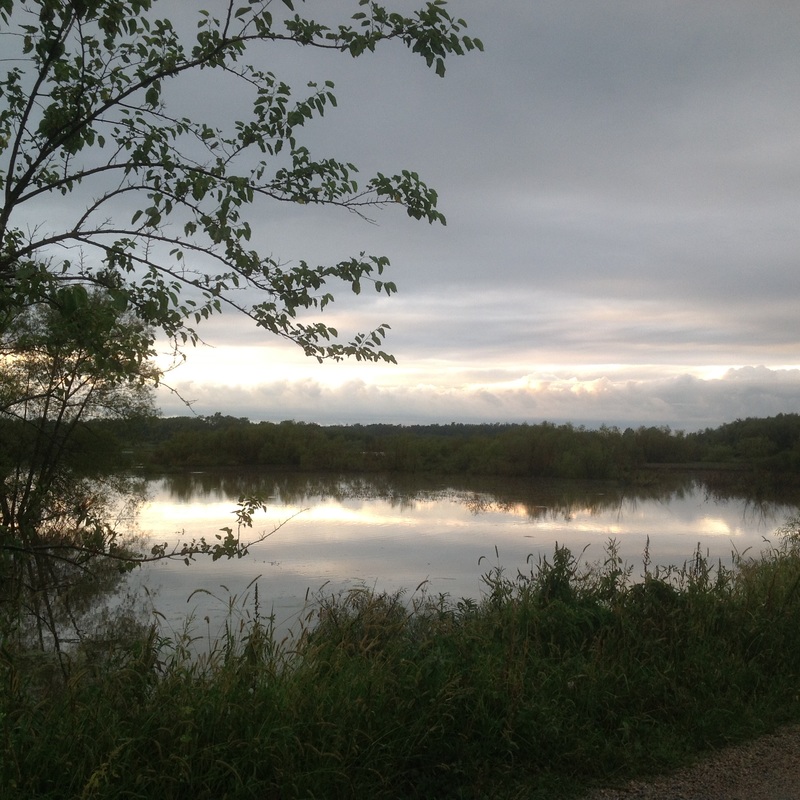
It is born in the heart of swampy wood and thicket, flows over a bed of muck or gravel, the banks are grass and flower-lined, its waters cooled and shaded by sycamore maple, and willow. June drapes it in misty white, and November spreads a blanket of scarlet and gold. In the water fish, turtle, crab, muskrat, and water puppy disport themselves. Along the shores the sandpiper, plover, coot, bittern, heron, and crane take their pleasure and seek their food. Above the hawk and vulture wheel, soar, and sail in high heaven, and the kingfisher dashes in merry rattling flight between the trees, his reflection trailing after him across sunlit pools.

The Limberlost is a wonderful musician, singing the song of running water throughout its course. Singing that low, somber, sweet song that you must get very close to earth to hear, because the creek has such mighty responsibility it hesitates to sing loudly lest it appear to boast.

All the trees rustle and whisper, shaking their branches to shower it with a baptism of gold in pollen time. The rushes and blue flags murmur together, and the creek and every sound belonging to it all combine in the song of the Limberlost.

Note: Excerpts from “Music of the Wild” in the section Songs of the Fields.