Birding Advice from Gene

By Terri Gorney

How was Gene able to take such incredible photographs of living birds and their nests? In her articles and in her bird study books she told her secrets of her success.

Gene’s first advice was to “use plain common sense. Approach the nest slowly, and when the young begin to cry, imitate them so that they will think you are a kindred thing.”

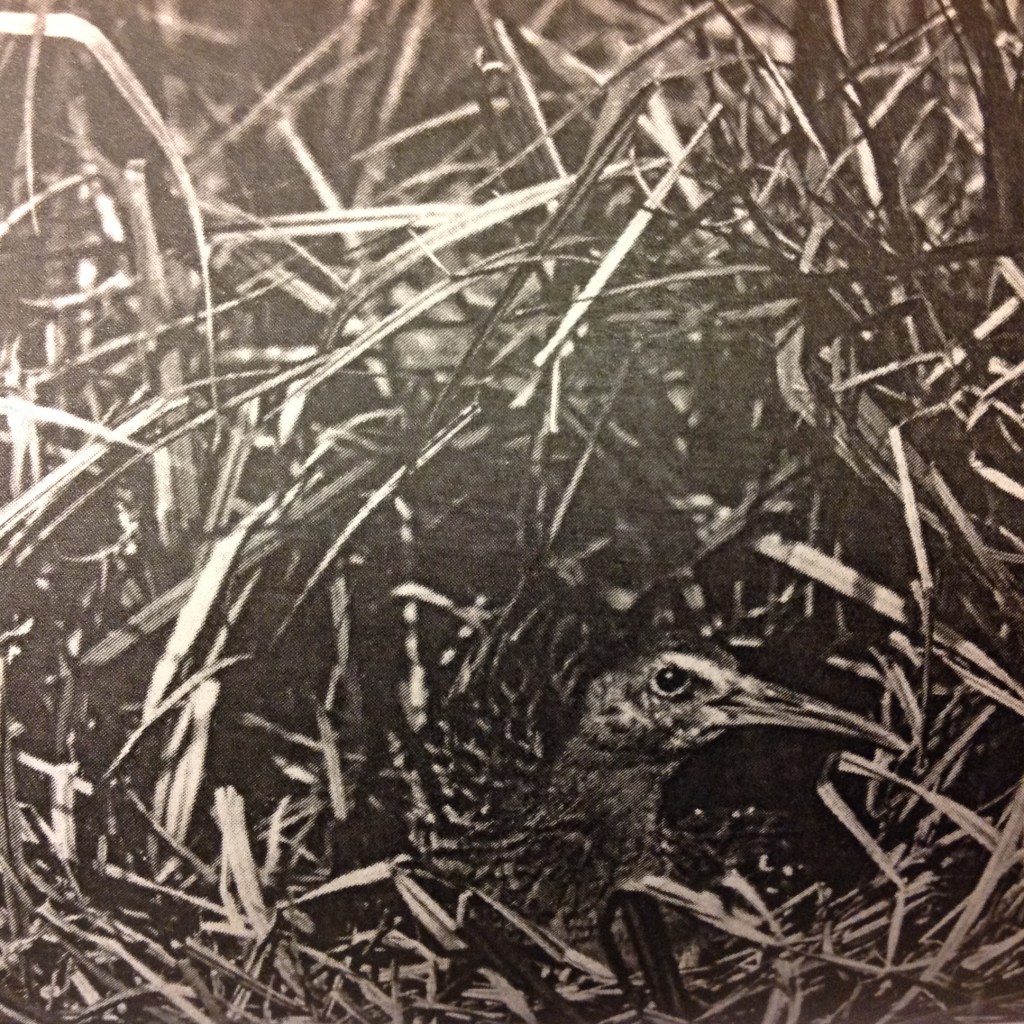
She had enormous patience and would spend hours and days to get the best pictures. She would allow the birds to become used to her presence to win their trust. For her king rail photographs, she came back seven days in a row and moved a little closer to the nest each day. She did not disturb the nest and Gene was able to get some great photographs.

She recommended spreading out food that the birds like and if necessary to feed them several times. In the winter, she enjoyed walks and would carry seed and bread with her to spread out along the road for the birds.

She dressed in what she called her “swamp clothes” that were comfortable and practical for work in the field. She hired young men to help her carry her gear. She had four cameras, one weighed forty pounds, a tall ladder, hose and waders. Two of the best men that she hired were Raymond Miller and Paxson. She writes about both men in her nature study books.

Since Gene lived in a time before the internet, she had a network of people in Geneva that she called her faithful friends or kind strangers who came to her when they had a bird or a nest of interest. Bob Black was an oil man who enjoyed hunting for bird nests in his spare time. He located over forty nests for Gene. Bob and Gene would remain lifelong friends.

Gene’s advice is still relevant over one-hundred years later. Common sense, patience, practical clothes and friends that will pass along information.

Mrs. Porter and the King Rail

By Terri Gorney

The King Rail is an elusive and shy bird and one that most birders will drive a distance for the chance to see; Gene Stratton-Porter was no exception. She was excited when someone knocked on the door of the Limberlost Cabin and told her there was “a big bird brooding” that was about “seven miles east of the Cabin, in a small swamp in one corner of Eli McCollum’s cornfield.”

Because of the distance, Gene had to wait until the next morning before leaving on her birding adventure. She wrote that she dreamed of the bird that night. She packed four cameras, one weighed forty pounds, dressed in her “swamp outfit” and loaded everything into a wagon to be pulled by a horse.

This area was on higher ground and was between the Limberlost and the Canoper. It was northeast of the town of Geneva. It was not an area that Gene Stratton-Porter went to bird. She stopped once to ask a farmer for directions as it was “new country” to her.

Many are thrilled just to hear the bird but that would never do for Gene. She photographed the female bird and her nest. She made a study of the rail coming back seven days in a row. She was patient and got a little closer to it every day. She called her the “Queen” rail on her nest. She wrote of there being twelve eggs in it. She noted that she made seven 14 mile round trips for a total of 98 miles in one week.

Gene’s account of the King Rail along with pictures is a rare documentation of the bird in Indiana for that time period. This encounter with Gene and the King Rail happened over 100 years ago northeast of the town of Geneva in rural Adams County. Using Gene’s words, the 1900 map of Adams County, google maps, and cemetery records, I was able to pinpoint where she saw and photographed the King Rail. Gene would recognize the area today. It is much as she described it. She wrote that she “turned from the wide broad highway and drove up a narrow country road.” In 2016, there was a cornfield there.

Gene would be pleased to know that King Rails, Virginia Rails, and Soras can now be seen or heard at the Limberlost Swamp Wetland Preserve just a short distance from the Limberlost Cabin. The north part of the preserve can be seen from the cabin’s yard.

Birders of any age might enjoy reading her non-fiction bird studies “What I Have Done with Birds,” “Friends in Feathers,” and “Homing with the Birds.” Her story of the King Rail is in the first two books.

Little known fact: Gene was a member of the Indiana Audubon Society, served as an officer and spoke at the Spring Meeting of 1908 in Fort Wayne.

Updates at the Indiana State Museum

By Megan Sanctorum with WishTV.com

The Indiana State Museum is working to change the way you explore the state’s history.

A transformation is underway to make the museum more interactive and hands-on. Museum leaders call it “story-based learning.”

New technology is being integrated throughout the exhibits. There will also be more demonstrations and audio for people to explore.

These updates are part of the “INVision Campaign.” It’s an $18 million project for the Indiana State Museum and its 11 historic sites.

The goal is to keep the valuable lessons the museum offers right now, but bring them out in new ways to connect with more people.

“We’ve really looked at what the signature experiences are in each of the sites. What really is that great story where you’re going to the place where history really happened and how we can bring that out in new ways,” said Susannah Koerber, Senior Vice President of Collections and Interpretation.

This is a five phase project that is expected to be completed by 2019.

If you want to check it out the first phase of this upgrade opens to the public on November 12.

Recently acquired collection of Gene Stratton-Porter letters, photos offer more details of her life

By Kevin Kilbane with the News-Sentinel

Her wedding announcements were simple and calling card size, inviting people to her marriage at 9 p.m. April 21, 1886, to Charles Porter of Geneva. The bills show it was a frugal affair.

Those are just two items in a new collection of letters, documents and photos that offer brief glimpses into the life of famed Indiana author and naturalist Gene Stratton-Porter and her family.

The collection, which the Indiana Historical Society (IHS) acquired this summer, recently became available for viewing in the IHS library in Indianapolis. Staff there also have begun making digital scans of items in the collection so they can be viewed online.

The collection contains no startling revelations, said Terri Gorney of Fort Wayne, who has been researching the author’s life and connections to Fort Wayne.

Gorney had hoped to find clues about whether Stratton-Porter owned a home in the 2400 block of Forest Park Boulevard in Fort Wayne. Property records for the house suggest she bought the lot and built a home there.

The IHS collection, which includes some items from 1886 and then jumps to the period of 1916-1923, doesn’t contain any references to a Forest Park Boulevard house, said Gorney, who drove to Indianapolis recently to see the collection with Randy Lehman, the recently retired site manager of one of Stratton-Porter’s former homes, the Limberlost State Historic Site in Geneva.

A RARE FIND

Lehman described the IHS collection as “a big deal.” Possibly because Stratton-Porter died unexpectedly at age 61 in a December 1924 car crash in Los Angeles, there doesn’t seem to have been an effort to create a formal archive of her letters, photos and other records, he said. Items such as those in the IHS collection are scarce.

“Anyone wanting to know Gene better can read through many letters, almost all of them typed, and look at many photographs for insight and historical reference,” Lehman said in an email.

Two photos really captured his attention:

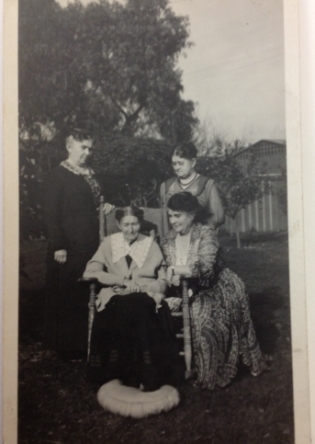
* One is a “very rare” image showing Charles Porter with Gene, their daughter Jeannette’s two daughters, and other family members.

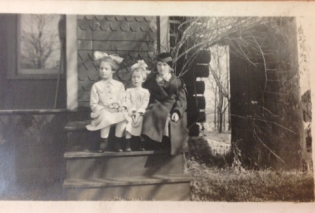
* The other shows the two granddaughters sitting on steps with a cousin, Leah Stratton.
“This picture was taken at the Limberlost Cabin in Geneva, and it clearly shows them sitting on steps that led up to the ice box just off the kitchen porch,” Lehman said. “We always thought the steps would have been necessary for the iceman to deliver ice to GSP’s (Gene Stratton-Porter’s) icebox, but it was just a theory — the original steps, if they were ever there, are long gone.

“Now we have a photograph that clearly shows the steps with GSP’s grandchildren sitting on them,” Lehman said. “It’s also proof that GSP and the grandchildren visited Geneva after she had moved into her Rome City home, which is the opposite to what some people claim — that GSP never came back to Geneva once she left in 1913.”

INTERESTING DETAILS

Gorney found interesting and sometimes humorous details in letters in the collection:
The documents include a typed version of Charles Porter’s first letter to Gene, who was born Aug. 17, 1863, near Wabash. Porter describes seeing her at a Chautauqua event in Rome City and on the train departing there afterward. With the clumsiness and salesmanship of a man clearly smitten, he invites her to begin corresponding with him.

In a May 28, 1886, letter to her father about a month after her marriage, Stratton-Porter mentions buying paints, brushes and art canvas at Keil Bros. in Fort Wayne, Gorney said. Some of the first paintings she did as a newlywed likely were with paints purchased in Fort Wayne.

In a Feb. 10, 1919, letter to her sister Ada Wilson of Fort Wayne, Stratton-Porter asks her sister to go get a certificate of deposit Stratton-Porter had at the local Tri-State Loan & Trust. But she asks Wilson not to mention it to Charles Porter or their daughter, Jeannette, because they didn’t know she had it.
Stratton-Porter grew up in a financially insecure household, so that may be why she kept some money of her own, Gorney said.

In another letter, Stratton-Porter tells her sisters that, in case she dies, she has set aside $5,000 in savings for Leah Stratton. Gene became Leah’s guardian after the 1916 death of Lemon Stratton, Gene’s brother and Leah’s father.

In a Sept. 7, 1919, letter to Wilson, Stratton-Porter mentions sales of her books declined dramatically during World War I. “I had to use a microscope on the check,” she said, referring to her payment.

However, in a March 6, 1923, letter to sister Florence Compton of Fort Wayne, Stratton-Porter proudly shares that she was paid $12,500 for her poem “Euphorbia,” the most she had ever received for her poetry, Gorney said.

EXCITING TIMES

Stratton-Porter had moved to the Los Angeles area in 1922 to get involved in filmmaking, and letters to her sisters describe the exciting lifestyle there.

“I met a string as long as your arm of etchers, painters, sculptors, with a sprinkling of poets and authors, and I had such a glorious good time that I wish I could do that kind of a party over twice each week all the rest of my life,” Stratton-Porter said in one letter.

Letters in the collection also show she didn’t forget her rural Indiana roots, Gorney said. Even after becoming a popular author, Stratton-Porter wrote to her sisters about things such as cleaning house, canning food and trying to find cheap peaches to make peach butter and peach jelly.

“She was a regular person,” Gorney said.

Gorney and Lehman both believe more of Stratton-Porter’s letters and papers still exist in private hands.

Now that IHS has started a Gene Stratton-Porter collection, Gorney hopes people will donate items to it so we all can learn even more about the author’s life.
A Walk in Music of the Wild

By April Raver

Since the beginning the forest has been singing its song, but few there are who have cared to learn either the words or the melody. Its chorus differs from that of any other part of the music of nature, and the price that must be paid to learn it is higher. The forest is of such gloomy and forbidding aspect that intimate acquaintance is required in order to learn to love it truly. So only a few peculiar souls, caring for solitude and far places, and oblivious to bodily discomfort, have answered this wildest of calls, and gone to the great song carnival among the trees. – Gene Stratton Porter, Music of the Wild

And it was with this attitude that I drove down SR18 towards Geneva last Saturday. I had spent many weekends wandering around the Limberlost Swamp. I’d tackled the new Deacon’s trail and enjoyed the Loblolly prairies and marveled at the beauty of Woodie Retreat. I’d explored Rainbow Bottom and driven around every county road in the area…but I’d yet to step foot into Music of the Wild or the Bird Sanctuary. There was something about those trees – that forest – which had kept me scouting the outskirts but never venturing inside.

A month earlier I had seen that Curt Burnette would be leading a new hike at Limberlost – in the Music of the Wild. This was the one area of the Limberlost that I had yet to explore. What better way to explore a new area than with Curt as my guide? And as I made the hour drive to the Limberlost on that day, I pondered what the day would bring. What wonders were hidden in those trees that I had carefully avoided? What beauty lay beyond the tree line? What chorus sang among the branches? What creatures fluttered among its leaves? I was about to find out.

We met at the visitor’s center in Geneva before our hike. We checked out the beautiful art in the Now and Then exhibit and listened to a few words of instruction from Curt before we headed out. We then drove down US 27 a few miles to our first stop: the marked entrance to “Music of the Wild.” We parked near the entrance sign and started walking north towards Limberlost Creek. Curt told us we were walking along the old railroad bed. In Gene’s time, the road used to run on the other side of the railroad bed. Not far from where we parked the path dead ends at the creek. Here Curt stopped and read to us a section of the book Music of the Wild. This is one of the spots in Geneva that we can match up to where Gene is describing as she wrote her book. She describes the place where the railroad bridge crossed the creek. “Here the creek reaches deep-shaded channel once more, and bursts into song crossing Armantrout’s pasture; for it is partly shaded, though many large trees on the banks are being felled. A happy song is sung on Rayn farm, where it is sheltered by trees and a big hill. In full force it crosses the road again, slides below the railroad bridge, rounds the hill, chanting a requiem to the little city of the dead on its banks, flows through the upper corner of the old Limberlost swamp, hurries across the road once more, and so comes singing into Schaffer’s meadow.” Currently the only way over the creek is on the road, as the railroad bridge is long gone. It was amazing to think of Gene standing in this spot one hundred years before. We back tracked our steps and turned to enter the forest just before it meets the creek. As we entered into the woods, a chorus of birds sang to us from high up in the treetops. One could almost see Gene standing on the edge of the creek, as the water trickled by and the birds sang their majestic songs. Did she have her camera in hand to capture live pictures of the creatures she so loved? Or did she have a pen and paper to record her observations? Or did she just simply stand – and enjoy the beauty that surrounded her? Because there is no bridge over the creek and with thanks to the several inches of rain Geneva had received in the days leading up to the hike, the rest of the Music of the Wild preserve was cut off from this small section. We returned to our cars and drove around to the other side of the preserve.

On this day, we had received special permission to park in the DNR Maintenance Building lot. To visit this side of Music of the Wild you must normally park in the Bird Sanctuary parking lot as parking is normally not allowed in this area. We walked back past the DNR building and into the trees. As we first stepped into the forest the tree canopy shaded our path but as the sun broke through the clouds over head, bits of sunbeams danced on the path as if beckoning us to travel deeper within. Off to the right, we quickly spotted a Brown Thrasher’s nest low among the branches of a bush to the side of the path. Much to my surprise we quickly turned to our right and walked out of the canopy of trees and into an open meadow with a nicely mowed path for us to follow. We walked along the path and appreciated the summer beauty that was still abundant on this fall day. The last of the purple asters and the bright yellow shafts of goldenrod poked out among the browning grasses of the prairie. A robin serenaded us from a power line above. Gene writes in Music of the Wild, “Robins are the alarm clocks of the fields, for almost without exception they wake the morning and all birds with their glad cry, ‘Cheer up!’” Good morning to you, too, Mr. Robin. Further along the path, Curt found part of a snake along the path, which had met an unfortunate end most likely by the mower. Just to our left along the path a small wetland was visible through the prairie grasses. As we walked, we talked of berries and plants and trees and leaves. Curt found a gall on the stem of a plant and explained to us how it was created. Suddenly a Song Sparrow flittered among the dormant branches of a bush as we walked by. As we approached the backside of the forest we had visited earlier, the path again became very soggy and we decided to take a shortcut to avoid the wet area. Suddenly a Red-tailed Hawk soared over our heads as we walked along. Curt told of a pair that had nested in the forest ahead – perhaps this was one of the pair? “By no stretch of the imagination could the big hawks be coupled with melody. They are the kings of the treetops, but they use a sign language that all other birds readily translate,” Gene writes in Music of the Wild. A little further along she continues: “There is not much to be said for hawk music, yet the voice of the forest would lose the charm of its wildest note were this great bird extinct, and it is because it is wild and different from sounds of every day that we love it. Then, as a picture seen from afar, the forest never would be complete without these birds of tireless wing hanging over it and reining upon their thrones of air.” As we came to the end of the prairie trails, we walked along the edge of a freshly cut farmer’s field. We marveled at the ability to see the hills and valleys that were suddenly visible in this flat open space. We admired some hollowed out trees and pondered what lightening strikes, insects, or animals that may have caused them. And then once again, we stepped into a forest. Colorful leaves scattered the forest floor as we walked along. Bright greens and yellows reflected the sun light from above. Thorny arms reached out to grab onto our sleeves as we walked along. Beautiful fungi of all kinds were growing in this part of the woods. The warm temperatures and wet weather had made conditions just right for their growth. A doe appeared at the edge of the woods and disappeared just as quickly. Before long the path emerged into the parking lot of the Bird Sanctuary and we checked out the map posted there to see where all we had traveled. We then followed the path further into the trees. After walking through the Goodrich Forest along paths of pine needles and enjoying more beautiful fungi blooms, we came upon another slightly larger wetland. We were careful to watch our step, as muskrat holes were abundant along the path. We didn’t see any muskrats on this day, but they were obviously around. We circled the wetland and headed back into the trees and followed the path back to our cars. At the edge of the forest, before we departed ways, a chorus of song filled the air as cardinals, finches, and sparrows sang adieu from the branches.

We spent three hours together exploring two miles of some of Geneva’s finest land: prairies, wetlands, fields, and yes– forests. After finally deciding to venture into some of Geneva’s forests, I agree with Gene who wrote further into Music of the Wild: “But to all brave, happy hearts I should say, ‘Go and learn the mighty chorus….’” I’m glad I finally decided to listen to the mighty chorus of the forest and I cannot wait until I can again return. If you are like me – and have explored much of the Limberlost, but avoided the Music of the Wild – I encourage you to take the time to visit the Music of the Wild and listen to the “chorus of the forest.”

Barred Owl

By Alexandra Forsythe

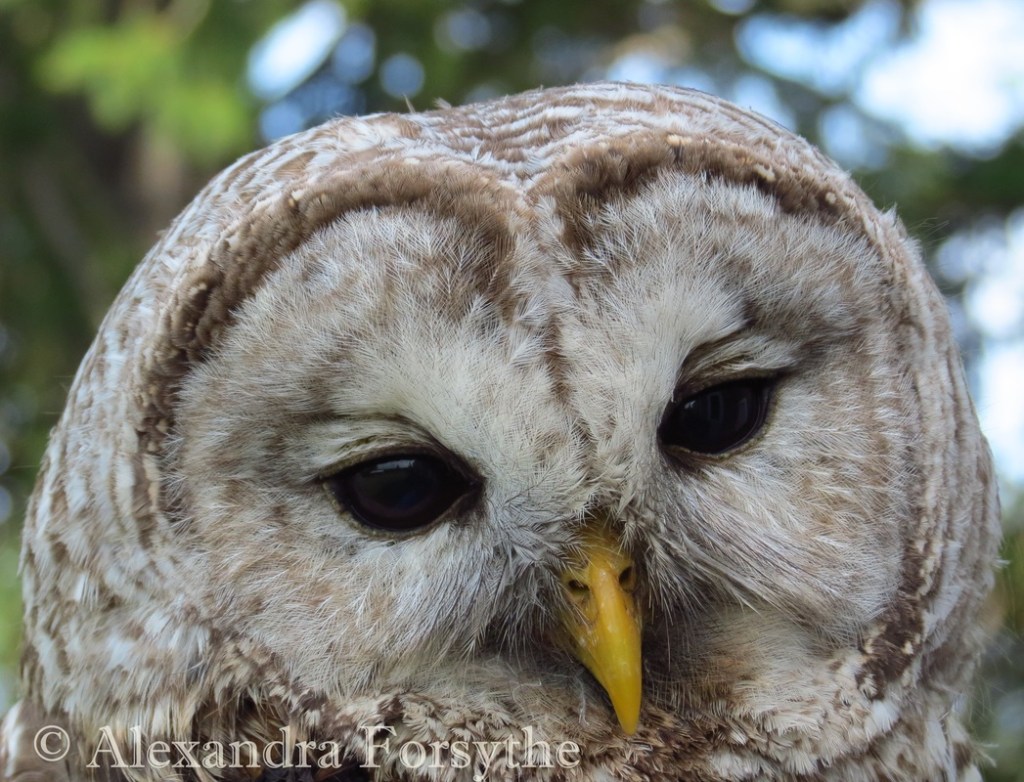
As a raptor rehabber, I’ve been privileged to work with some of the most amazing birds, including Barred Owls. As one of Indiana’s larger owls, the Barred Owl sits near the top of the food chain (beneath the Great Horned Owl). However, they do not have the same menacing attitude of their larger cousins. Yes, they do use their talons to their full advantage, but they also have a warmth and friendliness about them. Just look into those eyes!

Barred Owls are usually easier to find by ear than by eye. Listen for their distinctive call: “Who cooks for you? Who cooks for you all?” If you want to see a Barred Owl up close, you can often spot them around dusk flying low over the wetlands of the Limberlost Swamp in Geneva, Indiana.

While most owls prefer to eat mammals and like to stay dry, Barred Owls have a fondness for fish, frogs and crayfish, and are willing to wade in water to catch their prey. They will eat mammals, but the Barred Owls with which I have dealt have always preferred surf over turf.

Barred owls do not suffer from wanderlust; they instead choose to stay close to home all year. They have, however, slowly expanded their range and have been displacing and hybridizing with Spotted Owls in the Pacific Northwest. Since Spotted Owls are threatened with extinction, a controversial plan was put in place that includes killing Barred Owls living in the Spotted Owl’s range. The argument for the plan is that it is better to kill Barred Owls directly rather than kill Spotted Owls indirectly. You can read about the plan and the arguments here: http://www.newsweek.com/2015/05/29/killing-barred-owls-keep-spotted-owls-breathing-332540.html. Without human interference, Barred Owls are definitely survivors. Fossils of Barred Owls indicate they have been in existence for over 11,000 years (Hiscock Site, Genesee County, NY). Hopefully they’ll be around for thousands of years to come!

Gene Stratton-Porter, Geoscientist?

By Adrienne Provenzano

October 9 – 15, 2016 marks this year’s Earth Science Week, with the theme “Our Shared Geoheritage.” First started in October 1998 by the American Geosciences Institute, which seeks to connect “earth, science, and people,” the annual national and international event is a way to “help the public gain a better understanding and appreciation for the Earth Sciences and to encourage stewardship of the Earth.”

According to the AGI website for the event (EarthSciweek.org), geoheritage is “the collection of natural wonders, landforms, and resources that have formed over eons and come to this generation to manage, use, and conserve effectively.” Rocks and minerals, fossil fuels, water, air, and plant life are all part of the Earth’s geoheritage.

Ample information about Indiana’s geology in particular – including energy and mineral resources, water and environment, and even geological hazards, can be found at igs.indiana.edu, the site for the Indiana Geological Survey, an institute of Indiana University since 1993.

Gene Stratton-Porter was reluctant to label herself a scientist, and preferred to refer to herself as a nature lover. She was aware of the complex systems of the Earth, as evidenced in this quote from Music of the Wild: “It was Thoreau who, in writing of the destruction of the forests, exclaimed, ‘Thank Heaven, they cannot cut down the clouds!’ Aye but they can! That is a miserable fact, and soon it will become our discomfort and loss. Clouds are beds of vapor arising from damp places and floating in air until they meet other vapor masses, that mingle with them, and the weight becomes so great the whole falls in drops of rain. If men in their greed cut forests that preserve and distill moisture, clear fields, take the shelter of trees from creeks and rivers until they evaporate, and drain the water from swamps so that they can be cleared and cultivated – they prevent vapor from rising; and if it does not rise it cannot fall. Pity of pities it is: But man can change and is changing the forces of nature. I never told a sadder truth; but it is true that man can ‘cut down the clouds.'”

Whether roaming the prairie potholes formed by the glaciers in her beloved Limberlost, observing the flora and fauna along the Wabash River flowing above its limestone bed – like the hero of her Song of the Cardinal, or noticing the changes in landscape as oil, gas, and lumber were removed from the region, Gene Stratton-Porter took note of Indiana’s geoheritage, and shared her perspective in fact and fiction. Many connections of Earth, science, and people can be found in Gene Stratton-Porter’s works – and a visit to the Limberlost Cabin and the nature preserves associated with it reveals the contemporary connections as well. So while Gene Stratton-Porter may not have considered herself a geoscientist, she certainly appreciated our shared geoheritage!

Next Indiana Campfire Burns Bright at Limberlost

By Terri Gorney

“The Limberlost was arrayed as the Queen of Sheba in all her glory,” wrote Gene Stratton-Porter. Gene’s literary legacy and the natural history of the Limberlost were very much front-and-center at a sold out Trek and Talk hosted by Indiana Humanities and Limberlost State Historic Site at the Loblolly Marsh on Saturday night, October 8. Indiana Humanities created this unique program to connect literature and the land for Indiana’s Bicentennial.

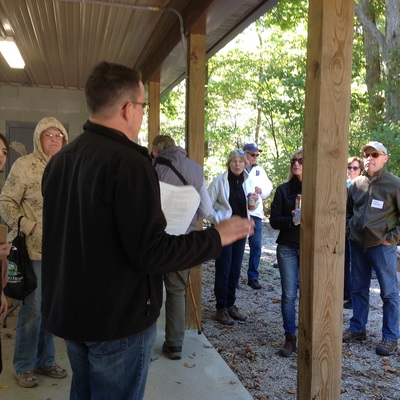
It was a perfect day for exploring the Limberlost. It began with a special tour of Gene’s Limberlost cabin in Geneva conducted by “retired” site manager, Randy Lehman. Guests heard about “Freckles,” and Elnora, and the Bird Woman’s connection to the cabin.

Limberlost naturalist, Curt Burnette, and Professor Rachel Blumenthal, from IU Kokomo, led the hike through the Loblolly Marsh’s prairie. The Loblolly Marsh was the first of the Limberlost territories to undergo restoration beginning in 1997, and that process continues today. There are basically five wetland preserves that are part of the Limberlost territories in northern Jay County and southern Adams County—all managed by DNR Nature Preserves.

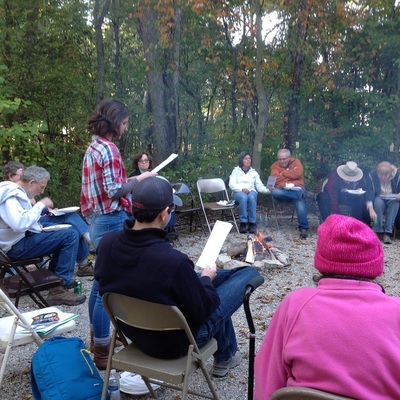
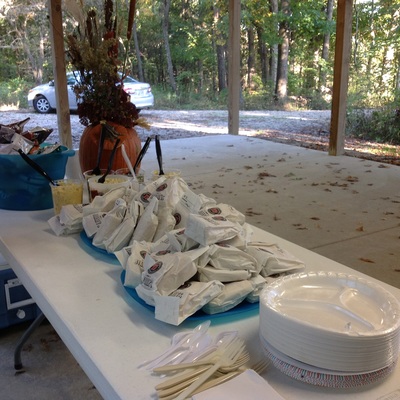
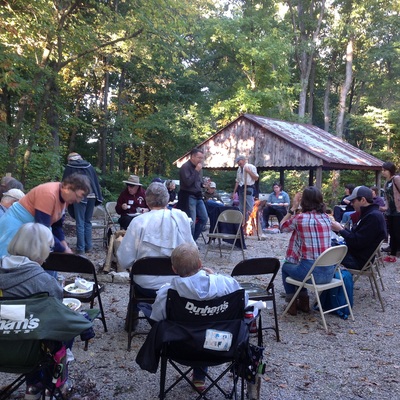
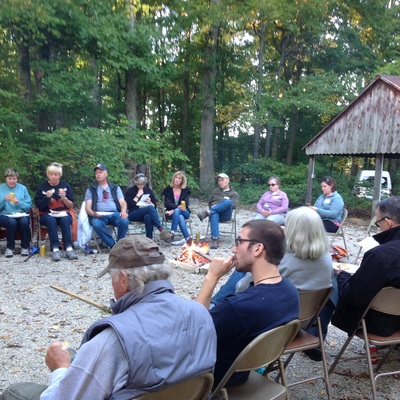
After the hike, dinner was served around a campfire at the well-equipped Loblolly Pavilion. Judy Williams, a Friend of the Limberlost, made a special centerpiece with natural items found around her home and guests enjoyed a special Bicentennial treat that she made for the occasion. We also welcomed Jim Langham, a journalist from the Berne Witness. Jim came to enjoy the hike and to get material for an article he was planning for the newspaper about this event.

After dinner, Professor Blumenthal led a good discussion of Gene’s writings and shared the poetry of some contemporary nature writers of today. The evening was not complete until s’mores were served and Adrienne Provenzano sang Curt’s poem “Loblolly Lullaby” and Gene’s 1916 poem “Limberlost Invitation.”

Thank you to Indiana Humanities for visiting Limberlost. It was fun working with the staff to make this event happen. We welcomed Jay County native George Hanlin home. George is a former resident of Pennville in Jay County, and he now serves as the Head of Grants for Indiana Humanities. A special thank you to Indiana Bicentennial Director, Perry Hammock, for another return visit to Limberlost, and we also thank the Indiana Historical Society, the Indianapolis Hiking Club, and guests from all over Indiana for attending this event.

If you missed this event, on October 22 Curt will be leading a hike at the Music of the Wild Nature Preserve. This is another Limberlost wetland property located in Jay County. The name is taken from Gene Stratton-Porter’s book, Music of the Wild, and the area that will be hiked is the same general area Gene refers to in the second part of her book. Curt will be exploring the nature of this preserve following along with Gene’s words. This is the perfect time of year to amble along Limberlost Creek, which flows through a section of this nature preserve.

Check out #trekandtalk Indiana Humanities