This is a sample from Chapter One of Gene’s book, “Moths of the Limberlost.” We hope the reader will enjoy and want to read more and visit the Limberlost Cabin in Geneva. This nature study book has stood the test of time.
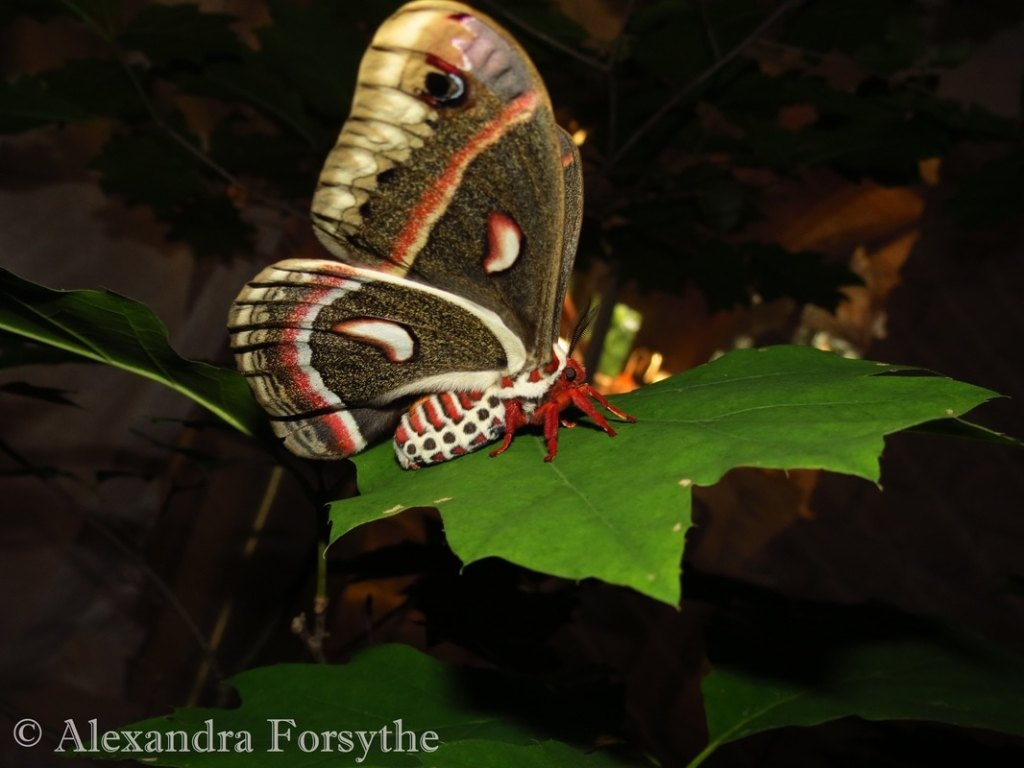
Primarily, I went to the swamp to study and reproduce the birds. I never thought they could have a rival in my heart. But these fragile night wanderers, these moon-flowers of June’s darkness, literally “Thrust themselves upon me.” When my cameras were placed before the home of a pair of birds, the bushes parted to admit light, and clinging to them I found a creature, often having the bird’s sweep of wing, of color pale green with decorations of lavender and yellow or running the gamut from palest tans to darkest browns, with markings of pink or dozens of other irresistible combinations of color, the feathered folk found a competitor that often outdistanced them in my affections, for I am captivated easily by color and beauty of form.
At first, because these moths made studies of exquisite beauty, I merely stopped a few seconds to reproduce them, before proceeding with my work. Soon I found myself filling the waiting time, when birds were slow in coming before the cameras, when clouds obscured the light too much for fast exposures, or on gray days, by searching moths. Then in collecting abandoned nests, cocoons were found on limbs, inside stumps, among leaves when gathering nuts, or queer shining pupae cases came to light as I lifted wild flowers in the fall. All these were carried to my little conservatory, placed in as natural conditions as possible, and studies were made from the moths that emerged the following spring. I am not sure but that “Moths of the Limberlost Cabin” would be the most appropriate title for this book.
“When you come to the end of a perfect day, And you sit alone with your thought, While the chimes ring out with a carol gay, For the joy that the day has brought, Do you think what the end of a perfect day Can mean to a tired heart, When the sun goes down with a flaming ray, And the dear friends have to part?
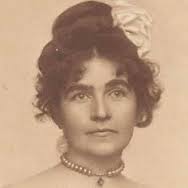
The composer and publisher Carrie Jacobs-Bond (1862- 1946) penned those words while staying at the Mission Inn in Riverside, California in 1909 after watching a sunset with friends. A few months later, she added a melody. In her autobiography, The Roads of Melody, she notes “ I was crossing the Mohave Desert, in the moonlight, with some more nature-loving friends; and without realizing that I had memorized those words, I began singing them to the original tune.”
The song “A Perfect Day “ was released in 1910 and went on to sell millions of copies and was very popular during World War I. It is one of Jacobs-Bond’s most enduring and heartfelt compositions. “I Love You Truly” is another of her 175 songs. Gene Stratton-Porter sent some poems to Carrie Jacobs-Bond to set to music, but no such settings were ever published, if even composed.
Carrie Jacobs-Bond was born in 1862 in Janesville, Wisconsin. She eventually moved to Chicago, Illinois and later to Hollywood, California. A pianist and singer, she composed music as a way to supplement her income when widowed to help support her young son. The difficulty of finding a publisher led her to publish her own music, starting the company in her small apartment, and eventually The Bond Shop was a very successful publishing company. It is easy to imagine that Gene Stratton-Porter may well have owned some of Jacobs-Bond’s sheet music and perhaps played and sang it in the music room of Limberlost Cabin. A watercolorist and china painter, Carrie Jacobs-Bond often decorated the covers of her music with her own paintings of roses and other flowers.
Detective work by Terri Gorney in various historical archives reveals that both Gene Stratton-Porter and Carrie Jacobs-Bond were guests of honor at several events in California in 1922 and 1923. On Sunday, December 10, 1922, a dinner party was given in honor of both women at a home on Wilshire Boulevard in Los Angeles at home of Mr. and Mrs. Howard Eugene Verbeck, he was an art photographer and she was a vocalist. Mentioned in the “society” pages of the Covina California “Argus” there was an interesting group in attendance, including musicians and actors. One can imagine lively and fascinating dinner conversations between this gathering of creative people.
In a letter now in the Indiana Historical Society’s collection, from Gene Stratton-Porter to one of her sisters, she describes in detail the “wonderful bouquet of old fashioned things” given to her at a Press Club of Los Angeles reception at which there were 500 people in attendance and she and Carrie Jacobs-Bond were guests of honor. “Mine began with a center of rosebuds, then a round of white sweet peas.” As Stratton-Porter notes, Mrs. Bond also received a bouquet – “all lavender and purple.”
Both women enjoyed music, were poets and painters, liked nature, were successful business women, were wives and mothers, and moved from the midwest to California to pursue their careers. Jacobs-Bond struggled with ill health at various times of her life, and didn’t have the financial stability that Stratton-Porter had, but both were able to succeed financially and artistically. Jacobs-Bond was invited to perform for both President Theodore Roosevelt and President Warren G. Harding. She enjoyed the works of Hoosier author James Whitcomb Riley and was certainly familiar with Gene Stratton-Porter. In many ways, Jacobs-Bond embodied the grit, perseverance, and resilience of many of Stratton-Porter’s characters.
To celebrate Women’s History Month, Adrienne Provenzano, otherwise known as the Songstress of the Limberlost, recorded a performance of “A Perfect Day” and Bill Hubbard, part-time naturalist at the Limberlost State Historic Site, put together a slideshow to accompany the music. You can see and hear it at limberlost.weebly.com and on the Friends of the Limberlost Facebook Page. We like to think there are many such “perfect days” at the Limberlost! Now that Spring is here, we invite you to come and experience some!
Well, this is the end of a perfect day, Near the end of a journey, too; But it leaves a thought that is big and strong, With a wish that is kind and true. For mem’ry has painted this perfect day With colors that never face, And we find, at the end of a perfect day, The soul of a friend we’ve made.
Since 1987 the US has celebrated “Women’s History Month” each March. Every year institutions like the Library of Congress, the National Park Service, and the Smithsonian Institution observe this month by paying tribute to the women who have come before us. Likewise, the Indiana State Museum and Historic Sites are celebrating, and we here at the Limberlost SHS are proud to honor Gene Stratton-Porter and her role in history.
On Saturday March 4, the Indiana State Museum held a conference called “Remarkable Women.” This year’s theme was “Women in Science,” and if there is anyone who can be considered a remarkable woman of science, it’s certainly Mrs. Porter.
Visitors to the museum were able to interact with the State Historic Sites who came to showcase their own women in science. At the Limberlost booth, we highlighted Gene’s nature books, her work as a photographer, and showed off some bird nests and moth cocoons. There were quite a few fans of Mrs. Porter—from readers who shared their favorite books, to scientists like Purdue professor of entomology Tom Turpin who shared how he was inspired by Gene’s work with moths. On the contrary, many people were hearing about Gene for the first time and were surprised at the many roles she played. Both adults and children alike enjoyed learning about orioles, cecropias, and the Limberlost.
About half of Indiana’s State Historic Sites were in attendance. New Harmony SHS featured Lucy Say and her connection to the site. The folks from Culbertson Mansion led a hands-on activity where kids could create their own “stenciled ceiling.” This simulated artist Kris Lemmon’s restoration work at the mansion. T.C. Steele SHS focused on Selma Steele and her work as a naturalist. At the Angel Mounds display, visitors could go on an archeological dig. Finally, Rhonda Deeg, a stained glass artist from Madison, showed guests how she helps restore historic windows and lamps.
From 11 a.m. to 4 p.m., four different speaking presentations were held, including keynote speaker Ora Pescoviz, M.D., a pediatric endocrinologist and researcher. Also in attendance was a fourth grade class from Cumberland Elementary School. Along with their teacher and a group of Purdue University students, they are working to have the Say’s Firefly named as Indiana’s State Insect.
The Remarkable Women event was a great way to showcase some of Indiana’s noteworthy ladies of science—both past and present. Here at the Limberlost, we are fortunate to celebrate women’s history everyday as we share the story of Gene Stratton-Porter with our guests. We invite you to celebrate Women’s History Month with us by taking a tour of the Limberlost Cabin or reading one of Gene’s many books!
Editor’s Note: The following was found while I was reading and researching the Geneva Herald. The following article was in the 7 Apr 1904 issue, p. 1. It is part of continued research for the Limberlost State Historic Site. The Alex Bolds farm in this article is now part of the Limberlost Swamp Wetland Preserve. It sits about where the Deacon’s Trail is located in Section 32. Even though this area was ditched and drained it would still flood just as it does today. Terri Gorney
Plunges Into the Water to Rescue Neighbors
C. L. Caldwell, living two and a half miles southwest of Geneva on the Fred Bimel farm, at the risk of his own life went to the rescue of a neighbor, a Mr. Ward, who lives on the Alex Bolds farm, in the famous Loblolly district, who awakened Saturday morning, March 26 th , to find his house surrounded by water from five to six feet deep and twenty six inches on the floor. Caldwell worked heroically from 7 in the morning until 5 o’clock in the evening, in water two to six feet deep and the waves at times rolling two feet high, and with ice froze about his neck and shoulders. The only thing he had near him to depend upon to help him in his struggle against the water and peril to which he was exposed was a box wagon bed which was used for a boat at times, and in this he started to take the wife of Mr. Ward, but striking a stump, he capsized, whereupon he took Mrs. Ward upon his back and waded out with her, a distance of forty rods and at times the waves rolling about his neck.
By the unceasing efforts of Caldwell and the arrival of two men from Geneva in a boat, about 4 o’clock the imperiled family were all rescued, and most of his stock also landed out of the water, but so near drowned that all perished except one horse, Mr. Ward losing three cows and two horses.
We dare say few men have the nerve and strength of Caldwell, the rescuer.
Geneva was proud of their hometown author Gene Stratton-Porter. In the November 3 1904 issue of The Geneva Herald was a bold front page banner of “Gene Stratton Porter: The Author of “Freckles” a New Book, Wins Place Among Popular Authors.”
In June of the same year, The Geneva Herald carried a story on E. Stetson Crawford and Aimee Lenalie, both of New York City and were guests of Gene’s at the Limberlost Cabin. They were involved in a new book that Gene was working on at the time. Crawford was a well-known illustrator and Lenalie was an author and French translator. The book they were working on was “Freckles.” Crawford’s illustrations would bring the Limberlost to life and Lenalie would translate the book into French.
This was just one of several positive editorials written in The Geneva Herald on one of Gene’s books.
The Editorial is as follows:
“Freckles” is the name of the new book written by Gene Stratton Porter, of this place. This makes her second attempt. The first was “The Song of the Cardinal” a bird story which was a leader among book sellers, but we are safe in saying that “Freckles” will far excel that of the former. It is a very interesting book from beginning to end and holds the read fascinated throughout.
Freckles is a nameless waif, but the way he carries himself through life and carries on his love affairs is simply grand. Angel, is a young girl who meets “Freckles” for the first time in his room or “cathedral” which was in the wood or Limberlost. Freckles came to the Limberlost lumber camp a poor, forlorn boy (a cripple) and by his pluck and courage manly straight forward way McClain hired him to keep guard over his mighty forest trees. Up to a few days before he had never seen such sights as met his gaze, and now he was sole guard and the birds and the insects and venomous snakes were his sole companions for hours at a time.
It was a very trying ordeal to him but his constancy of purpose was strong and he came out victorious in the end, his parent’s names were restored to him but not before he had a great accident befall him in saving the life of the beautiful girl who saved his life from “Black Joe” and his confederates who were a band of thieves and were feared for many miles around, but who lost his life in the swamps and to whom thought of repentance comes too late. Freckles and the Swamp Angel’s dreams materialize and leaves the reader with a feeling better for having read “Freckles” written by our own authoress, Mrs. Gene Stratton Porter.
The call of the Sandhill Cranes, that deep primitive sound, the sound of movement and migration came to the Limberlost February 13. Tom White reported seeing a small flock at the Limberlost Swamp Wetland Preserve (LSWP). The same day Ben Hess saw a small flock at the Loblolly Marsh. Bill Hubbard counted 500 Sandhill Cranes at the LSWP the next day. J Swygart took pictures of them. Curt Burnette could see them from his desk and took a picture from the west window of the Limberlost Visitor Center. Brian Daughtery took a picture of one of them in flight.
Other harbingers of spring arrived that same week including the woodcock, Wilson’s snipe, and killdeer. By February 17, the red-winged blackbirds were adding their voices to the marsh. On February 18, Randy Lehman and I saw over 80 roosting in a single tree north of the Loblolly Marsh.
Midland’s Chorus frogs began singing near Veronica’s Trail and Woody’s Retreat at the marsh. On February 19, while enjoying time at Woody’s Retreat I heard my first woodcock “peenting” and a snipe calling for a mate. There were 59 painted turtles and one garter snake out catching the sun’s rays. Curt Burnette saw a mourning cloak, the first butterfly of the year!
Bill Hubbard saw 300-350 gulls, mostly ring-billed. It appears they spent one night here before heading north. The first waterfowl began moving through the area. Clara Conroy had a nice list at LSWP on February 18: 6 Northern Shovelers, 53 Greater White-fronted Geese, 80 Northern Pintails, 6 American Black Ducks, 32 Green-winged Teal and 466 Mallards. April Raver captured a picture of Geneva’s first Turkey Vulture of the year.
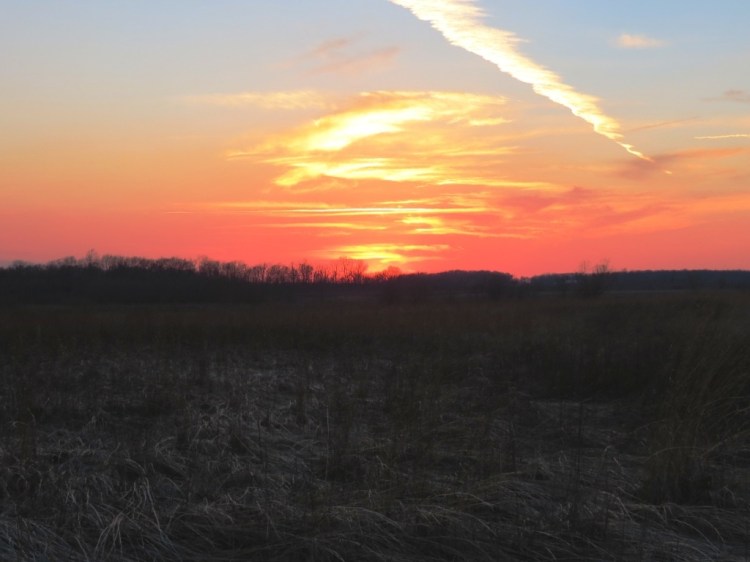
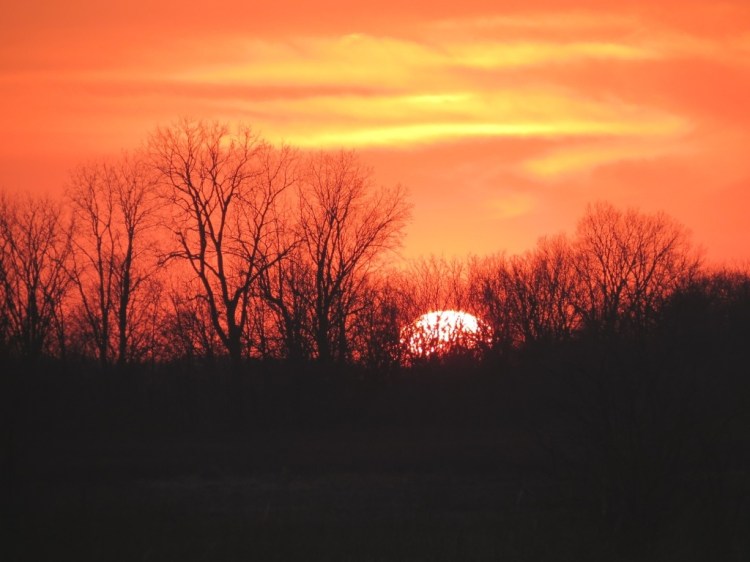
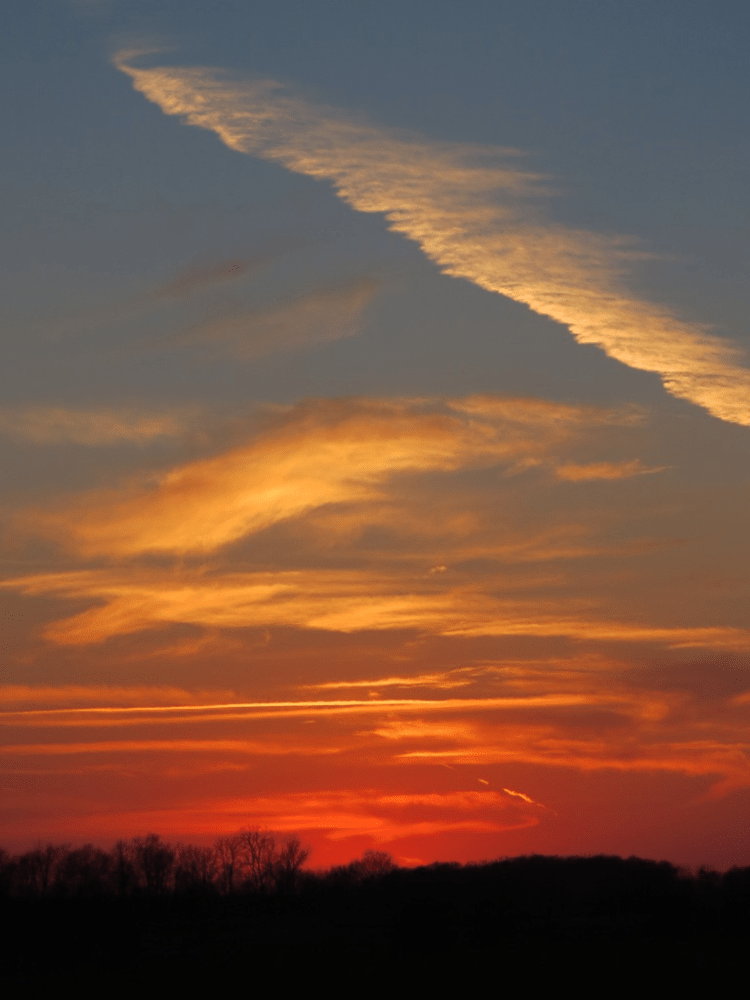
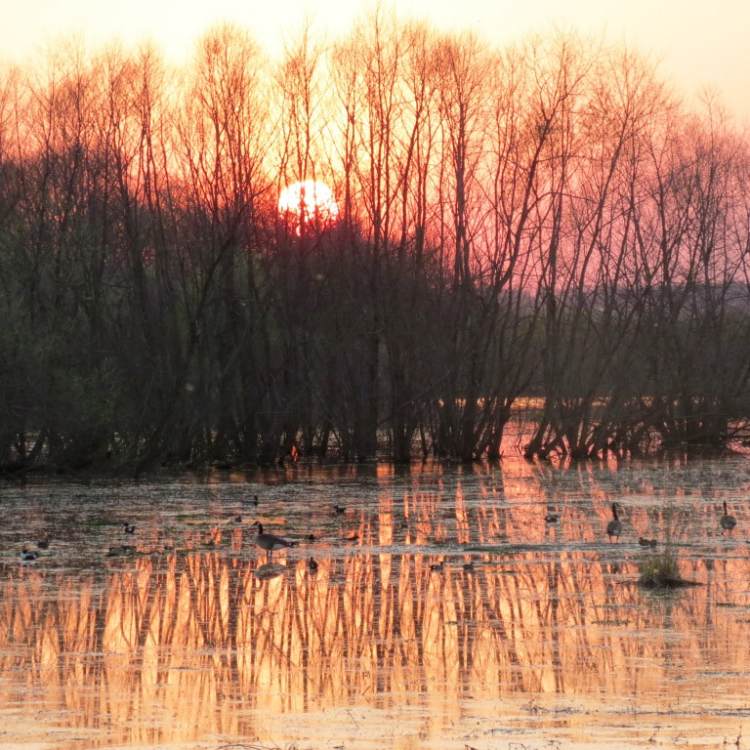
Randy Lehman took some beautiful sunset photos on February 18 at the Loblolly Marsh. A flock of Sandhill Cranes were calling and flying in front of the setting sun. A celebration of spring migration in February!
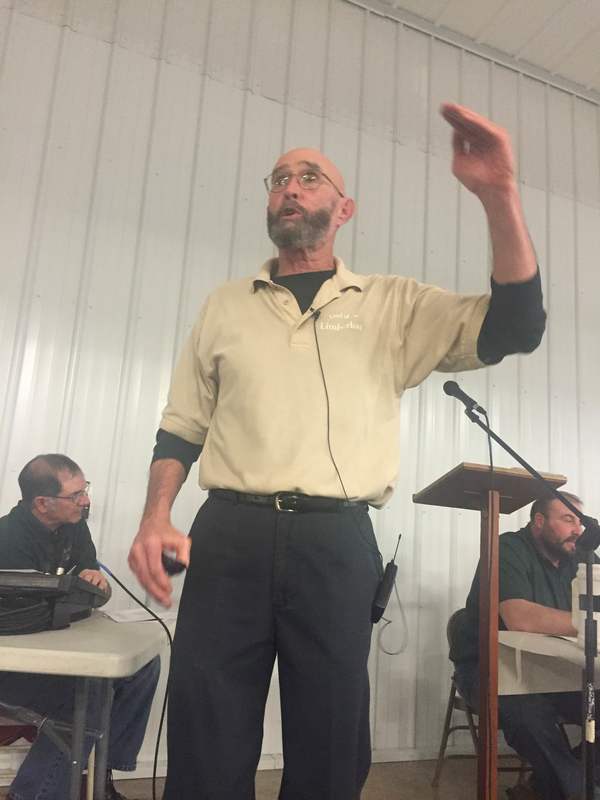
“Nature is full of adventures,” said Limberlost State Historic Site Naturalist Curt Burnette as he wrapped up a presentation on the history of the Loblolly Marsh Nature Preserve and the benefits of wetlands like the “Lob.” This year Curt was invited to be the featured speaker at the Jay County Soil and Water Conservation District annual meeting and dinner held on February 22.
The evening began around 5:30 at the Jay County Fair Grounds. Local organizations set up information tables and booths for incoming guests to explore before the meeting. The Limberlost booth featured information about Gene Stratton-Porter and the Cabin, Nature Preserves, and some hands-on displays like a woodpecker nest cavity, mink and muskrat furs, and a black bear skull. (Many participants were surprised to learn that black bears once roamed our area!) The booth also displayed a digital photo frame that featured Naturalist Bill Hubbard’s photography of birds in the Limberlost.
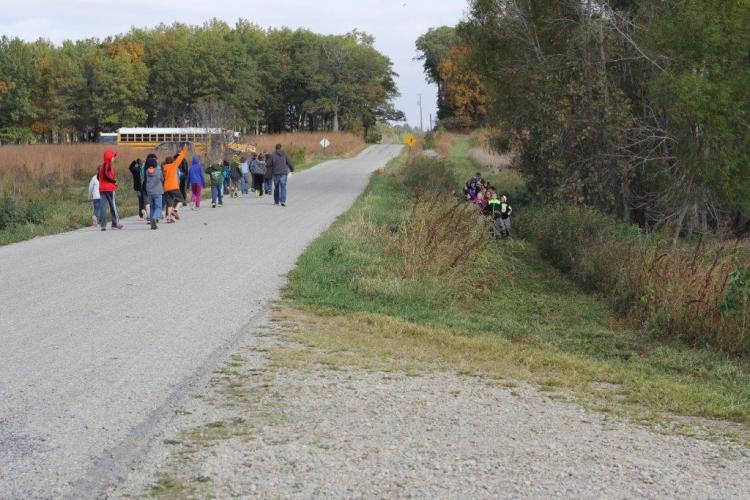
By 6:00, the crowd of approximately 200 members of the community made their way to their seats. Guests were treated to a delicious meal followed by a dessert of delightful cakes. As everyone finished their dinner, the District held their annual meeting with the swearing in of new officers and awards given to local farmers. District Coordinator Bettie Jacobs, recognized local FFA and 4H members for their hard work and achievements over the past year. Bettie is no stranger to the Limberlost, as each year she brings all of Jay County’s fifth graders on a field trip to the Lob for the annual Wetland Field Day where students rotate through stations hosted by a variety of experts including Limberlost and DNR staffs. Bettie then wrapped up the annual meeting by announcing winners of the door prizes, which featured four Limberlost t-shirts!
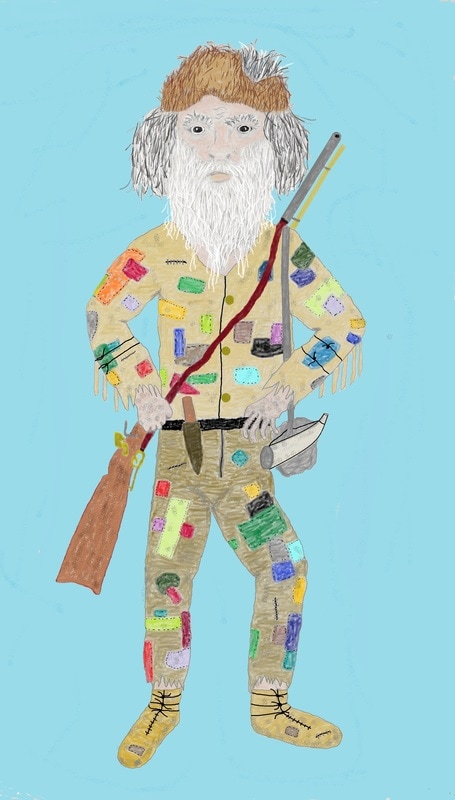
With the conclusion of the raffle, it was time for Curt’s program. Using a colorful slideshow, enthusiastic storytelling, and a dash of humor, Curt explained how the Loblolly and the Limberlost were first formed by glaciers in the last ice age. He described how the Loblolly was once full of lush plant life and served as excellent hunting grounds for Native Americans and early settlers. He even unveiled the long-forgotten folktale of the Loblolly Wizard including Curt’s own artistic illustration of this fabled Lob resident.
With historic photos and documents, Curt went on to explain how the wetlands were dredged and drained in the late 1800s, and how despite the efforts of local farmers, the Loblolly would persistently flood the fields year after year. The audience also learned about the efforts of Ken Brunswick, the Friends of the Limberlost, and DNR Nature Preserves to restore the Loblolly and Limberlost wetlands in the late 1990s.
To wrap up the presentation, Curt described how the re-established Loblolly is used today, both by wildlife and by visitors—like school groups, families, and many birders. He described some of the programs he hosts like Wildflower Safari in June and private gatherings through his Rent-a-Naturalist program. In the end, Curt’s discussion of the Lob was a hit, and many community members stayed afterward to ask questions and pick up information from the Limberlost information booth.
As Curt said, “Nature is full of adventures.” And whether you visit the restored wetlands in search of the Loblolly Wizard or a flock of migrating geese, you’ll be sure to have an adventure of your own!
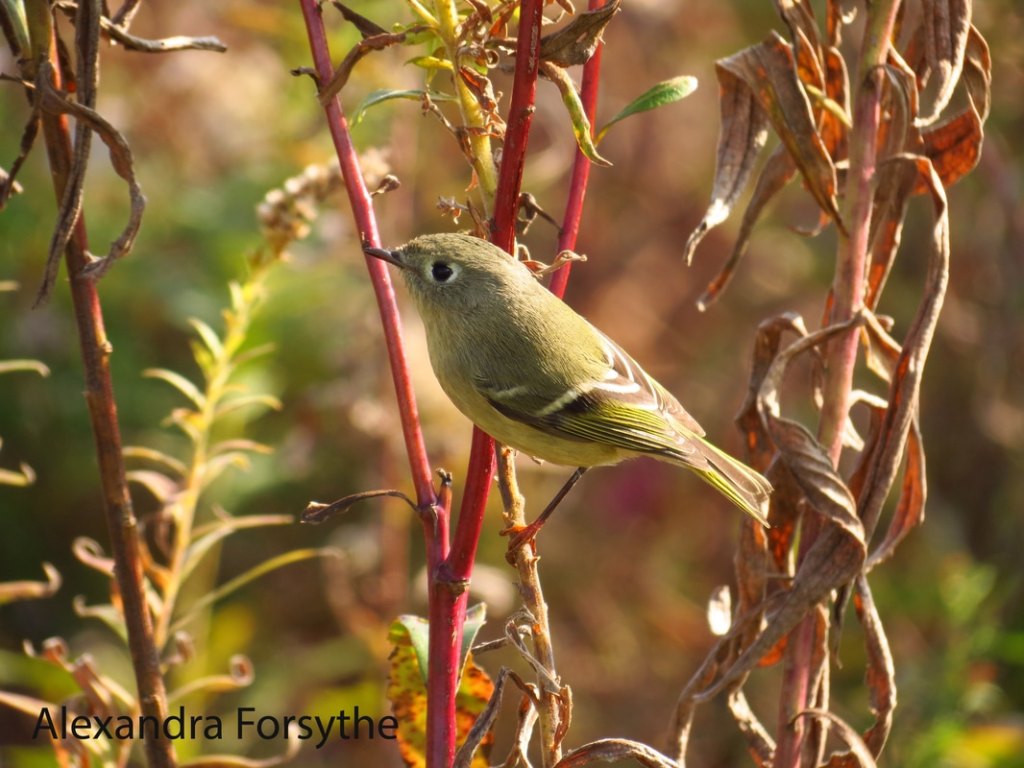
Quick! Identify this bird! Is it a Ruby-crowned Kinglet? Or a Cuvier’s Kinglet?
If you have never heard of a Cuvier’s Kinglet, there’s a good reason. While John James Audubon claims to have shot one in 1812 in Pennsylvania and included a painting of it in his “Birds of America” book, there is no evidence that such a bird ever existed. His painting appears to be a hybrid of a Ruby-crowned and a Golden-crowned Kinglet, with the dark head stripes of a Golden-crowned combined with the red crown of the Ruby-crowned. Was it a hybrid? A now-extinct species? Or did Audubon make a mistake? We may never know.
What we do know is that this tiny bird can be found across North America, from their breeding areas in northern North America to their winter grounds in the southern states. We also know that despite their diminutive size, they lay a lot of eggs: up to 12 per nest! Even though they have a curious habit of flicking their wings almost constantly, they only burn about 10 calories per day (“The Boreal Ecosystem”, James A. Larsen, p. 395 (2013)). According to the Chipper Woods Bird Observatory, over 325,000 Ruby-crowned Kinglets were banded between 1955 and 2000, but only about 120 have been recaptured. The oldest to be recaptured was a female in California that was at least 4 years, 7 months old.
Ruby-crowned Kinglets can be found throughout Limberlost in the early spring and late fall. Just look for a tiny, friendly bird flitting its way through the bushes near the swamp!
Did you ever wonder about “Romance at the Limberlost”? Well, romance was a common theme in Gene Stratton-Porter’s novels along with a love of nature and a happy ending.
Valentine’s Day 1911 was a special day. Gene began writing The Harvester after breakfast that morning according to her secretary Lorene Miller Wallace. She sat at her desk in the library facing the east window and wrote the book in a mere twelve weeks. David Langston, a “harvester” of the woods, is one of Gene’s best loved characters.
The Harvester is a love story told from the view of David Langston, a man who sees a vision of the woman he will love, his “Dream Girl”. The Limberlost Cabin is the backdrop for the story as well as the Limberlost Swamp. David Langston makes his living from harvesting plants and herbs for medicinal reasons and other purposes. He eventually finds his Dream Girl and does his best to win her. “In his soul” he knew he would marry his Dream Girl. At the Limberlost Cabin, the back porch, often referred to as the Dream Girl’s Porch, also serves as a private entrance to a room many consider the Dream Girl’s bedroom.
Gene weaves nature and love together in many passages in The Harvester. Some examples: “the quavering voice of a night love song” was an owl calling for a mate; “flickers drunk on the wine of nature, flash their yellow-lined wings and red crown;” she writes about the songs of spring and “the bold, clear whistle of the cardinal sounds never so gaily; and song sparrows pipe from every wayside shrub and fence post.” She wants the reader to learn and to appreciate and love the nature that is around them.
Romance and a love of nature are common threads in Gene’s other Limberlost novels. Freckles, Song of the Cardinal, and A Girl of the Limberlost are some of Gene’s best known novels, and there’s plenty of romance that plays out in these stories, too.
We hope you will read one of Gene’s books this Valentine’s Day and enjoy the lure of the Limberlost and the romance to be found there. The Limberlost Cabin is open all winter for tours and our gift shop carries all of Gene’s books mentioned in this blog.
“I love the cuckoo,” wrote Gene Stratton-Porter in her book Friends in Feathers. The yellow-billed cuckoo is a secretive bird of the woods. It is not an easy bird to see let alone to find a nest. Gene’s friend Jacob Studer called the bird a “slipper” because it slips into the underbrush so easily.
Two of her best cuckoo nests were on the Hale farm, just outside of Geneva. Will Hale, who worked for the Bank of Geneva, showed Gene a cuckoo nest on the same day he led her to where the kingfisher was nesting. Bob Black found several nests around Geneva. Gene discovered that the cuckoo will use abandoned old nests of other birds, such as a robin or a green heron. She made a study of the habits of this bird.
Of all the young birds Gene photographed, the cuckoo was her favorite. She loved their “trusting, tender, and gentle” disposition.
For all her success over a five year period of photographing the nests and young cuckoos, Gene was frustrated in that she had not been able to photograph an adult cuckoo. This is primarily due to the fact that they perch in thick foliage. This changed in June 1906. Bob Black came to Gene and said that he had found a nest on the Aspy farm and that it was a short distance off the ground, not twelve feet. It was also situated where Gene could place the camera on a tripod and have a clear photograph of the mother bird on the nest.
She lost sleep over the excitement and “nervous strain” of thinking about photographing an adult cuckoo. She was ready for a new adventure.
When she saw the cuckoo, Gene noted that it was the black-billed cuckoo, not the yellow-billed which is more common. She photographed the mother on the nest for the next few days. She patiently moved a little closer to the nest each day. Eventually she was able to get to within ten feet of the nest.
Gene was a gifted naturalist, photographer, illustrator and writer. We are lucky that she called this part of Indiana home. Her nature studies and photographs are still amazing accomplishments over 100 years later.
Gene would be pleased to know that over one-hundred years later, the cuckoo still nests around Geneva. With wetland restoration, especially along the Wabash River watershed, it is the perfect habitat for this bird.
Limberlost is celebrating the 100th anniversary of Friends in Feathers. This is the last book of Gene’s that is entirely about the birds of Limberlost. The Friends of the Limberlost gift shop carries the book Friends in Feathers. One chapter is on the cuckoo. This book has stood the test of time in regards to Gene’s bird studies.
 Friends of the Limberlost