By Terri Gorney
Gene Stratton-Porter commented that she enjoyed hearing a Bobolink every summer. “This veritable music box pours out his song, the whole of which is an interrupted run, interspersed with his call note and ravishing variations which run high and drop again in a sort of fantasy of irrepressible, spontaneous clearness.”
In May 1908, Gene was very pleased to show T. Gilbert Pearson the male Bobolink in his breeding plumage on the Stanley farm on the east side of Geneva. Gilbert would go on to lead the National Audubon Society.
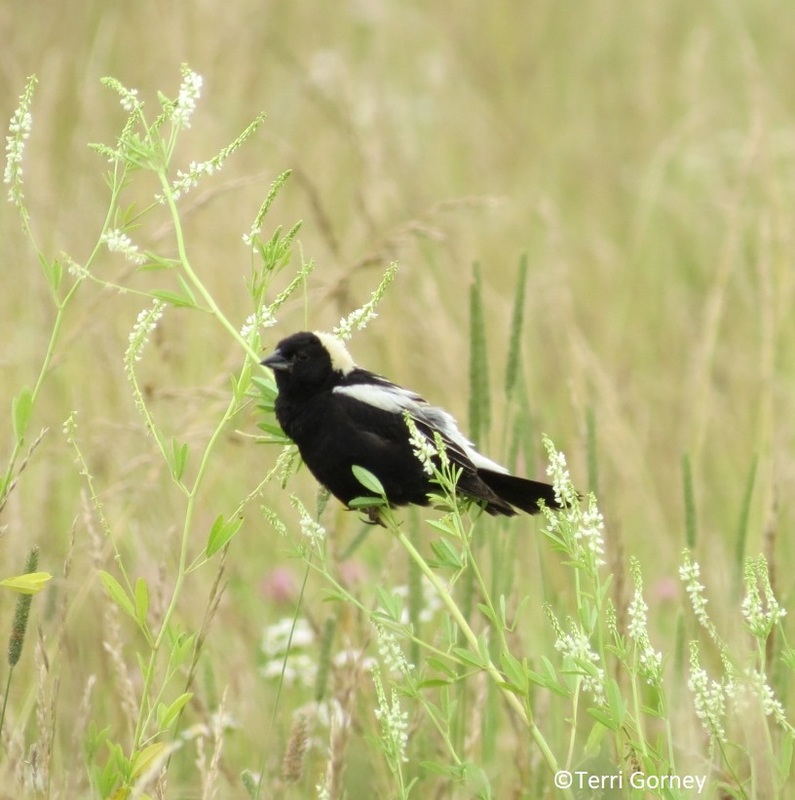
The male is distinctive in his breeding plumage and perches on low vegetation while singing. He frequently sings in flight also. The Bobolink is black underneath and white on the back making him look like he is wearing a tuxedo backwards. After the breeding season, he returns to drab coloring, similar to the female, and remains that way until the following spring.
Bobolinks are a good bird to have around open fields as they eat mostly seeds from what are considered weeds at this time of year.
The Bobolinks like to nest in open fields of alfalfa, hay or clover. They are a ground nesting bird and the nests are made of grasses and are hard to locate as they are well hidden in vegetation cover. The female will leave the nest and run before flying. A female will typically lay 4-7 eggs. Their populations have been decreasing due to habitat destruction and a pair will raise only one brood a year. According to Don Gorney, a bird expert from Indianapolis, Bobolinks are a grassland specialist that are sensitive to habitat size. He estimates that they need a minimum of 50 acres to nest.
Ken Brunswick has seen as many as four males at one time at Limberlost this year. Ken’s boyhood recollections of it in the 1950s on his family farm in Ohio is “etched in his mind.” They nested in the hay fields on the family farm.
Jane Brooks Hine, a female ornithologist from DeKalb County, was given credit by the Indiana Academy of Sciences for the first sighting of a Bobolink in Noble County in 1883. By 1886 she writes that there was a pair nesting on her farm in northwest DeKalb County.
It is very gratifying to see these beautiful birds back at Limberlost. Gene Stratton-Porter would be very pleased to know that her singer has now chosen to nest and spend the summer season back at her beloved Limberlost. She enjoyed watching them nest in the summer. She commented that “the Bobolinks danced and chattered on stumps and fences, in an agony of suspense, when their nests were approached, crying pitifully if they were destroyed.”
After about a nine week stay in our area, Bobolinks typically congregate in marshes before the long journey back to their winter home in central South America. They usually migrate in large flocks which they will be doing shortly. May they have a safe journey and return to the Limberlost next spring!
If you are interested in researching more on the Bobolink, check out these websites:
www.allaboutbirds.org/guide/bobolink/id, www.mbr-pwrc.usgs.gov,
www.nationalzoo.si.edu.
 Friends of the Limberlost